Abstract
This article questions the intellectual foundations of economic growth policies dominated by production-function economics, which frame development as the efficient allocation of labor, capital, and an abstract residual called total factor productivity. Drawing on Innovation lifecycle theory and Schumpeterian insights, it argues that long-term growth is driven not by factor reallocation but by the Reinvention of products and industries through successive technological paradigms. Mainstream frameworks—from Solow’s residual to endogenous growth and institutional theories—treat knowledge as linear, cumulative, and durable, failing to account for the high failure rates of ideas, Startups, and patents, and the rapid depreciation of technologies. The article shows how allocation-centric policies misdiagnose industrial decline as an adjustment problem, encouraging trade liberalization and technology import while neglecting capability preservation and reinvention. As a result, both advanced and late-industrializing economies risk industrial downgrading and premature deindustrialization. Sustainable growth, the article concludes, requires a reinvention-centric policy framework that prioritizes innovation lifecycles, capability building, and strategic transitions between product waves over static efficiency–even going beyond Schumpeter paradigm.
For decades, economic growth policy has been dominated by a deceptively simple framework: the production function. By linking output to labor (L), capital (K), and total factor productivity (TFP), economists have claimed a scientific basis for prescribing growth strategies. According to this logic, growth emerges from accumulating inputs, improving efficiency, and investing in education and institutions so that “ideas” raise productivity. Yet the growing disconnect between these prescriptions and real-world outcomes raises a fundamental question: why should economists, armed with such models, be entrusted with guiding national growth strategies?
The limitations of the production-function approach are no longer abstract. In many less developed and middle-income countries, massive investments in education have coincided with rising graduate unemployment and a diminishing role for labor in value creation. At the same time, industrial economies are witnessing premature deindustrialization, despite apparently sound macroeconomic fundamentals. These outcomes are not anomalies; they are symptoms of a deeper conceptual failure.
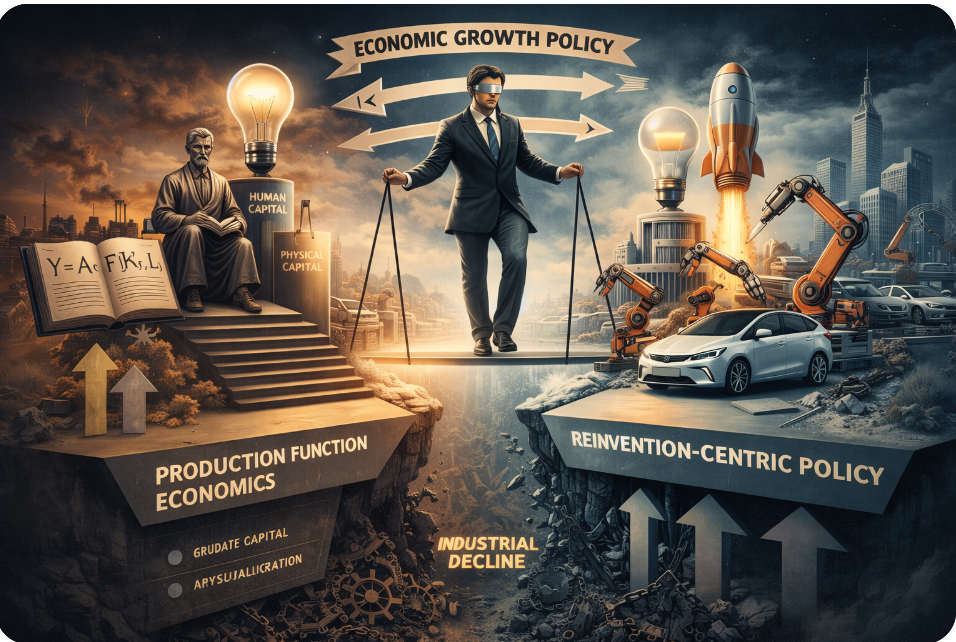
At its core, production-function economics is allocation-centric. It assumes that growth is achieved by reallocating labor and capital more efficiently under largely given technologies, while innovation is reduced to a residual term—TFP. Knowledge and ideas are assumed to diffuse smoothly and indefinitely, raising productivity across sectors. What this framework systematically overlooks is the reinvention of products as the true driver of long-term growth.
Innovation lifecycle theory provides a radically different lens. It emphasizes that products, industries, and technologies evolve through distinct phases: emergence, scaling, maturity, and decline. Growth accelerates not by endlessly optimizing mature products, but by reinventing them into new product categories, thereby triggering fresh cycles of diffusion, learning, and value creation, resulting in long wave of growth. The long evolution of the light bulb—from incandescent to fluorescent to LED—is a simple but powerful illustration. Each reinvention expanded markets, reduced costs, and created new waves of growth, not because of better factor allocation, but because the product itself was transformed.
Mainstream economics has struggled to theorize this process. Even Robert Solow, despite his Nobel Prize-winning contribution, could not explain how knowledge and ideas actually generate growth. By relegating them to a residual, Solow’s framework implicitly acknowledged that the most important driver of growth lay outside the model. This omission has had lasting consequences for policy.
Paul Romer’s endogenous growth theory attempted to address this gap by treating ideas as an explicit factor of production. However, Romer’s framework still assumes a linear and cumulative relationship between ideas and economic prosperity. More ideas, in this view, automatically translate into more growth. Empirical reality sharply contradicts this assumption. Roughly 94 percent of patents remain unused, 97 percent expire without generating profit, and more than 90 percent of startups fail within their first three years. These outcomes are not marginal inefficiencies; they are structural features of innovation. Ideas do not generate growth by existing. They generate growth only when embedded in viable products that successfully move through innovation lifecycles.
Moreover, Romer’s implicit presumption of the endless life of ideas and the infinite scope of innovation ignores the fact that ideas, like products, depreciate. Technologies become obsolete, markets saturate, and knowledge loses relevance as new paradigms emerge. Innovation is not a smooth accumulation of ideas; it is a discontinuous process of reinvention, selection, and extinction.
Institutional theories of growth, many of them also Nobel Prize-winning, suffer from a similar linearity. By emphasizing institutions as enablers of Creative Destruction, these frameworks suggest that “good institutions” automatically foster growth. If that were the case, why has Canada been suffering been slow growth? Yet institutions alone do not determine which industries are reinvented, which capabilities are preserved, or when economies should abandon mature product waves in favor of emerging ones. They explain the conditions under which innovation might occur, but not how strategic choices about reinvention are made. Canada’s recent deal with China for exporting Canola in exchange for opening the door for Chinese EVs underscores it.
Even Philippe Aghion’s influential Schumpeterian work—while offering a richer account of creative destruction and product evolution—stops short of addressing the central policy Dilemma: how should economies decide when and how to migrate from an existing wave of growth to the next? At the firm level, such decisions are already fraught with uncertainty. At the national level, where entire ecosystems of skills, suppliers, and institutions are involved, the challenge is exponentially greater.
This is precisely where production-function economics fails policy-makers. By focusing on reallocation, it encourages governments to shift labor and capital away from declining sectors toward apparently more efficient uses, often through trade liberalization and technology import. What it fails to recognize is that capabilities do not reallocate the way factors do. Once an industrial ecosystem erodes, rebuilding it becomes extremely costly, if not impossible.
The result is a recurring policy trap. Economists recommend reallocating resources based on static efficiency, while innovation lifecycles demand sustained investment in reinvention. Countries that follow the former path often find themselves locked into mature or declining product categories, exporting commodities or low-value manufactures while importing high-value, innovation-intensive goods.
This tension is now visible across both developed and developing economies. Advanced economies risk industrial downgrading by neglecting reinvention, while late-industrializers are encouraged to specialize according to comparative advantage rather than build the capabilities required for future product waves. In both cases, allocation-centric policy crowds out reinvention-centric strategy.
The implications for growth policy are profound. If growth depends on reinvention rather than allocation, then economists—trained primarily in equilibrium models and production functions—are ill-equipped to guide national strategies for winning the next wave of innovation. The key decisions are not about marginal efficiency, but about which product lifecycles to enter, which to exit, and how to sustain learning during transitions.
Winning the next wave of growth has thus become a national challenge, not merely a firm-level one. It requires coordinated investments in experimentation, tolerance for failure, and long-term capability building—none of which sit comfortably within standard economic policy toolkits. When economists dominate growth policy, there is a real risk that nations will optimize themselves out of their industrial futures.
This does not mean that economics is irrelevant. It means that growth policy must be grounded in a different analytical foundation—one that places product evolution and reinvention at the center, treats ideas as perishable inputs, and recognizes innovation lifecycles as inherently uncertain and discontinuous.
Until such a shift occurs, the question remains unavoidable: if prevailing economic theories cannot explain how growth waves emerge, mature, and are replaced, why should economists be entrusted with deciding how nations allocate resources to pursue them?