Abstract
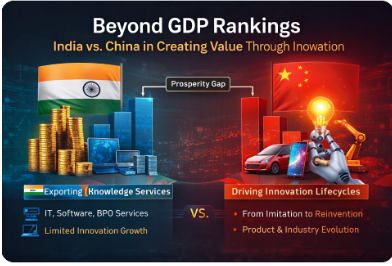
India’s ascent to the world’s fourth-largest economy by nominal GDP marks an important milestone, yet it obscures a deeper structural challenge. Despite comparable starting points in 1980, India’s per capita income has fallen far behind China’s, with the prosperity gap widening nearly fivefold over four decades. This paper argues that the divergence cannot be explained by manufacturing versus services or labor versus knowledge alone. Instead, the decisive factor lies in how value is created through the evolution of Innovation lifecycles. While India has primarily exported knowledge-based services with limited long-term value capture, China systematically embedded knowledge into products, using manufacturing as a learning platform to progress from imitation to Incremental innovation and Reinvention. This strategy enabled China to dominate multiple industries, from smartphones to electric vehicles, while simultaneously eroding India’s domestic value addition capacity. The analysis concludes that we need to go beyond India’s GDP ranking. GDP scale without innovation evolution is insufficient for prosperity, and closing the India–China gap requires a strategic shift toward idea-based value creation driven by continuous product evolution.
As of early 2026, India has officially surpassed Japan to become the world’s fourth-largest economy by nominal GDP, reaching approximately USD 4.18–4.19 trillion. This milestone is rightly celebrated as a national achievement and a reflection of India’s growing economic footprint. Yet, beneath the headline numbers lies a more complex and less comfortable reality. India’s rise in aggregate GDP is driven largely by its sheer population size, which is almost twelve times larger than Japan’s. When viewed through the lens of per capita income, the picture changes dramatically: the average Indian remains roughly twelve times poorer than the average Japanese citizen. This contrast invites a deeper inquiry into what GDP growth truly represents—and, more importantly, what it conceals. Hence, we need to focus on beyond India’s GDP ranking.
A more revealing comparison emerges when India’s trajectory is examined alongside China’s. In 1980, India’s per capita GDP stood at roughly USD 267–271, slightly higher than China’s at about USD 195. At that time, the two countries appeared to be on comparable development paths, with India even holding a modest lead. Fast forward forty-five years, and the divergence is striking. According to IMF and World Bank data, by 2025 China’s per capita GDP had reached around USD 13,806, while India’s remained close to USD 2,800. In relative terms, Indians have become almost five times poorer than Chinese citizens over this period. This widening prosperity gap raises a critical question: what fundamentally explains China’s success relative to India’s stagnation or very slow growth in per capita Wealth?
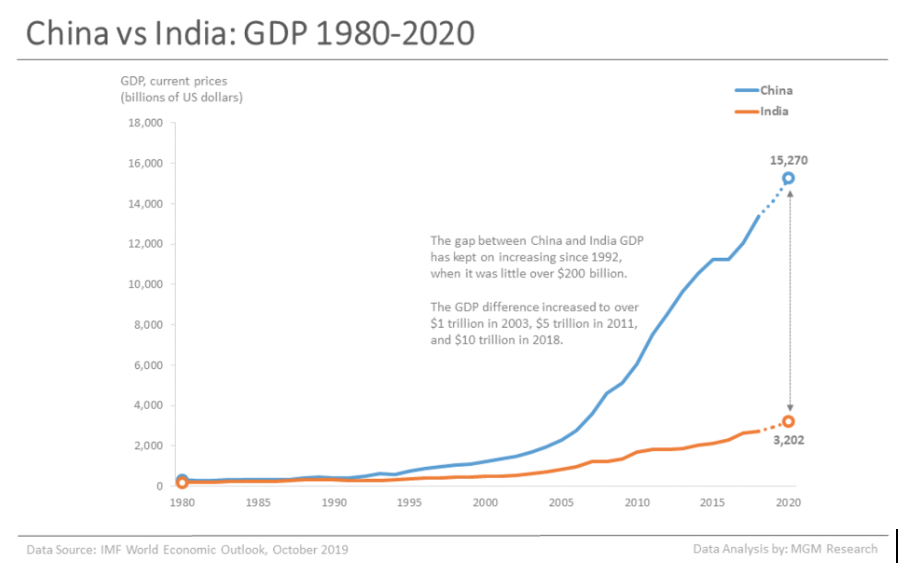
A common explanation credits China’s role as the “global factory,” supplying massive quantities of low-cost labor to the world. By contrast, India is often portrayed as having chosen a superior path—becoming a global hub for IT, software, and business process outsourcing (BPO), sectors that are ostensibly more knowledge-intensive and higher value-adding. At first glance, this argument appears persuasive. Knowledge-based services should, in theory, generate more income than labor-intensive assembly and manufacturing. Yet the empirical outcome contradicts this assumption. Despite India’s dominance in global IT services, China has dramatically outperformed India in raising per capita income. Clearly, the distinction between “labor-based manufacturing” and “knowledge-based services” does not capture the true source of China’s advantage.
The more decisive factor lies in how each country has approached value creation through the evolution of innovation lifecycles. Often overlooked by popular media, development practitioners, and policymakers, China’s strategy was never limited to supplying labor. Alongside manufacturing, China deliberately pursued the accumulation, internalization, and transformation of knowledge into products. Its core objective was not merely to produce goods efficiently, but to drive the continuous evolution of those goods—moving from imitation to incremental improvement, and eventually to mutation and reinvention. This focus on product evolution allowed China to steadily climb the value ladder across multiple industries.
In contrast, India’s strategy largely emphasized exporting knowledge as a service rather than embedding knowledge into products. Indian firms became highly successful at writing software, managing back-office operations, and delivering IT services for global clients. However, much of the intellectual property, product ownership, and long-term value capture remained with foreign firms. Knowledge was rented out, not compounded. China, by comparison, treated manufacturing as a learning platform. By producing for global leaders, Chinese firms absorbed Tacit Knowledge, engineering capabilities, and system-level understanding—inputs essential for driving innovation lifecycles forward.
The evolution of the smartphone industry illustrates this divergence vividly. Initially, Chinese firms participated in global value chains as contract manufacturers, exemplified by Foxconn assembling Apple’s iPhones with a “Made in China” label. But manufacturing was only the beginning. Chinese companies such as Huawei, Xiaomi, Oppo, and Vivo rapidly moved beyond imitation. They incrementally advanced designs, improved features, optimized costs, and experimented with new market segments. Over time, they mutated the dominant iPhone-style design into diverse product variants tailored to different price points and consumer preferences. As a result, these firms not only became formidable competitors within China but also captured significant market share in India—displacing domestic brands such as Micromax that failed to evolve at a similar pace.
India’s experience with grassroots innovations further highlights the challenge. Proponents often point to the impressive number of registered grassroots innovations—over 350,000 documented by India’s innovation foundation—as evidence of a vibrant innovation ecosystem. Yet quantity has not translated into prosperity. Most of these innovations lack scalability, integration into industrial systems, and pathways for cumulative value addition. Without mechanisms to evolve inventions into mass-market products and global platforms, their economic impact remains marginal. Innovation, when disconnected from lifecycle evolution and market scaling, adds little to national wealth.
The contrast becomes even sharper in emerging industries such as electric vehicles (EVs). China has aggressively pursued the reinvention of automobiles, treating EVs not merely as cleaner substitutes for gasoline vehicles but as entirely new technological systems. Through sustained investment in batteries, power electronics, software, and manufacturing processes, Chinese firms have positioned themselves at the forefront of the global EV industry. This strategic push is already reshaping global automotive value chains, potentially shifting the global automotive innovation epicenter to China.
For India, the implications are troubling. While Indian firms locally manufacture up to 85 percent of components for conventional gasoline vehicles, the shift to EVs threatens this value-added capacity. EV production relies heavily on batteries and electronic components, areas where China dominates. As a result, Indian automakers may be forced to import as much as 80 percent of EV components—largely from China—eroding domestic value creation. Thus, China’s success in driving innovation lifecycles is not only adding value within its own economy but also actively destroying value addition opportunities in India across a growing range of products.
Viewed through this lens, India’s ascent to the world’s fourth-largest economy appears less reassuring. Aggregate GDP growth, driven by population and services exports, masks a deeper failure to compete in the global race of innovation evolution. The core issue is not labor versus services, nor manufacturing versus software. It is the ability—or inability—to continuously evolve inventions into higher-value products, platforms, and industries so that ideas are traded, which is far more scalable than labor or knowledge trading. China’s policies, institutions, and corporate strategies have been aligned toward this objective. India’s, by contrast, have often favored short-term growth, rent-seeking, or fragmented innovation efforts disconnected from industrial evolution.
Therefore, despite its impressive GDP ranking, India is falling behind in the most consequential dimension of modern economic competition: idea-based value creation through the evolution of innovation lifecycles. If India is to narrow the prosperity gap with China, it must fundamentally rethink its strategy. This requires shifting from exporting isolated knowledge services and labor-centric manufacturing of mature products to embedding ideas into products, from celebrating invention counts to winning global battles of product evolution, and from labor-centric growth to innovation-driven reinvention. Only by graduating to idea-based value creation and leading the global evolution of inventions can India convert economic scale into shared prosperity.
Key messages:
Closing the prosperity gap requires a strategic shift: India must move from labor- and service-led growth to winning global battles in product evolution and innovation lifecycles.
India’s rise to the 4th largest economy by GDP is real but misleading: the achievement is driven largely by population size, while per capita income remains extremely low compared to Japan and China.
India and China started at similar income levels in 1980, yet over 45 years China’s per capita GDP became nearly five times higher, revealing a deep and widening prosperity gap.
The gap cannot be explained by “manufacturing vs. services”: despite India’s success in IT, software, and BPO, these knowledge services did not translate into sustained national value creation.
China’s true advantage lies in driving the evolution of innovation lifecycles—moving systematically from imitation to incremental improvement, mutation, and reinvention of products.
China embedded knowledge into products, while India largely exported knowledge as a service, allowing long-term value capture to remain abroad.
Smartphones illustrate the divergence: Chinese firms evolved from contract manufacturing to global product leaders, displacing Indian brands in India’s own market.
Grassroots innovation in India lacks scalability and value capture, limiting its impact on national prosperity despite large numbers.
China’s reinvention of industries like electric vehicles is reshaping global value chains, while India risks losing domestic value addition capacity through rising import dependence.
GDP rank masks strategic weakness: India is losing the global race where it matters most—idea-based value creation through innovation evolution.