Abstract
In the early 1980s, India and China were similarly poor, with India enjoying a modest per capita income advantage. Both countries opened their economies to the Western-led global system, yet adopted distinct integration paths. India leveraged English proficiency and skilled labor to become a global hub for technology and knowledge-intensive service exports, while China absorbed low-wage, labor-intensive manufacturing. Contrary to early expectations, China has emerged nearly five times richer than India by 2025. This paper argues that the divergence stems not from sectoral choice—services versus manufacturing—but from the nature of value creation. India largely remained trapped in selling skilled labor time, whereas China systematically progressed from selling labor to trading ideas through imitation, Incremental Innovation, process improvement, and eventual Reinvention. By embedding ideas into products, processes, and industrial systems, China unlocked scalable Wealth creation and broad productivity gains. The central development lesson is that sustainable prosperity requires transitioning from time-based services to idea-centric, innovation-driven growth.
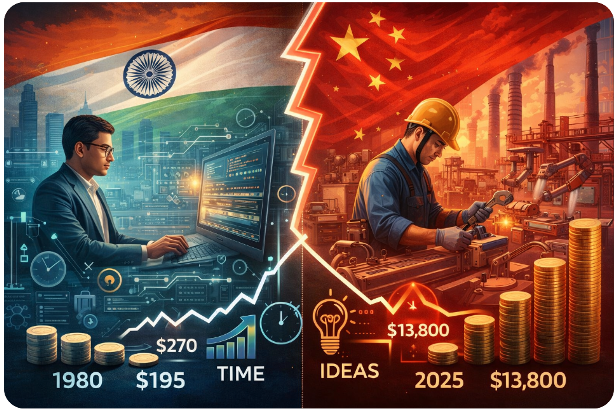
The rise of India as the fourth-largest economy, surpassing Japan, conceals a much deeper lesson. In the early 1980s, both India and China were extremely poor countries, emerging from decades of inward-looking economic policies and limited integration with the global economy. In 1980, India’s per capita GDP stood at approximately $270, while China’s was about $195. In relative terms, Indians were roughly 27 percent wealthier than the Chinese. At that moment in history, few would have predicted that within four decades China would become nearly five times richer than India in per capita terms. Yet by 2025, China’s per capita GDP had risen to around $13,800, compared with India’s approximately $2,800. This dramatic reversal raises a fundamental development question: why did two similarly poor countries, opening up at roughly the same time, experience such divergent prosperity outcomes?
Both countries reached a similar strategic crossroads in the late 1970s and early 1980s. Having grown exhausted with closed-door policies, import substitution, and state-dominated economic models, India and China each decided to integrate with the Western-led global capitalist system. Both sought to connect to global value chains dominated by firms and markets in the United States, Europe, and Japan. However, the pathways they chose—and the nature of value they created—proved to be profoundly different.
At the outset, many development professionals believed India held a natural advantage. Unlike China, a large share of India’s educated population was conversant in English, the lingua franca of Western business, science, and technology. This linguistic and cultural proximity appeared to lower barriers to integration with global markets. Early evidence seemed to support this optimism. Indians gained rapid access to information technology, software development, and business process outsourcing opportunities, particularly in the United States.
Following the 1991 economic reforms, India’s IT and software service exports grew explosively. Software exports increased from just $131.2 million in 1990 to roughly $7.8 billion by 2001–02, expanding at an average annual rate exceeding 30 percent throughout the decade. India quickly emerged as a global hub for low-cost, skilled, technology-centric services, with exports dominating the sector’s output. This success story led many development experts to hail service exports—especially knowledge-intensive services—as a shortcut to prosperity in the modern global economy.
China, by contrast, lacked English proficiency among its workforce and had far fewer professionals ready to plug directly into Western service markets. As a result, Chinese workers initially qualified for lower-paying, labor-intensive manufacturing jobs. Western companies began relocating assembly lines and manufacturing plants to China, producing everything from toys and textiles to electronics and automobiles. At first glance, this appeared to be a less sophisticated and lower-value growth path.
By the 1990s, the world was witnessing the rise of two massive economies—together accounting for nearly 35 percent of the global population—integrating into the global economic system through different channels. India relied primarily on exporting high-value, knowledge-intensive services performed by educated youth and paid by the hour. China relied on exporting labor-intensive manufacturing services, also paid by the hour. Given these contrasts, it seemed logical to assume that India, with its higher-value exports, would ultimately achieve greater prosperity than China.
Reality unfolded in the opposite direction.
Despite becoming global powerhouses in their respective domains—India in technology-centric services and China in industrial production—the two countries experienced sharply divergent outcomes in broad-based prosperity. By 2025, average Chinese citizens were nearly five times richer than their Indian counterparts. This outcome cannot be explained simply by differences in export growth or integration with global markets. Instead, it demands a deeper examination of how value was created and scaled in each economy.
In their early phases of globalization, both India and China were essentially selling the time of their workers. India sold the time of engineers, programmers, and service professionals, billing foreign clients by the hour. China sold the time of factory workers, assembling and manufacturing products for global firms, also compensated largely on a per-hour basis. While India’s labor earned higher wages per hour than China’s, both models were constrained by the same fundamental limitation: time does not scale.
The critical divergence emerged in what China did next. Unlike India, China did not remain confined to selling labor or services. While continuing to provide manufacturing services to Western firms, China simultaneously invested in building domestic capabilities to replicate, imitate, incrementally innovate, and eventually reinvent products and production processes. Chinese firms began learning by doing—absorbing foreign technology, modifying designs, improving processes, and gradually moving up the value chain.
China actively fostered domestic firms capable of turning products into platforms for ideas. Manufacturing became not just a source of employment, but a laboratory for experimentation, Process innovation, and industrial learning. Over time, Chinese firms developed their own automation systems, robotics, and production technologies, reducing dependence on foreign capital goods and increasing productivity. This shift transformed China from a seller of labor time into a seller of ideas embedded in products, processes, and systems.
In recent years, this trajectory has become even more evident. China has begun showing signs of winning the reinvention race in major industries, including electric vehicles, batteries, renewable energy equipment, and advanced manufacturing. These sectors are not merely about assembling components; they are about integrating design, engineering, software, manufacturing, and supply chains into scalable innovation ecosystems. This ability to trade ideas—rather than hours—has unlocked a far more powerful and scalable mechanism of wealth creation.
India, in contrast, largely remained locked into a service-export model centered on billing time. While highly successful in generating foreign exchange and creating a globally respected IT sector, this model struggled to spill over into large-scale domestic industrial capability, Product innovation, or idea-centric value creation. The service model proved less effective at generating broad-based productivity gains across the economy. As wages rose, cost advantages eroded, and scalability remained limited by the availability of skilled labor.
The development lesson from the India–China divergence is therefore not that services are inferior to manufacturing, nor that low-wage labor is superior to high-skill labor. Rather, the lesson is that sustainable prosperity depends on graduating from selling time to selling ideas. Ideas—whether embodied in products, processes, platforms, or systems—scale far more effectively than labor hours. They enable learning, reinvention, and cumulative innovation, which in turn drive long-term income growth.
China’s idea-centric wealth creation path appears significantly more scalable and better suited to achieving high-income status. India, unless it reorients its growth strategy toward deeper value creation through product innovation, industrial learning, and reinvention, risks becoming trapped in a middle-income—or even low-middle-income—growth equilibrium. The contrast between the two countries underscores a fundamental truth of modern development: connecting to the global economy is necessary, but how a country creates and compounds value ultimately determines its prosperity.
Key messages:
Sustainable national prosperity depends on idea-centric value creation, where products, processes, and systems—not hours worked—become the primary engines of wealth.
Selling time does not scale — whether through low-wage manufacturing or high-skill services, time-based growth eventually hits a ceiling.
China’s Breakthrough came from shifting from labor to ideas, embedding learning, imitation, process innovation, and reinvention into domestic firms.
India’s service-export success masked a structural weakness: limited spillovers into product innovation, industrial capability, and economy-wide productivity.
Manufacturing mattered not for jobs, but for learning, providing China a platform to absorb, mutate, and eventually originate globally competitive ideas.