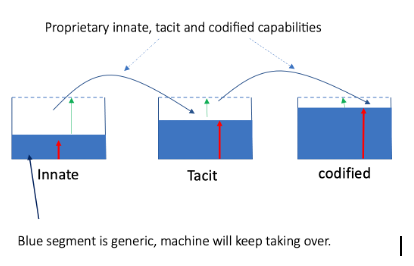
In the midst of the much-touted Fourth Industrial Revolution, there is a growing realization that human-free production and usage of products is not yet economically feasible. As industries seek efficiency through automation and Innovation, a more nuanced understanding of human roles in production, R&D, and usage is essential for maximizing Wealth creation. This article explores why the optimum reallocation of human roles is necessary, drawing from key observations about shifting labor dynamics, diminishing returns on R&D, and the challenges of automating innate human abilities. Hence, challenge is about optimally balancing automation and human roles for maximizing economic gain.
The Shift from Artisans to Low-Skilled Labor
Historically, production relied on artisans who possessed specialized skills and deep knowledge of their crafts. However, with the advent of industrialization and technological progress, this paradigm has shifted toward task-based production, where work is divided into discrete, repeatable tasks and the role of Codified Knowledge and skills in performing those tasks are automated. This transition has fueled a rise in demand for a low-skilled labor force that can perform repetitive tasks more efficiently.
While automation promises to further reduce the need for human labor in production, certain barriers remain. Fully automating complex human activities, such as innate abilities (e.g., dexterity, intuition, and judgment), is both costly and challenging. For example, the $80 billion investment in developing autonomous vehicles underscores the difficulty of replicating the innate abilities of human drivers.
Implications for Wealth Creation
The fragmentation of production into discrete tasks has enabled companies to improve efficiency and lower costs. However, human capital remains essential in specific areas, particularly in tasks requiring creative problem-solving, innovation, and decision-making. The need for human involvement in R&D and operational oversight is crucial to sustaining innovation and preventing stagnation.
The Role of Human Capital in R&D and Automation
Human capital is increasingly focused on R&D efforts aimed at automating knowledge and skills. This involves developing technologies that codify expertise and improve productivity. However, there is a paradox: while R&D investment is growing exponentially, the returns on this investment are diminishing.
Diminishing Returns on R&D Investment
Studies show that research productivity has been declining over the past few decades in the USA. On average, research productivity falls by 10% each year, meaning that it takes significantly more resources today to achieve the same outcomes as in the past. According to one analysis of US data, it now requires 15 times more researchers to maintain the same rate of economic growth compared to 30 years ago. Since 1930, the number of Americans engaged in R&D has increased more than twentyfold, but their collective productivity has dropped by a factor of 41.
This trend highlights a critical issue: profit making ideas are becoming harder to find, and the marginal gains from additional R&D investment are shrinking. Despite these challenges, continued investment in R&D is necessary to drive technological progress and maintain competitive advantages.
Balancing Human and Machine Roles
One of the key takeaways from this observation is the importance of balancing human and machine roles. While machines excel at repetitive, codifiable tasks, humans are better suited for tasks that require creativity, adaptability, and emotional intelligence. This balance is essential for optimizing wealth creation and ensuring sustainable innovation.
The Cost and Challenges of Automating Innate Abilities
Automation has made significant strides in areas like manufacturing, data processing, and logistics. However, attempts to automate innate human abilities—such as those required for complex decision-making, detecting subtle signals, intuitive responses, and creative thinking—remain prohibitively expensive and technologically challenging. The development of autonomous vehicles serves as a prime example: despite substantial investments, achieving fully autonomous driving is still a work in progress.
The cost and complexity of automating innate abilities underscore the need for a more targeted allocation of human roles. Rather than pursuing full automation, companies should focus on integrating human skills where they add the most value. For instance, human drivers can complement autonomous systems by handling edge cases and providing oversight in unpredictable scenarios.
Human Learning and Innovation
Another critical aspect of human involvement in production and usage is the role of learning during operation through empathy and Passion for Perfection. Innovation often arises from practical experience and problem-solving on the job. Human-free production risks slowing down innovation because machines, unlike humans, do not learn from experience in the same way. This highlights the importance of maintaining human involvement in operational processes to foster continuous improvement and knowledge transfer.
The Need for Optimum Reallocation of Human Roles
Given the challenges and limitations of full automation, the optimum reallocation of human roles is essential for maximizing wealth creation. This involves strategically deploying human capital in areas where it can have the greatest impact, such as:
- R&D and Innovation: Human creativity and problem-solving are critical for generating new ideas and breakthroughs.
- Operational Oversight: Humans can provide oversight and make judgment calls in complex or unpredictable situations.
- Learning and Adaptation: Human involvement in operations facilitates continuous learning and innovation.
Policy Implications
To achieve this optimal allocation, policymakers and business leaders must consider several strategies:
- Investing in Human Capital: Training and upskilling workers to adapt to changing job requirements and take on more value-added roles.
- Promoting Collaborative Automation: Encouraging the development of technologies that enhance, rather than replace, human capabilities.
- Incentivizing Innovation: Providing incentives for R&D activities that focus on human-machine collaboration and address diminishing returns.
Conclusion
The pursuit of full automation is not a panacea for economic growth and efficiency. While automation can lower costs and improve productivity, the role of human remains indispensable in driving innovation, providing oversight, and fostering learning. The challenges of automating innate abilities and the diminishing returns on R&D investment further underscore the need for an optimum reallocation of human roles. By strategically deploying human role in areas where it adds the most value, businesses and economies can maximize wealth creation and sustain long-term growth.
The future of work lies not in replacing humans with machines, but in finding the right balance between automation and human roles to achieve greater efficiency and innovation.
Five Key Takeaways:
- Full Automation Faces Economic and Technological Limits:
Human-free production and usage of products remain economically unfeasible due to the high cost and complexity of automating innate human abilities like intuition and adaptability. - Task Fragmentation Shifts Labor Demand:
The transition from skilled artisans to low-skilled labor for task-based production has reduced human roles in repetitive tasks but increased the need for creative and problem-solving skills in R&D and innovation. - Diminishing Returns on R&D Investment:
Despite exponential growth in R&D spending, research productivity has declined. It now takes significantly more researchers and resources to achieve the same innovation outputs as in the past, reflecting diminishing returns. - Human Involvement Drives Innovation and Learning:
Human oversight in operations is essential for fostering continuous learning and innovation, which machines cannot replicate. Human roles in operations enable real-time problem-solving and knowledge transfer. - Optimum Human-Machine Collaboration Maximizes Wealth Creation:
Strategic reallocation of human roles—focusing human capital on R&D, oversight, and tasks requiring creativity—can enhance productivity and drive sustainable growth. Collaborative automation, rather than full replacement, is key to maximizing gains.
Five Research Issues about Automation and Human Roles:
- Economic Feasibility of Automating Innate Human Abilities:
Investigating the cost-benefit dynamics of automating complex human skills, such as intuition, creativity, and adaptability, and identifying scenarios where human-machine collaboration offers better returns than full automation. - Strategies for Mitigating Diminishing Returns on R&D Investment:
Examining approaches to enhance research productivity, including innovations in R&D processes, knowledge-sharing mechanisms, and cross-disciplinary collaboration to address the declining efficiency of innovation efforts. - Impact of Task-Based Production on Labor Markets and Skill Development:
Analyzing how the fragmentation of production into discrete tasks affects labor demand, skill requirements, and opportunities for upskilling the workforce to meet the needs of a changing job landscape. - Role of Human Oversight in Innovation and Learning during Operations:
Studying the mechanisms through which human involvement in production and operations fosters innovation, including the role of experiential learning and real-time problem-solving in driving process improvements. - Optimal Human-Machine Collaboration Models for Wealth Creation:
Developing frameworks to determine the most effective allocation of human and machine roles across industries, focusing on maximizing productivity, reducing costs, and fostering sustainable innovation.