Technology has always been a double-edged sword, serving as both a catalyst for prosperity and a harbinger of decline for those unable to adapt. The rise, fall, migration, and monopolization of prosperity is a recurring narrative in the history of leveraging technology possibilities. This dynamic is evident across industries and underscores the critical importance of Reinvention to sustain market leadership. By examining key examples such as the rise and fall of the Edison light bulb, the Yahoo search engine, and Nokia’s Mobile phone, Kodak’s decline, and the struggles of Intel and NorthVolt, we can uncover lessons essential for aspiring innovators and market leaders about the Innovation success cycle.
The Rise of Reinvention: Edison and the Light Bulb
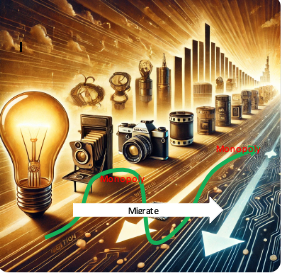
Reinvention lies at the heart of leveraging technology possibilities. Thomas Edison’s transformation of the hurricane or oil lamp into the electric light bulb exemplifies this principle. By replacing liquid fuel-burning technology with electrically heated filaments, Edison not only revolutionized lighting but also unleashed a wave of Creative Destruction that decimated the demand for hurricane and oil lamps. This shift resulted in the decline of industries and skills tied to these older technologies, while prosperity migrated to Edison, General Electric (GE), and other light bulb innovators.
The sustained refinement of Edison’s invention illustrates the cumulative power of incremental advancements. As light bulb technology advanced, a competitive race ensued, ultimately leading to the monopolization of the market by companies like GE. This monopolization is a natural outcome of technological progress, as it rewards those who can sustain innovation and refine the product better than others over time. The rise of Edison’s light bulb highlights how reinvention creates new avenues for prosperity while rendering existing industries obsolete. Besides, it also underscores the reality of monopolizing the new wave by winning the Incremental innovation race. Ironically, the reinvention of filament light bulbs as LED bulbs resulted in their migration from GE to Nichia, which was the same reason for which Edison’s GE rose.
The Fall and Migration of Prosperity: Kodak’s Reinvention Fault
The story of Kodak serves as a cautionary tale for innovation leaders. For over a century, Kodak dominated the film camera industry, even achieving monopoly market power. However, the company faltered when it failed to lead the reinvention of film cameras into digital ones. In contrast, Sony embraced the opportunity to drive this reinvention by introducing electronic image sensors to replace film technology. This shift marked the migration of prosperity from Kodak to Sony and from the United States to Japan.
Sony’s success underscores the importance of identifying and pursuing next waves of reinvention. By winning the incremental advancement race in image sensor technology, Sony achieved a monopolistic position in the high-end camera market. Meanwhile, Kodak’s inability to adapt highlights the perils of the reinvention fault line, a trap that often ensnares industry leaders when they fail to pivot to emerging opportunities.
Lessons from Failure: NorthVolt and Intel
The failure of NorthVolt in the lithium-ion battery industry illustrates the risks of attempting to replicate or imitate market leaders. Despite substantial investment—over $15 billion—and operating in Sweden, one of the world’s most innovative countries, NorthVolt struggled to secure a strong market position due its failure in driving the mechanics of reinvention. This failure underscores a critical lesson: aspiring entrants should focus on discovering and driving new waves of reinvention rather than competing head-to-head with established leaders.
Similarly, Intel‘s struggles in the semiconductor industry highlight the consequences of missing key reinvention opportunities. By failing to adopt the fabless and foundry model, Intel ceded its leadership position in silicon chip manufacturing. Despite substantial support from the U.S. government through the Chips and Science Act triggering the chip war, Intel has been unable to reclaim its former glory. This scenario raises concerns that Intel could face the same fate as Kodak, Nokia, Yahoo, or Polaroid—companies that failed to sustain their leadership by embracing reinvention.
Monopolization of Prosperity: The Role of Incremental Advancement
Once a company successfully leads a wave of reinvention, it often consolidates its market position through incremental advancements. This process enables the winner to improve performance, reduce costs, and outpace competitors, ultimately monopolizing the market. For example, Sony’s dominance in high-end image sensors stems from its ability to continuously refine its technology, building on its initial success in reinventing the camera.
Monopolization, however, is not permanent. The very forces that drive prosperity toward market leaders also set the stage for future disruption. As new technologies emerge, the leaders of today must be vigilant to avoid falling into the reinvention fault line. Companies like Apple and Sony exemplify how to sustain leadership by constantly seeking new opportunities for reinvention, whether through Product innovation or new business models.
The Dynamics of Innovation Success Cycle
The migration of prosperity is an inevitable consequence of technological evolution. It occurs not because of low-cost replication or imitation but because of the inability of market leaders to adapt to emerging reinvention waves. This pattern is evident in the decline of Kodak, Nokia, DEC and Polaroid, as well as the challenges faced by Intel. Prosperity migrates to those who can identify and leverage new technology possibilities, as evidenced by Sony’s rise in the camera industry and Apple’s success in redefining consumer electronics.
The migration of prosperity also has broader implications for nations and regions. For instance, the shift from Kodak to Sony represents not only a transfer of market leadership but also a migration of economic benefits from the United States to Japan. Similarly, the rise of TSMC around fabless and foundry model has migrated prosperity from the USA to Taiwan, making Taiwan a high-income economy. This underscores the importance of fostering environments that encourage reinvention and support the development of new technologies.
Strategies for Sustaining Prosperity in Innovation Success Cycle
To navigate the rise, fall, migration, and monopolization of prosperity, companies must adopt proactive strategies:
- Embrace Reinvention: Market leaders must continuously seek opportunities to reinvent their products and business models. Reinvention is the key to sustaining leadership and avoiding obsolescence.
- Focus on Incremental Advancements: Once a wave of reinvention is established, companies should prioritize incremental improvements to consolidate their market position and maintain competitiveness.
- Anticipate Future Waves: Aspiring entrants should avoid direct competition with established leaders and instead focus on identifying and driving the next wave of reinvention. This approach offers the greatest potential for success.
- Avoid the Reinvention Fault Line: Companies must remain vigilant to avoid becoming complacent or overly reliant on existing technologies. Failure to adapt to emerging trends can lead to decline, regardless of past success.
- Leverage Ecosystems: Collaborating within ecosystems can accelerate innovation and provide access to resources and expertise. For example, fabless companies and foundries in the semiconductor industry have demonstrated the value of ecosystem-based models.
Lesson for Aspiring Countries to Benefit from Innovation Success Cycle
- Give up low-cost proposition through replication: less costly and lower quality alternatives have been losing steam as innovators are succeeding in increasing the quality and reducing the cost simultaneously.
- Avoid head-on competition with industry leaders: due to the success of offering the highest quality at the least cost by the winner, profiting from head-on competition by the follower with the winner has been losing steam.
- Give up labor and natural resource-centric competitiveness: due to the decreasing cost contribution from labor and natural resources, industrial economy competitiveness should focus on idea based value addition through winning the innovation race.
- Question belief in innovation ecosystem and STEM competence: due to the importance of winning the reinvention race for adding value through ideas, belief in innovation ecosystem investment for driving economic growth has been weakening.
- Navigate and leverage reinvention opportunities: time to focus on navigating reinvention opportunities, sporting the target, preparing to drive, and winning the global race for generating economic value from innovation.
Conclusion
The dynamics of rise, fall, migration, and monopolization of prosperity in leveraging technology possibilities, creating an innovation success cycle, offer valuable insights for businesses and policymakers. Success depends on the ability to drive reinvention, sustain incremental advancements, and anticipate future opportunities. By understanding these patterns, companies can position themselves to lead new Waves of Innovation, attain market dominance, and sustain prosperity over time.
However, the risks of complacency and the reinvention fault line remain ever-present. History shows that no company is immune to the forces of technological evolution. As the stories of Edison, Kodak, Sony, and Intel illustrate, the path to enduring success lies in a relentless commitment to leveraging technology possibilities and embracing the transformative power of reinvention.
Five Key Takeaways from the Innovation Success Cycle:
- Reinvention Drives Success: The ability to reinvent products and business models is critical for leveraging technological possibilities. Failure to adapt often leads to decline, as seen in Kodak’s fall and Sony’s rise.
- Incremental Advancements Secure Market Dominance: Once a reinvention wave is established, sustaining leadership depends on continuous incremental improvements, as demonstrated by GE in the light bulb market and Sony in image sensors.
- Avoid the Reinvention Fault Line: Companies must remain vigilant and proactive to avoid being trapped by reliance on outdated technologies, a mistake that cost Intel its leadership in silicon chips.
- Prosperity Migration is Unavoidable Without Adaptation: Economic benefits tend to migrate to regions or companies driving the next wave of innovation, emphasizing the importance of reinvention for both businesses and nations.
- Imitation is Not a Path to Leadership: Aspiring entrants should focus on identifying new waves of technological reinvention rather than replicating or imitating established leaders, as seen in NorthVolt’s failure to compete in the lithium-ion battery market.
These takeaways emphasize the importance of innovation, adaptability, and foresight in sustaining prosperity.
Five Research Questions with Clarifications:
- What are the defining characteristics of successful reinvention in leveraging technology possibilities?
Clarification: This question aims to identify the specific elements, such as timing, resources, and leadership strategies, that contribute to effective reinvention in various industries. - How do incremental advancements influence the monopolization of markets following a technological Breakthrough?
Clarification: The focus here is on understanding how sustained improvements after initial innovation lead to market dominance, using examples like Sony in image sensors or GE in lighting. - What factors contribute to the reinvention fault line, and how can organizations avoid it?
Clarification: This investigates why established leaders often fail to pivot to emerging technologies, exploring organizational inertia, misaligned incentives, or resource allocation issues. - How does the migration of prosperity impact regional and national economies, and what policies can mitigate adverse effects?
Clarification: The question examines how shifts in technological leadership affect economic power dynamics between countries and regions, exploring potential strategies to retain prosperity. - What role do ecosystems and collaborative models play in accelerating reinvention and sustaining competitive advantage?
Clarification: This delves into how partnerships, supply chains, and ecosystem collaborations (e.g., fabless semiconductor models) support innovation and reduce risks of obsolescence.
These questions aim to deepen understanding of the dynamics discussed in the article while offering practical insights for businesses and policymakers.