Why don’t many high-performing firms, such as Palm, Digital Equipment, or Research in Motion, no longer exist? Build to Last has been a dream of every entrepreneur. However, it’s pretty challenging to make it happen. Hence, “Built to Last,” a 1994 book by Jim Collins and Jerry I. Porras, became very popular among business professionals. These two authors summarized the results of a six-year study analyzing enduringly great companies, such as General Electric and Hewlett-Packard, and comparing them to their less successful competitors. Rather than relying on a single visionary leader or a “great idea”, their findings argue that enduring success comes from having a core philosophy and a guiding mission. Such a finding raises questions about this core philosophy and guiding mission. What does building a strong core ideology, setting ambitious goals, and fostering a culture of progress mean for meeting the dream of building to last? This article deciphers those observations within the context of the rise and fall of firms due to the renewal of products through Creative Destruction.
Product Life Cycles Cause Rise and Fall of Firms: Lessons to Build to Last
At the core of high-performing firms, there has been a success in winning the evolution race of products. However, most products have been evolving in an episodic form through a series of reinventions. For example, the music player has undergone six major reinventions, resulting in the evolution of Edison’s phonograph to Streaming Services. Unfortunately, this success does not last long due to the rise of the Reinvention wave, causing the creative destruction effect. Despite winning the Innovation race and establishing a price-setting capability to consistently report expectation-beating financial numbers, seven out of ten innovation leaders fail to drive and win the next wave of product evolution. Often, this reality challenges the Build to Last dream.
Examples of Creative Destruction Causing Disruptive innovation on Innovation Leaders
- Palm: During the late 1980s and early 1990s, numerous attempts, including Apple’s Newton, failed to resonate palm top computing innovations with consumer preferences in getting Jobs to be done. To the surprise of many, a little company, Palm, succeeded in resonating with the design of the Palm Pilot and consumer preferences. Its success was so great that its valuation reached approximately $58 billion during the peak of the dot-com bubble in March 2000. Palm’s market capitalization was higher than that of General Motors and McDonald’s. More surprisingly, it surpassed the combined worth of Apple, Amazon, Google, and Nvidia. Unfortunately, within 10 years of reaching the peak, Palm disappeared, raising the question of why. It occurred due to the failure of the Palm Pilot to withstand the creative destruction effect of smartphones with PDA features.
- Nokia: Once unthinkable, cell phone handset king Nokia collapsed due to the rise of Apple’s creative destruction wave with the iPhone. It happened due to Nokia’s late response to catch up with the multitouch-based user interface promoted by the iPhone.
- Blockbuster: Blockbuster could not sustain its success and ultimately disappeared due to two waves of creative destruction. Consequently, its valuation fell from $8.4 billion in 1994 to $24 million in 2010. The first wave of creative destruction eroding the market value came from Netflix’s DVD mainlining services, removing the necessity of driving to rental stores. And the next one, a far bigger one, emerged from streaming video over the Internet.
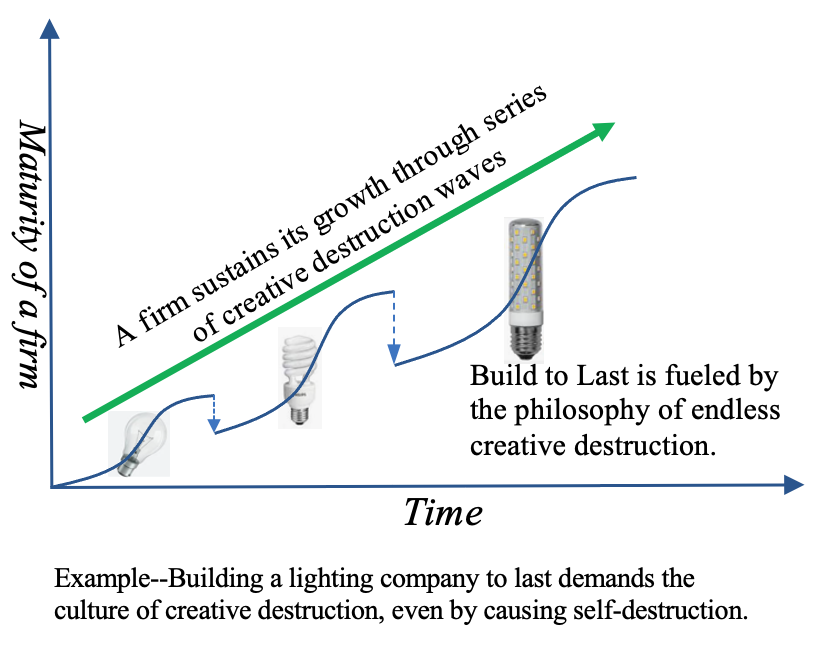
- General Electric (GE): In the book “Build to Last”, GE was presented as a role model. In 2000, after more than 100 years of birth, GE became the most valuable company. It was the outcome of the sustained growth of its products. Unfortunately, it did not last for long. Its share price fell as high as 61% from $ 295 to $ 113 in just over 3 years. The loss of lighting business due to the creative wave of destruction of the LED light bulb was one of the reasons. The second steep fall occurred in 2007 due to its weak preparation for the impending creative destruction from renewable energy on its fossil fuel-based power generation equipment and service business.
Renewal of Corporate Life through Creative Destruction
Apple: A tiny Apple grew from the Garage as a large corporation, thanks to the success of unleashing a creative wave of destruction of text-based computer interfaces through graphical user interfaces. However, the maturity and imitation by competing platforms like Windows led to a steady decline of Apple, reaching near death in 2001. Surprisingly, it regained its life due to Steve Jobs’ success in pursuing the iPod, unleashing creative destruction on portable music players like the Walkman. Unfortunately, the rise of smartphones was posing a threat to fade away iPod’s success. Hence, Steve Jobs pursued the iPhone as a creative wave of destruction on the conventional design of smartphones. Through the process of these two major Creative waves of destruction, Apple recovered and became an iconic corporate success.
Sony: A radio repair shop in war-ravaged Japan emerged as a consumer electronics innovation success story due to its mission of unleashing creative destruction on American and European companies. It occurred due to the reinvention of vacuum tube-based radio, television, and other consumer electronics through the development of the Transistor. To sustain this success in TV, Sony continually reinvented itself. Similarly, Sony’s rise and fall in the digital camera market have also been marked by creative destruction.
Renewal through Creative Destruction–Philosophy for guiding the mission of Build to Last
As explained, at the core of the rise and fall of corporate successes lies the power of creative destruction, driven by the evolution of inventions or products through reinvention. Unless there has been a corporate philosophy of pursuing creative destruction, success could not be built. To sustain success, the same philosophy should remain active for subsequent renewal, even if it leads to self-destruction, as Apple did with the iPod and iPhone, and Sony did with the CRT-based Trinitron TV and flat-screen. Hence, the Build to Last mission should be guided by the strong core ideology of pursuing renewal. It may also require setting ambitious goals that lead to self-destruction. It should focus on fostering a culture of progress through a relentless journey of creative destruction to meet the dream of building to last.