THE WAVES
  • Home
  • News
    • Recent Updates
    • Weekly Newsletter
    • Monthly Newsletter
    • Quarterly Newsletter
  • Topics
    • Technology
      • Internet
      • AR/VR & Digital twins
      • Robotics
      • AI & Data Analytics
      • IoT & Wearable
      • Blockchain
      • Computing
      • Sensors & Perception
      • 3D Printing
      • Energy Tech
      • Space
      • Gadgets
    • Transformation
      • Education
      • Health
      • Transportation
      • Farming
      • Energy
      • Security
      • Mining & Blue Economy
      • Food & Living
      • Communication
      • Entertainment
      • Manufacturing
      • Work & Management
      • Public Service
    • Startups
      • Culture
      • Country
      • New Entry
      • Accelerators
      • Incubators
      • Death Valley
      • Investments
      • Exit & IPO
      • Valuation & Financing
      • Idea & IP
    • Education & Research
      • School
      • University
      • Academic Research
      • Corporate Research
      • Public-funded Research
      • Economics of Innovation
      • Growth Economics
      • Training
      • Publications
      • Patents & IP
    • Industrial Revolutions
      • Future of Work
      • Sustainable Development
      • Smart Manufacturing
      • Job Transformation
      • Industry Transformation
      • Competition & Monopoly
      • National Response
      • Education & Skills
      • Social Change
    • Investment & Review
      • Public
      • Corporate
      • Venture Capital
      • Capital Market
      • Philanthropy
      • Personality
    • Inventions
    • Automation
  • Strategy
    • Value Proposition
      • Product
      • Process
      • Sustainability Goals
      • Business Model
      • Complementary
      • Externality
    • Innovation
      • Disruptive Innovation
      • Incremented Innovation
      • Sustaining
      • Schumpeter’s Creative Destruction
      • Redesign for Winning
    • Competition
      • Leading
      • Following
      • Blue Ocean
      • Monopolisation
      • Porter’s Five Forces
      • Business Cycle
    • Intangible Assets
      • Human Capital
      • R&D Management
      • Tripple Helix
      • Intellectual Property
      • Productive Knowledge
      • Technology Managment
    • Competence
      • Organization Agility
      • Innovation Culture
      • Infrastructure
      • R&D facility
      • Great by Choice
      • Build to Last
      • Good to Great
    • Technology Acquisition
      • Scientific discovery
      • Invention
      • Fusion
      • Adaptation & Refinement
      • Licensing
      • Start-up acquisition
  • Policy
    • Technology Development
    • Industry
    • Innovation Diffusion
    • Jobs, Privacy & Security
    • Regulation & Law
    • Sustainability
    • Equity & Inclusiveness
    • Climate Change
    • Environment
  • Opinion
    • Opinion
  • Megatrends
    • Individual Preferences
    • Planet and Society
    • Technology
    • Political Economy
    • Market Power & Monopoly
    • Globalisation
    • Schumpeter’s creative destruction
    • Startups & VC
    • Human Role in Work
    • Value of Natural Resources
    • Patents & Ideas for Redesign
  • Publication
    • Case Studies
    • Magazine
    • Books
    • Reports
    • White Papers
    • Journals
THE WAVES In-depth investigation on Technology, Society, and Policy dynamics for interpreting the past as well as present, and predicting the future so that success rate of pursuing ideas, start-ups, and innovation economy increases.

Technology, Society and Policy

Winning and Losing in Reinvention Race : keeps unfolding: --making America’s innovation bucket leaky, creating prosperity out of reinvention, and turning invention successes transitory
THE WAVES
  • Home
  • News
    • Recent Updates
    • Weekly Newsletter
    • Monthly Newsletter
    • Quarterly Newsletter
  • Topics
    • Technology
      • Internet
      • AR/VR & Digital twins
      • Robotics
      • AI & Data Analytics
      • IoT & Wearable
      • Blockchain
      • Computing
      • Sensors & Perception
      • 3D Printing
      • Energy Tech
      • Space
      • Gadgets
    • Transformation
      • Education
      • Health
      • Transportation
      • Farming
      • Energy
      • Security
      • Mining & Blue Economy
      • Food & Living
      • Communication
      • Entertainment
      • Manufacturing
      • Work & Management
      • Public Service
    • Startups
      • Culture
      • Country
      • New Entry
      • Accelerators
      • Incubators
      • Death Valley
      • Investments
      • Exit & IPO
      • Valuation & Financing
      • Idea & IP
    • Education & Research
      • School
      • University
      • Academic Research
      • Corporate Research
      • Public-funded Research
      • Economics of Innovation
      • Growth Economics
      • Training
      • Publications
      • Patents & IP
    • Industrial Revolutions
      • Future of Work
      • Sustainable Development
      • Smart Manufacturing
      • Job Transformation
      • Industry Transformation
      • Competition & Monopoly
      • National Response
      • Education & Skills
      • Social Change
    • Investment & Review
      • Public
      • Corporate
      • Venture Capital
      • Capital Market
      • Philanthropy
      • Personality
    • Inventions
    • Automation
  • Strategy
    • Value Proposition
      • Product
      • Process
      • Sustainability Goals
      • Business Model
      • Complementary
      • Externality
    • Innovation
      • Disruptive Innovation
      • Incremented Innovation
      • Sustaining
      • Schumpeter’s Creative Destruction
      • Redesign for Winning
    • Competition
      • Leading
      • Following
      • Blue Ocean
      • Monopolisation
      • Porter’s Five Forces
      • Business Cycle
    • Intangible Assets
      • Human Capital
      • R&D Management
      • Tripple Helix
      • Intellectual Property
      • Productive Knowledge
      • Technology Managment
    • Competence
      • Organization Agility
      • Innovation Culture
      • Infrastructure
      • R&D facility
      • Great by Choice
      • Build to Last
      • Good to Great
    • Technology Acquisition
      • Scientific discovery
      • Invention
      • Fusion
      • Adaptation & Refinement
      • Licensing
      • Start-up acquisition
  • Policy
    • Technology Development
    • Industry
    • Innovation Diffusion
    • Jobs, Privacy & Security
    • Regulation & Law
    • Sustainability
    • Equity & Inclusiveness
    • Climate Change
    • Environment
  • Opinion
    • Opinion
  • Megatrends
    • Individual Preferences
    • Planet and Society
    • Technology
    • Political Economy
    • Market Power & Monopoly
    • Globalisation
    • Schumpeter’s creative destruction
    • Startups & VC
    • Human Role in Work
    • Value of Natural Resources
    • Patents & Ideas for Redesign
  • Publication
    • Case Studies
    • Magazine
    • Books
    • Reports
    • White Papers
    • Journals

  • Editor's Pick
  • Good to Great
  • Uncategorized

Good to Great Demands a Flow of Ideas

Five forces shaping the idea flow for creating a flywheel effect

  • Md. Rokonuzzaman
  • Created: November 5, 2025
  • Last updated: November 5, 2025
Good to Great mission demands a directional flow of ideas in creating a flywheel effect

Due to the urgency of building high-performing companies, Jim Collins’ book “Good to Great” has been sold more than 4 million copies. Based on investigative analysis of 1435 good companies, he has presented a thesis on how companies can transition from being good to great. The core of the thesis is that graduation from good to significant requires a combination of effective leadership, sound strategy, a strong culture, and disciplined execution. At the performance level, these traits should produce sustained performance improvements in products and processes, creating a flywheel effect. However, how those traits are going to produce a Flow of Ideas for sustained improvement of quality and reduction of cost of whatever those companies have been delivering to make them great had not been spelled out in that best-selling book, Good to Great.

Hence, high-sounding management advice faces execution challenges, leaving excited management professionals clueless about creating the flywheel effect. Therefore, this article presents areas to focus on for generating a flow of ideas that drive the evolution of products, ultimately achieving the vision of Good to Great. 

Good to Great within the Context of Product and Process Evolution

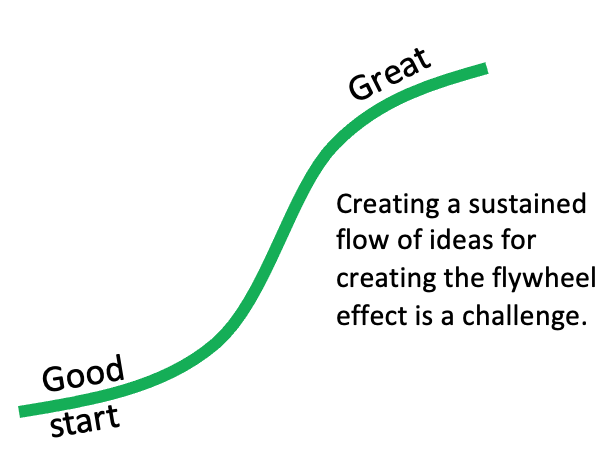
The core thesis of Good to Great is about creating the flywheel effect in organizational performance. How will this effect be created? As we know, a company’s financial performance and brand value depend on the performance of its products in the market. For better performance, products should continue to improve and become more affordable, resulting in increased revenue, a higher profit-to-revenue ratio, and enhanced brand value. As we know, all great products begin their journey in humble form; you may call it a good start. The challenge lies in sustaining incremental advancements of both products and processes to produce them, resulting in increased quality and reduced costs. Hence, the core of the Good to Great thesis is about driving the evolution of good products to make them great, resulting in building great companies.

Examples of Good to Great

Apple: In 2007, Apple’s performance was strong due to the success of the iPhone 1. Over the last 17 years, Apple has evolved from a good to a great company. The underlying reason has been the evolution of the iPhone from a good to a great product. To make it happen, Apple had to create a flow of ideas, increasing its patent portfolio to over 116,000. Besides, in this evolution race, Apple had the challenge of winning the competition to transfer the idea flow into growing revenue and profit. Consequently, Apple’s stock price has increased from $3 in 2007 to $270 in 2025.  

Toyota: In 1933, nearly 50 years after the invention of the automobile by Carl Benz, Toyota began manufacturing automobiles. In contrast to assembling imported components, Toyota focused on designing and manufacturing engines, as well as many other key elements. It was a good beginning, for sure. However, its cars and trucks were far inferior to those produced by American firms like GM or Ford.  Hence, Toyota focused on refinement to drive the evolution with a flow of ideas. This journey has graduated Toyota from a Good to a Great company. To ensure a steady flow of ideas, Toyota pioneered many management practices, from TQM to just-in-time. However, at the core of this success has been Toyota’s idea engine, producing an endless flow of ideas for incremental advancements in product features and their precise implementation through the increasing role of automation and robotics in its production process.

Sony: Certainly, Sony’s radio and television products were not impressive in the 1960s, and the company itself was not either. At best, they were good. Surprisingly, they have become great. It happened due to the continued refinement of Sony’s products, making Sony an iconic and innovative company. 

Microsoft: In the 1980s, neither Microsoft nor its Disk Operating System was great. For sure, there were good. To graduate to the level of outstanding performance, Microsoft had to continually refine the operating system and applications like Word, PowerPoint, and Excel. This journey of refinement required a flow of ideas to create a talked-about flywheel effect. 

TSMC: In 1987, Taiwan Semiconductor Manufacturing Company was not born as a great company. It remained good for more than a decade. However, at the dawn of the 21st century, it started to show signs of being a great company. Subsequently, it emerged as a great performer in the global semiconductor industry. The underlying force has been its relentless journey of refining the semiconductor service.

All these examples emphasize a shared theme: a good company transforms into a great one through the evolution of its decent products into outstanding ones. Achieving this requires a continuous flow of ideas. This reality prompts a crucial question: how can a company maintain a steady flow of ideas over decades to progress from good to great?

Five Forces for Sustained Flow of Ideas

For the sustained growth of products to create a flywheel effect, the five forces play a vital role in creating a flow of ideas. These forces are: (i) Urgency of getting the jobs done better, (ii) empathy and Passion for Perfection, (iii) Science, Technology, and Engineering, (iv) Creativity, and (v) Necessity of winning the competition.

 The urgency of Getting jobs done better: Whether it’s taking a shower or communicating with someone, human beings have an endless sense of urgency in getting tasks done effectively. Hence, they have been seeking increasingly improved products to accomplish tasks more effectively at a lower cost. This endless urgency has created a demand for a continuous flow of ideas to refine products, making them increasingly suitable for the jobs they are designed to do. For this reason, starting with the iPhone, all the products around us have undergone significant evolution. Therefore, for a systematic flow of ideas to create the flywheel effect, the focus should be on getting Jobs to be done.

Empathy and Passion for Perfection: How to get ideas for improving products in helping customers to get their jobs done better? Should we wait for the customer to tell us? Unfortunately, no. Often, customers are unaware of their latent desires. Hence, the focus should be on empathy and a passion for perfection to create a directional flow of ideas, leading to sustained improvement of products and ultimately graduating from good to great.

Science, Technology, and Engineering: Certainly, empathy and a passion for perfection, with a focus on doing jobs better, will create the urgency to generate ideas. However, this is not enough to generate meaningful ideas that can be implemented. To proceed further, we require a solid understanding of relevant science, technology, and engineering (STE) principles, as well as the ability to apply and advance them. 

Creativity: Once the urgency of getting jobs done better and STE possibilities are fed into the creativity, ideas start flowing. This common thread ties up individual creativity into a company’s creative engine, vital for sustained and directional flow of ideas.

Winning the Competition: The urgency to diffuse products and make a profit from them demands winning the competition. Hence, it has a vital role in generating a directional flow of ideas, creating the flywheel effect of performance improvement for both products and companies.

Creating a Directional Flow of Ideas

To avoid making Good to Great merely management hype, the reality of achieving Breakthrough performance requires the accumulation of ideas for improving products and processes, one after another, rotating the flywheel turn by turn. To make it happen, we need an organic evolutionary process being shaped by five Innovation forces as explained in this article.
Enlighten others

Subscribe

Subscribe now to our newsletter

You May Also Like

Which Type of R&D Should Be the Focus of Bangladesh and many other less developed countries?
View Post
  • 3 min

Types of Research and Development

Bangladesh can turn its high-tech parks into engines of prosperity by housing R&D wings of local producers
View Post
  • 3 min

Bangladesh’s High-Tech Park Owe: Can Low-Tech Be a Solution?

How speculative markets and continuous storytelling combine to decouple asset valuation from delivery of innovations
View Post
  • 8 min

The Rise of Muskism Turning Musk a Trillionaire: Narrative-Driven Capital Accumulation and the Illusion of Disruptive Innovation

Leave a Reply Cancel reply

Your email address will not be published. Required fields are marked *

Subscribe

Subscribe now to our newsletter

Principles

  • Economics of Technology
  • Innovation Economics
  • Technology & Innovation Policy

History & Observations

  • Technology History
  • Innovation History
  • Strategy & Policy in retrospect
  • Entrepreneurs & Innovators
  • Startups & Corporations
  • Patents & Publications
  • Design & Redesign Thinking

About Us

  • Who we are
  • What we deliver
  • Genesis
  • Mission
  • Scope
  • Editorial & Advisory Board
THE WAVES
  • Contact
  • Advertise

Input your search keywords and press Enter.