Abstract:
Joel Mokyr’s explanation of modern economic growth rightly emphasizes the transformative role of “useful knowledge” in shifting the engine of growth from Smithian market expansion to sustained productivity gains during the Industrial Revolution. Yet his framework leaves unresolved questions: why growth appears in discrete industrial revolutions rather than as a linear accumulation of knowledge, why successive revolutions generate increasing prosperity, and why periods of knowledge saturation recur. This essay argues that these puzzles can be resolved by recognizing the layered structure of scientific knowledge. Drawing on Thomas S. Kuhn’s episodic view of scientific progress, it proposes that each industrial revolution has been powered by a deeper layer of scientific understanding—ranging from intuitive craft knowledge and mechanical science to electrical engineering, quantum and data-centric technologies, and now computational and cognitive science. Each layer enables qualitatively new scales of invention while eventually reaching saturation, necessitating descent into deeper layers. This perspective reframes industrial revolutions as structurally inevitable episodes in long-run economic growth.
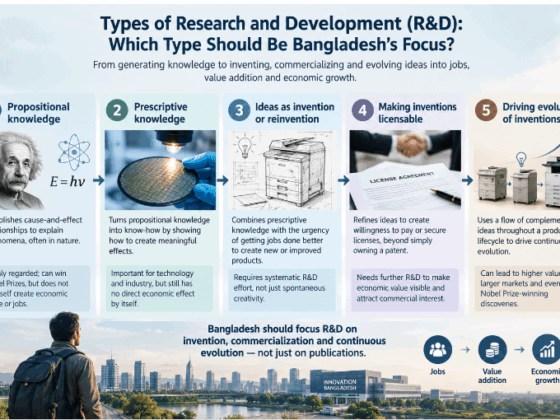
Joel Mokyr’s great intellectual contribution was to shift our understanding of modern economic growth away from capital accumulation and trade alone, toward the production and use of what he famously called “useful knowledge.” In explaining Britain’s unprecedented growth between 1760 and 1850, Mokyr argued that the Industrial Revolution marked a fundamental change in the engine of growth itself. Before it, growth everywhere in the world was largely Smithian—driven by market expansion, trade liberalization, and division of labor. After it, growth increasingly emerged from systematic improvements in products and production processes.
Yet Mokyr himself acknowledged an unresolved puzzle. Why should this transformation be called a revolution rather than an acceleration of an existing trend? Why did economic history not experience one continuous, linear expansion of useful knowledge, but instead witness multiple industrial revolutions, each distinct in character, scale, and impact? And why did knowledge accumulation sometimes appear to saturate, losing its power to drive growth—only to be reignited later in a new form?
The missing link lies in how we conceptualize knowledge itself. Treating useful knowledge as a single, continuously accumulating stock obscures a crucial structural reality: scientific knowledge is layered, and each layer has historically powered a distinct industrial revolution.
From Linear Accumulation to Layered Knowledge
The intellectual roots of this perspective can be traced to Thomas S. Kuhn’s The Structure of Scientific Revolutions. Kuhn famously rejected the idea that science progresses through smooth accumulation of facts and theories. Instead, he proposed an episodic model in which periods of “normal science” are punctuated by paradigm shifts—deep transformations that redefine what counts as legitimate knowledge, methods, and problems.
Economic historians absorbed Kuhn’s insights only partially. While Mokyr emphasized the institutional and cultural conditions that allowed useful knowledge to flourish, he retained an implicitly linear view of knowledge growth. This leaves several empirical facts insufficiently explained: the episodic nature of industrial revolutions, their rising economic returns, and the recurring need for fundamentally new scientific foundations to sustain growth.
If we extend Kuhn’s insight from the history of science to the evolutionary economy of technology, a clearer picture emerges. Useful knowledge does not deepen uniformly. It advances layer by layer, with each layer enabling qualitatively new forms of invention, Reinvention, and economic scale.
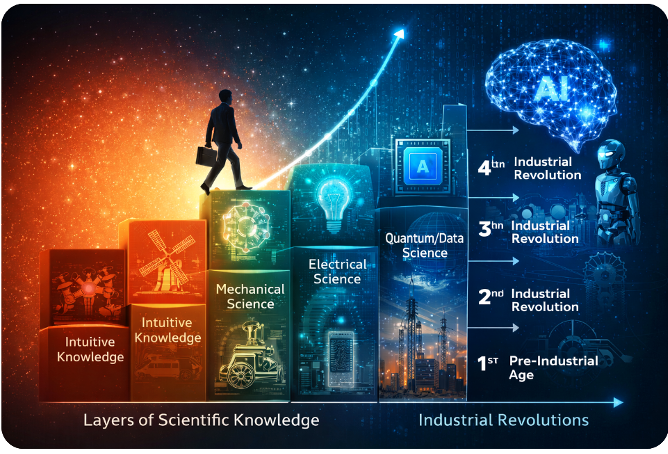
Five Layers of Scientific Knowledge, Five Growth Regimes
Viewed through this lens, the history of industrialization can be organized around at least five major layers of scientific knowledge.
The first layer is intuitive, art form, craft-based, and experiential knowledge—an art form rather than a formal science. This knowledge powered invention in the pre-industrial world: windmills, waterwheels, metallurgy, shipbuilding, and agricultural tools. Innovation existed, but its scope and scale were narrow and its diffusion was slow and limited. Growth was shallow and fragile, easily constrained by population pressure, resource limits and trade barriers.
The second layer emerged with mechanical science and engineering, providing a systematic understanding of motion, force, and energy. This layer powered the First Industrial Revolution. Steam engines, mechanized textiles, and factory systems transformed production, but they remained bounded by physical constraints and relatively localized scaling. Growth accelerated, yet still faced diminishing returns as mechanical recombination possibilities matured.
The third layer—electrical science and engineering—enabled a far greater leap. Electricity allowed energy to be transmitted, controlled, and scaled with unprecedented flexibility. The Second Industrial Revolution reorganized entire economies through electrification, mass production, telecommunications, and chemical industries. Productivity gains dwarfed those of the mechanical era, not because firms worked harder, but because the underlying scientific layer allowed far deeper scale of reinvention of product and process lifecycles.
The fourth layer arose from quantum science, semiconductors, and data-centric software. By enabling manipulation at the atomic and informational level, this layer drastically reduced marginal costs—especially in software. The Third Industrial Revolution created global value chains, digital platforms, and exponential scaling effects unimaginable in earlier eras. Prosperity increased not incrementally, but discontinuously.
We now stand at the threshold of a fifth layer: computational and cognitive science, embodied in artificial intelligence. Unlike previous layers, this one targets not energy or matter, but cognition itself—the ability to sense, predict, optimize, and create. If history is any guide, this layer will power an industrial revolution whose economic impact surpasses all previous ones.
Why Revolutions Are Episodic, Not Endless
This layered framework resolves several long-standing puzzles.
First, it explains why industrial revolutions are revolutionary rather than merely cumulative. Each new layer of scientific knowledge unlocks an entirely new design space for invention and reinvention, and unleashes destruction to the market of products powered by the previous layer. Growth accelerates not because more knowledge is added, but because a deeper layer changes the rules of what is technologically possible.
Second, it clarifies why prosperity migrates geographically. Regions that first master a new layer—Britain in mechanics, the United States and Germany in electricity, East Asia and Silicon Valley in semiconductors—become temporary centers of global growth. As the layer matures and diffuses, returns decline and leadership shifts again.
Third, it explains why growth eventually saturates within each regime. At any given layer, the lifecycles of inventions and innovations are finite. Once the recombinatorial possibilities of that layer are exhausted, additional knowledge yields diminishing economic returns. Growth slows—not because innovation has failed, but because the scientific foundation has reached its limits.
This is why knowledge accumulation at a single layer cannot drive growth endlessly. Sustained prosperity requires descent into a deeper layer of scientific understanding.
Rethinking Mokyr for the Age of AI
Seen this way, Joel Mokyr’s thesis remains profoundly correct—but incomplete. Useful knowledge is indeed the engine of modern growth. What Mokyr under-theorized is the structure of that knowledge and its episodic deepening.
The future of prosperity will not be determined by how much data we collect, how many papers we publish, or how much R&D we fund within existing paradigms. It will be determined by whether societies can cultivate the next layer of scientific knowledge—and reorganize institutions, skills, and incentives around it.
Artificial intelligence is not merely another general-purpose technology. It is the expression of a deeper cognitive layer of science. If history repeats itself, its economic impact will be revolutionary—not because machines will replace humans, but because cognition itself will become a scalable input to the evolution of inventions.
Understanding growth through layered scientific knowledge does more than resolve historical debates. It offers a roadmap for the future—one that reminds us that prosperity is neither automatic nor linear, but episodic, structural, and deeply rooted in how humanity understands the world.
In that sense, the next industrial revolution will not be an anomaly. It will be the next layer revealing itself.