What should be the goals of science and technology? Notably, in less developed countries, setting the goals of science and technology is an issue. For sure, science and technology (S&T) have been at the root of ideas in Getting jobs done better. They fuel Innovation and Wealth creation. Hence, to leverage S&T for driving economic growth, less developed countries have been increasing investment in producing S&T graduates. Some have also invested in R&D, producing publications and patents.
In general, the goal of science is to discover knowledge. However, should it be limited to meeting our urgency of knowing? The more important goal is to invent as well as advance technologies to offer us better means of getting jobs done. Hence, science and technology has been at the root of innovation and new business.
However, is the science and technology competence good enough to create profitable businesses and drive eocnomic growth out of innovation? Unfortunately, despite the growing demand for S&T graduates in advanced countries, less developed ones have been suffering from increasing unemployment due to their limited supply. For example, 85% of engineering graduates in India are failing to get engineering jobs. On the other hand, the demand for engineering graduates in advanced countries has been outstripping the supply. Why is there such a disparity?
Drawing lessons for setting the goals of science and technology
Let’s draw a lesson from an example. Out of an accident, a scientist at Raytheon invented the technique of microwave heating. Raytheon explored the underlying science, developed technology, and innovated a new product–a microwave oven for heating food. The production of this technology product required engineers, technicians, and also labor labor-centric skilled workforce.
Often developing countries focus on labor aspect of technology economy–keep replicating a product, innovated in the developed world. Instead of innovating, they focus on consuming, replicatging, and repairing of technology products. On the other hand, whatever they innovate out of S&T ideas fail to generate profitable busienss.
 In 1945, upon accidental observation, Raytheon innovated the microwave oven for quick heating of food using microwave energy. This 5 ft 11 inch tall, weighing 340 kilograms (750 lb) and costing about US$5,000 ($57,000 in 2019 dollars), used to consume 3 kilowatts; it was about three times as much as today’s microwave ovens, requiring water cooling. It was neither producing profitable revenue for Raytheon nor did it attract many customers to pay for it. This huge machine used to take substantial labor for manufacturing, installation, and maintenance. Such a high labor requirement could have been a blessing for developing countries like Bangladesh.
Japan’s goals of science and technology go beyond labor-based replication
|
Unlike less developed countries, the Japanese focused on reinventing the microwave oven to leverage science and technology: But the Japanese looked into it from a different perspective. They took the license of it with the permission of further enhancement. They did not limit their activities only to keep producing the same licensed product. Instead, the Japanese focused on advancing the underlying technology core, succeeding with the invention of a compact microwave tube, leading to the redesign of the oven to make it better as well as cheaper. And they kept doing it, releasing successive better versions at a lower cost, creating a greater market and increasing profitable revenue. They kept managing diverse technologies, from electronics and software to convection heating, to maintain a Flow of Ideas to fuel their redesign mission. The culture of pursuing a relentless journey of perfection plays a vital role. Through this approach, the Japanese succeeded in leveraging Science, Technology, and Innovation out of the generation of knowledge, technological advancement, and ideas of the redesign. |
So far, most of the developing countries, including Bangladesh, did not focus on this aspect. The Scientific, Engineering, and Economist community could not make it clear to policymakers and marshal national resources to harness this potential. The import substitution-based strategy of producing technology products (pursued by Steel and Engineering Corporation, Transcom, Rangs, or Walton in Bangladesh, for example) did not focus on this critical opportunity. As a result, the value-addition ability is mostly through labor in producing technology products. And profit-making primarily depends on tax differential, paying less for labor, other incentives, and often fraudulent means. Like many other developing countries, Bangladesh, Vietnam, and Indonesia are in a race to attract FDI for selling their labor in manufacturing products for Japanese, American, or European firms. On the other hand, their growing STEM graduates are not finding opportunities to add value through ideas for the redesign. |
Basically, we can leverage technology by Seven (7) major means: 1. operation and consumption, 2. replication of products, 3. improving production process, 4. improvement of existing products through redesign, 5. innovating new ones, and 6. advancing and fusing technologies for supporting innovation and redesigns, and 7. making scientific discoveries for technology inventions.
So far, Bangladesh and most of the developing countries are focusing on 1&2. The value addition opportunity out of 1&2 is limited, and is also diminishing.
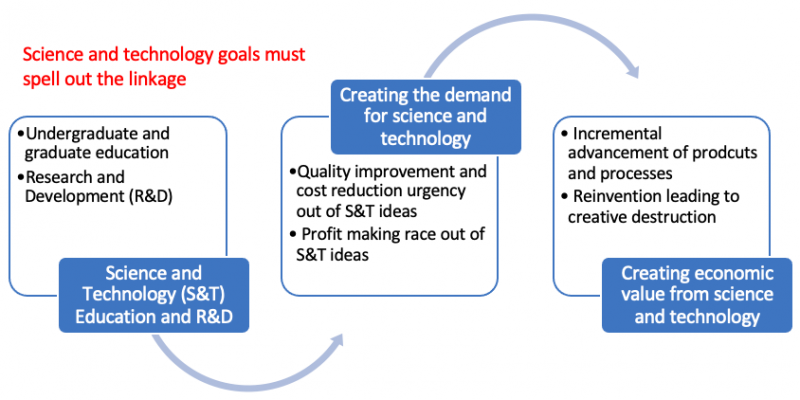
Goals of Science and Technology in Perspective

Muslims in Science in the Middle Ages
Prior to the Middle Ages, knowledge about the universe was in the art form in ancient philosophical writings. From 700 AD to 1200 AD, Muslim scientists established the root of modern science and technology. However, the goals of science and technology in this era were limited to knowing the greatness of the creation of God as per instruction of the Holy Quran. Hence, despite significant advancement, they could not leverage their science and technology glory to drive economic prosperity. Consequentially, they could not sustain their edge and lost to the Europeans.
Europeans broadened the goals of science and technology

Unlike the Muslims, Europeans expanded the goals of science and technology (S&T). They targeted to leverage S&T for scaling up inventions and innovations for profiting from the possibility of making products better and cheaper. Hence, in addition to learning from the work of Muslim Scientists, they focused on advancing and pursuing profit-making opportunities out of the application of it. It started unfolding with the advancement of Steam engines and mechanization of production. Consequentially, European industrial products started getting better and cheaper due to the flow of material, energy, labor and time-saving ideas stemming from S&T. Such endeavors led to the formation of the first industrial revolution. Consequentially, the UK-led Europe rose to the peak of global prosperity in the 19th century.
Like Europe, the USA, Japan, South Korea, and Taiwan have focused on science and technology to drive economic growth. Lately, China has been very aggressive for levering S&T for attaining economic and military egdges.
Less developed countries are suffering from narrow goals of science and technology

After the end of colonization, India-led former colonies started building an industrial economy through locally produced products which they used to import from Europe. Hence, they focused on science and technology to attain the capability of operating and repairing imported capital machinery for making copies of licensed or pirated products. Although some of them, like India, attempted to advance science, they could not convert that advancement into innovating products or processes. Hence, the goals of science and technology in less developed countries have been limited to operating, repairing, and replicating foreign products. Thus due to lack of quality jobs, top S&T graduates of these countries have been emigrating.
However, through such an approach, economic benefits from science and technology have been very limited in these countries. However, once less-developed South Korea and Taiwan have succeeded in leveraging S&T to create economic value out of ideas of innovation. Hence, they have succeeded in reaching high-income status.
Goals of science and technology must expand in less developed countries
For opening a sustained, endless growth path, we need to focus on 3, 4, 5, 6, and 7. I hope it sheds some light on how to “leverage Science, Technology, and Innovation.” All these 07 steps are guided by envisioning the unfolding transformation of society out of technology innovation in a globally connected Market Economy.
To manage this transformation to maximize gain and minimize pain, we must keep steering out policies, regulations, education, training, infrastructure, culture, values, careers, start-ups, investment, and many more. Unfortunately, we often ignore the necessity of these capabilities for leveraging science and technology. Due to their inadequacy in them, we often miss the opportunity or pursue the following approach. Although the following appears to be a proven path, the following does not repeat the success.
To maximize leveraging S&T, we must focus on predicting unfolding opportunities to turn S&T capability into profitable revenue. Managing this journey in uncharted, unknown territory demands rational decision-making in the midst of uncertainty. Areas to focus on are (i) science&technology, (ii) customer preferences, (iii) response to competition, (iv) team’s capability and culture, (v) supply chain, partners, and alliance, (vi) infrastructure and ecosystem, (v) finance and cashflow, (vi) public policies, and (vii) Ethics, values, and leadership. Hence, S&T capability alone does not spell out success.
In order to acquire the prediction capability, we need to detect some repeatable patterns. And these patterns exist at the melting point of science, technology, innovation, competition, the economics of production and consumption, public policies and regulation, customer preferences, behavioral economics, culture, and social transformation. To get them, we need to keep dissecting past and present dynamics of the technology-led transformation of our society by the profit-making competition in the globally connected competitive market.
Scientific knowledge is to fuel the uprising of innovation waves, subsequently causing destruction to products of previous generations. As a matter of fact, the core strength of the market economy to keep progressing is the creation of successive innovation waves. Hence, for leveraging S&T, less developed countries should focus on developing the capacity to improve existing products through Incremental innovation and Reinvention. Consequentially, they will succeed in offering a better quality alternative at less cost, creating the market for their S&T ideas.
Related articles:
Innovation Magic through Ideas of Redesign