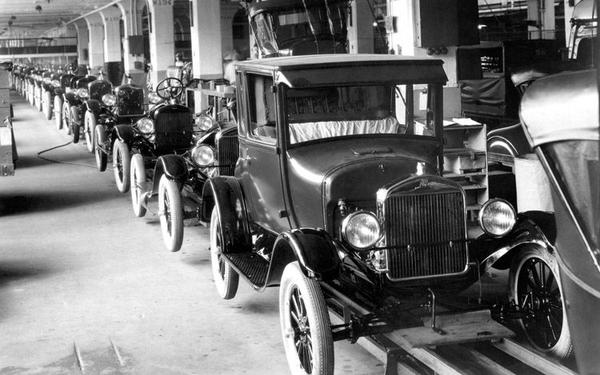
At the dawn of the 19th century, a number of emerging technology cores offered profit-making opportunities out of innovations. Hence, competition emerged to unfold creative Waves of Innovation to offer better substitutions. These creative waves destroyed the market of most of the steam engine-based innovations offered by the first industrial revolution. Besides, the 2nd industrial revolution also brought a few new ones.
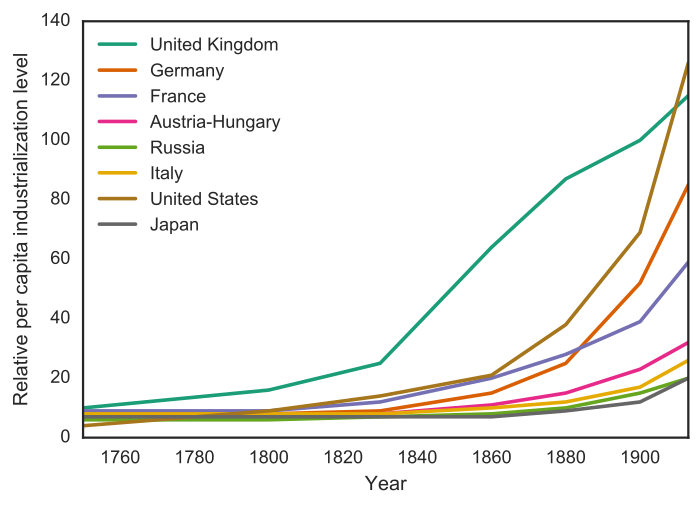
By 1870, With the steam engine technology’s maturity, the creative waves driving the first industrial revolution reached saturation. However, the growth of electricity invention and the internal combustion engine (ICE) reaching early childhood opened the era of the second industrial revolution in the 1870s. Subsequently, the rolling out of Carl’s Benz’s ICE-powered automobiles and the emergence of Thomas Alva Edison’s light bulb and electrical power production, as well as distribution systems, started a new era of innovations. These innovations included automobiles, light bulbs, steel-making processes, mass production, assembly lines, electrical grids, and large-scale manufacturing. However, the epicenter of the industrial revolution moved from the United Kingdom (UK) to the USA, Germany, and other parts of Europe. Consequentially, the rapid economic growth began to occur after 1870, springing from a new group of innovations at the dawn of the second industrial revolution.
The transition of the steam-powered first industrial revolutions to the 2nd one reveals that the effect of technology on economic growth creates a long cyclic effect. The economy experienced high growth during the ramp-up period of steam engine technology. However, at the maturity of this technology, economic growth slowed down, marking the end of the first industrial revolution. This is followed by the high economic growth due to the scaling up effect of the next technology cores, fueling the second industrial revolution. Hence, such observation underscores the hypothesis of long cycle-like phenomena in the modern world economy.
Technology cores fueling innovations in the 2nd industrial revolutions
The uprising of waves of innovation marks every industrial revolution. Some of those waves destroy existing products and industries in making them. At the same time, others create completely new types of products. To fuel these creative waves, we need technology cores. Once emerging technology cores, having high growth potential, reach early childhood, they start forming and driving innovation waves.
For the second industrial revolution, notable such technology cores are internal combustion engines, electricity, and electrical motors. Furthermore, job division, specialization, and production also formed a very powerful technology core. Internal combustion engines (ICEs) and Electrical motors took the role of the steam engine in providing energy. Besides, Electricity in the form of light bulb innovation and production and distribution of electrical power through grids fueled massive innovation waves. Five major technologies fueling creative waves in the era of the 2nd industrial revolution are below. Besides, these technology cores kept improving in making innovations like the light bulbs, and automobiles increasingly better and also less costly to produce. Consequentially, they kept diffusing deeper in society as progressively growing waves.
Internal combustion engine (ICE)
British inventors and engineers played a leadership role in the invention and advancement of steam engine technology. This was one of the reasons that Britain was at the epicenter of the first industrial revolution. At the dusk of the first industrial revolution, inventors were working on ICE. Subsequently, ICE grew as a better substitute for the steam engine. In fact, during the 2nd industrial revolution, in many applications, ICE replaced the steam engine.
Instead of British inventors and engineers, Belgian engineer Étienne Lenoir, around 1860, demonstrated the first commercially successful internal combustion engine. However, the first modern internal combustion engine was created in 1876 by German Engineer Nicolaus. In the autumn of 1860, Otto and his brother learned of a novel gas engine that Jean Joseph Etienne Lenoir had built in Paris. Upon filling patent for the copy of the Lenoir engine, the brothers were rejected by the Prussian Ministry of Commerce. Later on, Otto had obtained many patents from several different nations and for several different features of the internal combustion engine. The invention and subsequent advancement played critical roles in a series of innovation waves. A notable one is the growth of automobiles as a strong wave of Creative Destruction.
The invention of electricity and development of electrical power system
Among many scientists, engineers, and tinkerers, in the late 18th century, Benjamin Franklin, an American, conducted extensive research in electricity, selling his possessions to fund his work. However, the practical use of the knowledge of electricity and electrical technology inventions, contributed by many curious minds of America and Europe, started to roll out in the 1880s. It was due to the commercialization work of American innovator Thomas Alva Edison, among many others. Electrical technologies in the form of a generator, distribution network, and storage (battery) formed a very powerful technology core to fuel innovations in the era of the 2nd industrial revolution. They kept driving creative destruction, leading to Disruptive innovation.
Electrical motor and vacuum tube electronics
The discovery of electromagnetism due to the work of Hans Christian Ørsted and André-Marie Ampère, in 1819–1820, formed the foundation of turning electrical energy into mechanical motion. Subsequently, Michael Faraday invented the electric motor in 1821. This invention opened the opportunity of using electric motors to power the industry and many other industrial products. Furthermore, in 1904, British engineer John Ambrose Fleming invented and patented the first vacuum tube thermionic valve. This invention gave birth to electronics for integrating information into the machine age.
Job division, specialization, and production line
Mechanization played a vital role in turning Adam Smith’s economic theory of job division and specialization into a productivity improvement technology core. This technology core led to the production line technology for organizing industrial activities. It had a tremendous effect on improving productivity, reducing workers’ skill and knowledge requirements, and opening job opportunities for a less-skilled workforce.
Unfolding creative waves of innovation
Due to technology alone industrial revolution does not unfold. Innovators need to leverage them to unfold creative waves. Technology cores underpinning the 2nd industrial revolution had a strong potential for profit-making competition to drive waves of innovations. Besides, in comparison to the steam engine, these technologies were far more capable. Both the breadth and depth of innovations were far greater. Hence, the 2nd industrial revolution had a far greater impact on economic growth, prosperity, and quality of living standards. Some of the examples are below:
Automobiles
The emergence of ICE technology core encouraged innovators to change the technology core of the horse wagon. Hence, they targeted replacing the horse with ICE to provide propulsion. Subsequently, this led to Carl Benz’s patent on “automobile fueled by gas” in 1886. Besides, the uprising of automobile innovation caused destruction to the horse wagon industry. Since its emergence, the automobile industry has been growing over the last more than 135 years. Even today, in the global GDP of $90 trillion, the automobile industry alone generated as high as $4 trillion in revenue. Furthermore, the global petroleum industry fueling more than 2 billion automobiles is responsible for almost $3 trillion in revenue. Besides, the revenue of almost $500 billion by German automakers is good enough to make Germany an industrially rich country. Japan is enjoying a similar benefit from the automobile industry.
Lighting and electrical power system
Human beings were after electric lighting for a long. This long journey culminated in Thomas Alva Edison’s carbon filament technology-based lightbulb innovation in 1879. To create the market for an electric light bulb, Edison focused on advancing and laying out an electric power distribution network. During the 1880s, he patented a system for electricity distribution. Besides, in 1883, the first standardized incandescent electric lighting system employing overhead wires began service in Roselle, New Jersey. Since then, electric power production and distribution network has been expanding across the world.
Household appliances
The availability of electrical energy from the grid and electrical motor formed a new technology core for innovating a number of applications. Particularly, innovators targeted household appliances. For example, General Electric introduced its first electric toaster in 1909. As early as 1904, electric washing machines were advertised and discussed in newspapers. By 1928, US electric washing machine sales reached 913,000 units. Subsequently, many more such innovations started to emerge by leveraging power networks and electric motors.
Telephone
A long journey of telephone invention acts culminated in the issuance of a patent for the practical use of the telephone to American Alexander Graham Bell. He also co-founded the American Telephone and Telegraph Company (AT&T) in 1885. Besides, the electric grid played a vital role in charging batteries to power the diffusion of the telephone network.
Radio and Television
The discovery of the electromagnetism phenomenon and the invention of the vacuum tube for amplifying signals led to the innovation of Radio and Television. These two inventions alone made a significant contribution to the uprising of the 2nd industrial revolution. By the way, many of these inventions are not the outcome of a single individual. For example, the invention of Television is the cumulative effect of more than a dozen great minds over almost 100 years.
Railroads, Shipping, and Airplane
The advancement of ICE gave a new technology core to innovators to replace the steam engine used in ships and railways. Hence, diesel engines started to take over steam engines. Consequentially, railways and ships started getting faster, less polluting, and more reliable. Besides, Wright Brothers’ flying machine, developed during 1904-1905, needed propulsion. Certainly, a steam engine or horse was not a preferred option for propelling a flying machine. The ICE and electric motor played a vital role in taking off this idea.
Automation and mass production
The progression of motors, electromechanical relays, and vacuum tube electronics opened the opportunity to add decision-making and action-taking capability to machines. Hence, innovators started replacing mechanical automata with electrical and electronics. This replacement also offered a far larger scale and scope advantage in bringing automation in production. In fact, the advancement of automation was vital for the practical implementation of job division, specialization, and production line concepts as mass production innovation. As mass-production reduced the skill requirement, it also opened the opportunity of globalization of manufacturing. In fact, during the 3rd industrial revolution, many of the developing countries benefited from this development of the 2nd industrial revolution. Creative waves driving the industrial revolutions also kept shaping the future of work. The continued progression of technology, leading to automation, also started to raise the issue of survival and growth in the age of automation.
Geographic distribution of industrialization
By 1900, the leader in industrial production was Britain with 24% of the world total, followed by the US (19%), Germany (13%), Russia (9%), and France (7%). Europe together accounted for 62%. However, the dawn of the second industrial revolution showed a clear uprising of the USA. Particularly, this is due to the fact that by the end of the 19th century, the USA started showing its leadership in key technology cores unfolding the second industrial revolution. Besides, during the 2nd industrial revolution, the global GDP grew fivefold from $1.92 trillion in 1870 to $10.25 trillion in 1952.