Abstract
“Make America Great Again” is often framed as political populism, but it reflects a deeper intellectual divide about how nations create Wealth. This article contrasts two routes to national greatness: the engineer’s Reinvention-based logic and the economist’s allocation-based logic. Drawing on Innovation lifecycle theory, it argues that America’s postwar prosperity was driven not by efficient allocation of labor and capital, but by continuous reinvention of products and industries through sustained investment in science, technology, and engineering, as articulated by Vannevar Bush. Mainstream economics, unable to theorize innovation lifecycles, reduced this success to a residual and subsequently guided policy toward tariffs, subsidies, and protection of mature industries. From Reagan to Trump, such allocation-centric tools have managed decline rather than created new growth waves. The article shows that America’s loss of industries stems from failure in dynamic efficiency—reinventing products at maturity—rather than from unfair trade or low-cost labor. Without a reinvention-centric framework, economic policy remains structurally incapable of making nations great in peacetime.
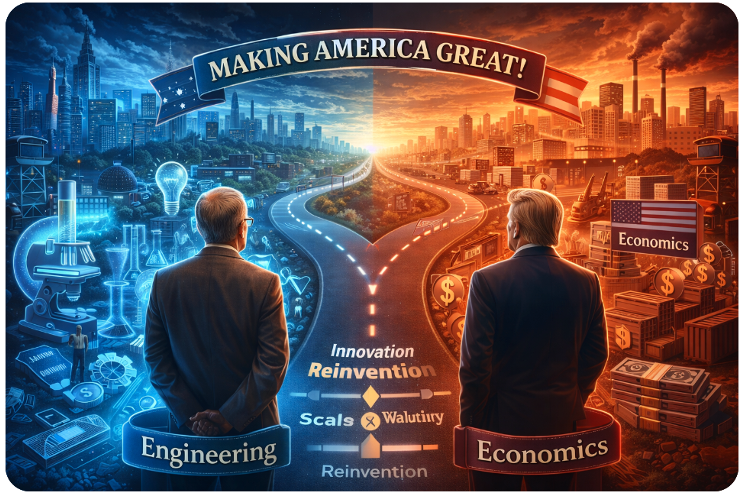
Donald Trump’s “Make America Great Again” agenda is often portrayed as a political eccentricity or a nationalist impulse. In reality, it reflects a deeper intellectual divide about how nations create wealth. That divide is not ideological but epistemological—between two knowledge systems. One, rooted in engineering and innovation, views prosperity as the outcome of continuous reinvention along the innovation lifecycle. The other, rooted in mainstream economics, views prosperity as the result of the efficient allocation of existing resources. America’s rise was driven by the former. Its current struggles stem from the dominance of the latter.
This distinction matters because wealth is not created evenly across time. It is created disproportionately at specific stages of the innovation lifecycle—during invention, early diffusion, scaling, and reinvention. Allocation theories are largely blind to these stages. They optimize within a given structure; they do not explain how the structure itself emerges, evolves, or becomes obsolete.
The Engineer’s Route: Reinvention as the Engine of National Wealth
During World War II, America did not win by allocating resources more efficiently than its adversaries. It won by reinventing warfare itself—through radar, synthetic materials, advanced manufacturing, computing, and nuclear science. President Franklin D. Roosevelt understood that this technological superiority was not accidental; it was the result of deliberate coordination between science, engineering, industry, and the state.
Anticipating the transition to peacetime, Roosevelt asked Dr. Vannevar Bush—an electrical engineer and MIT professor—to define a strategy for sustaining national greatness. Bush’s answer, articulated in Science, the Endless Frontier, was grounded in what we now recognize as innovation lifecycle theory, even if the term did not yet exist. He argued that continuous public investment in science and engineering would repeatedly generate new technologies, new products, and new industries—each initiating a fresh lifecycle of growth.
This approach worked because it targeted the highest-value phases of the lifecycle: invention, early commercialization, and scalable diffusion. The result was not merely economic growth, but structural transformation. Silicon Valley emerged. Entire sectors—semiconductors, aerospace, pharmaceuticals, computing—were born and reborn. American firms dominated global trade not by price competition, but by setting technological frontiers. High wages, global talent attraction, and durable prosperity followed naturally.
In short, America became great by owning the early and renewal phases of innovation lifecycles, where value creation is maximal.
The Economist’s Puzzle: When Growth Defied Allocation
The postwar boom of the 1950s, 1960s, and 1970s stunned economists. Growth accounting models—built on labor and capital accumulation—could not explain what was happening. Robert Solow famously labeled the unexplained surplus “the residual,” later attributing it vaguely to technological progress.
But this was not a minor omission. It revealed a foundational limitation of mainstream economics: it could measure the outcomes of innovation, but not the process. The discipline lacked a theory of how products evolve, how technologies mature, and how reinvention resets competitive advantage. By treating technology as an exogenous factor rather than a lifecycle-driven system, economics reduced innovation to a black box.
As a result, policy advice increasingly gravitated toward what economics does best: allocation under constraints, not reinvention across time.
Reagan and the Turn to Allocation Logic
By the 1980s, America faced competitive pressure from Japan, which had mastered late-stage lifecycle reinvention—process innovation, quality improvement, and manufacturing excellence. Alarmed by the loss of industrial leadership, President Ronald Reagan turned to economists for solutions.
The response followed textbook allocation logic: tariffs, export restraints, subsidies, and coordination mechanisms such as SEMATECH. These measures addressed distribution of existing rents, not the creation of new ones. They improved outcomes within mature lifecycles but failed to launch new Waves of Innovation-led growth.
Japan, meanwhile, continued to outperform by systematically reinventing products at maturity—exactly where American firms tended to exit or stagnate. The problem was not unfair trade; it was asymmetric lifecycle positioning.
Trump as the Logical Outcome of Allocation-Centric Thinking
Donald Trump represents not a break from this tradition, but its culmination. Trained in economics and business, he naturally reached for allocation tools: tariffs, trade wars, coercive bargaining, and resource control. When these failed to restore industrial vitality, escalation followed—toward territorial, resource, and geopolitical leverage.
This trajectory is predictable. Allocation tools cannot create new lifecycles. They can only redistribute value within existing ones. When mature industries fail to generate prosperity, allocation logic pushes policymakers toward zero-sum strategies—protection, extraction, and conflict.
Even more damaging is how efficiency-based resource allocation biases attention toward large-demand but mature industries, where returns are diminishing and innovation potential is low. This leaves the next wave of reinvention—electric mobility, energy systems, advanced materials, AI-driven manufacturing—to countries like China, which explicitly organize policy around lifecycle positioning rather than short-term efficiency.
Why America Is Losing Industries—And Why Economics Can’t Explain It
America’s industrial decline is often blamed on intellectual property theft, cheap labor, or foreign subsidies. These explanations are incomplete. The real cause lies in dynamic efficiency failure—the inability to continuously reinvent products as they move through their lifecycle.
Time and again, American firms have pioneered industries only to lose leadership at maturity, when reinvention becomes critical. Asian firms have excelled precisely at this stage, recombining engineering knowledge, manufacturing innovation, and market feedback to reset the competitive curve. Mainstream economics has no theory for this process—and therefore no policy instruments to address it.
Conclusion: Reinvention, Not Allocation, Makes Nations Great
The contrast between the engineer’s route and the economist’s route could not be clearer. Engineers view prosperity as a function of reinvention across innovation lifecycles. Economists view it as efficient allocation within a static structure. America’s greatest era emerged when the former guided policy. Its current malaise reflects the dominance of the latter.
Until economics integrates innovation lifecycle theory—explicitly modeling how products are invented, scaled, mature, and reinvented—it will remain ill-equipped to guide national greatness in peacetime. And until policymakers rediscover reinvention as the primary source of wealth, “Make America Great Again” will remain a slogan chasing symptoms rather than causes.