THE WAVES
  • Home
  • News
    • Recent Updates
    • Weekly Newsletter
    • Monthly Newsletter
    • Quarterly Newsletter
  • Topics
    • Technology
      • Internet
      • AR/VR & Digital twins
      • Robotics
      • AI & Data Analytics
      • IoT & Wearable
      • Blockchain
      • Computing
      • Sensors & Perception
      • 3D Printing
      • Energy Tech
      • Space
      • Gadgets
    • Transformation
      • Education
      • Health
      • Transportation
      • Farming
      • Energy
      • Security
      • Mining & Blue Economy
      • Food & Living
      • Communication
      • Entertainment
      • Manufacturing
      • Work & Management
      • Public Service
    • Startups
      • Culture
      • Country
      • New Entry
      • Accelerators
      • Incubators
      • Death Valley
      • Investments
      • Exit & IPO
      • Valuation & Financing
      • Idea & IP
    • Education & Research
      • School
      • University
      • Academic Research
      • Corporate Research
      • Public-funded Research
      • Economics of Innovation
      • Growth Economics
      • Training
      • Publications
      • Patents & IP
    • Industrial Revolutions
      • Future of Work
      • Sustainable Development
      • Smart Manufacturing
      • Job Transformation
      • Industry Transformation
      • Competition & Monopoly
      • National Response
      • Education & Skills
      • Social Change
    • Investment & Review
      • Public
      • Corporate
      • Venture Capital
      • Capital Market
      • Philanthropy
      • Personality
    • Inventions
    • Automation
  • Strategy
    • Value Proposition
      • Product
      • Process
      • Sustainability Goals
      • Business Model
      • Complementary
      • Externality
    • Innovation
      • Disruptive Innovation
      • Incremented Innovation
      • Sustaining
      • Schumpeter’s Creative Destruction
      • Redesign for Winning
    • Competition
      • Leading
      • Following
      • Blue Ocean
      • Monopolisation
      • Porter’s Five Forces
      • Business Cycle
    • Intangible Assets
      • Human Capital
      • R&D Management
      • Tripple Helix
      • Intellectual Property
      • Productive Knowledge
      • Technology Managment
    • Competence
      • Organization Agility
      • Innovation Culture
      • Infrastructure
      • R&D facility
      • Great by Choice
      • Build to Last
      • Good to Great
    • Technology Acquisition
      • Scientific discovery
      • Invention
      • Fusion
      • Adaptation & Refinement
      • Licensing
      • Start-up acquisition
  • Policy
    • Technology Development
    • Industry
    • Innovation Diffusion
    • Jobs, Privacy & Security
    • Regulation & Law
    • Sustainability
    • Equity & Inclusiveness
    • Climate Change
    • Environment
  • Opinion
    • Opinion
  • Megatrends
    • Individual Preferences
    • Planet and Society
    • Technology
    • Political Economy
    • Market Power & Monopoly
    • Globalisation
    • Schumpeter’s creative destruction
    • Startups & VC
    • Human Role in Work
    • Value of Natural Resources
    • Patents & Ideas for Redesign
  • Publication
    • Case Studies
    • Magazine
    • Books
    • Reports
    • White Papers
    • Journals
THE WAVES In-depth investigation on Technology, Society, and Policy dynamics for interpreting the past as well as present, and predicting the future so that success rate of pursuing ideas, start-ups, and innovation economy increases.

Technology, Society and Policy

Winning and Losing in Reinvention Race : keeps unfolding: --making America’s innovation bucket leaky, creating prosperity out of reinvention, and turning invention successes transitory
THE WAVES
  • Home
  • News
    • Recent Updates
    • Weekly Newsletter
    • Monthly Newsletter
    • Quarterly Newsletter
  • Topics
    • Technology
      • Internet
      • AR/VR & Digital twins
      • Robotics
      • AI & Data Analytics
      • IoT & Wearable
      • Blockchain
      • Computing
      • Sensors & Perception
      • 3D Printing
      • Energy Tech
      • Space
      • Gadgets
    • Transformation
      • Education
      • Health
      • Transportation
      • Farming
      • Energy
      • Security
      • Mining & Blue Economy
      • Food & Living
      • Communication
      • Entertainment
      • Manufacturing
      • Work & Management
      • Public Service
    • Startups
      • Culture
      • Country
      • New Entry
      • Accelerators
      • Incubators
      • Death Valley
      • Investments
      • Exit & IPO
      • Valuation & Financing
      • Idea & IP
    • Education & Research
      • School
      • University
      • Academic Research
      • Corporate Research
      • Public-funded Research
      • Economics of Innovation
      • Growth Economics
      • Training
      • Publications
      • Patents & IP
    • Industrial Revolutions
      • Future of Work
      • Sustainable Development
      • Smart Manufacturing
      • Job Transformation
      • Industry Transformation
      • Competition & Monopoly
      • National Response
      • Education & Skills
      • Social Change
    • Investment & Review
      • Public
      • Corporate
      • Venture Capital
      • Capital Market
      • Philanthropy
      • Personality
    • Inventions
    • Automation
  • Strategy
    • Value Proposition
      • Product
      • Process
      • Sustainability Goals
      • Business Model
      • Complementary
      • Externality
    • Innovation
      • Disruptive Innovation
      • Incremented Innovation
      • Sustaining
      • Schumpeter’s Creative Destruction
      • Redesign for Winning
    • Competition
      • Leading
      • Following
      • Blue Ocean
      • Monopolisation
      • Porter’s Five Forces
      • Business Cycle
    • Intangible Assets
      • Human Capital
      • R&D Management
      • Tripple Helix
      • Intellectual Property
      • Productive Knowledge
      • Technology Managment
    • Competence
      • Organization Agility
      • Innovation Culture
      • Infrastructure
      • R&D facility
      • Great by Choice
      • Build to Last
      • Good to Great
    • Technology Acquisition
      • Scientific discovery
      • Invention
      • Fusion
      • Adaptation & Refinement
      • Licensing
      • Start-up acquisition
  • Policy
    • Technology Development
    • Industry
    • Innovation Diffusion
    • Jobs, Privacy & Security
    • Regulation & Law
    • Sustainability
    • Equity & Inclusiveness
    • Climate Change
    • Environment
  • Opinion
    • Opinion
  • Megatrends
    • Individual Preferences
    • Planet and Society
    • Technology
    • Political Economy
    • Market Power & Monopoly
    • Globalisation
    • Schumpeter’s creative destruction
    • Startups & VC
    • Human Role in Work
    • Value of Natural Resources
    • Patents & Ideas for Redesign
  • Publication
    • Case Studies
    • Magazine
    • Books
    • Reports
    • White Papers
    • Journals

  • Editor's Pick
  • Future of Work
  • Industrial Revolutions

Future of Work – persistent uncertainty

Future of work will keep evolving due to technology roles in both job creation and automation

  • Md. Rokonuzzaman
  • Created: January 22, 2022
  • Last updated: December 17, 2022
Future of work is uncertain as technology advancement is increasing task supply and making machines increasingly able to human-like roles better

Due to technology, the looming job loss threat is a big concern about the future of work. But does not technology create jobs? How come we have more jobs now than we had centuries ago if it does not? Furthermore, is it not due to technology, unskilled labor force of less developed countries has qualified for factory jobs? Furthermore, is it not due to technology, millions of high-paying jobs are available in Silicon Valley, Bangalore, and many other places?

On the other hand, the deployment of 2.7 million robots in factories has certainly caused job loss. Similarly, Bank of America’s prediction of 3 million jobs loss (during 2021-2022) in India’s export-oriented IT sector is a matter of concern. But there is no denying that India got those jobs due to technology. For sure, technology has been creating and killing jobs—making the future of work uncertain.  Instead of getting upset, we need greater clarity about the role of technology in job creation and loss. Such clarity is vital for understanding the dynamics and predicting the unfolding future. The challenge is to figure out the likely changing roles of humans in work to prepare accordingly.     

In many factories, there has been an increasing number of robots. On average, a single robot can take over jobs from 5 to 7 workers. However, not only blue-collar jobs are susceptible to automation. Robotic process automation (RPA) is taking over cognitive roles from white-collar workers. Unlike physical robots taking over manual roles, software robots are after cognitive functions. According to Bank of America’s prediction, over 2021-2022, 1 million American office workers will lose jobs to RPA. Similarly, in the business process outsourcing industry, 0.7 million Indians will lose jobs due to RPA. Hence, let’s look into the role of technology in job dynamics.

Genesis and characteristics of work:

Whether resting, playing, or working in the factory, human beings are busy continuously meeting their purposes. To get those purposes done increasingly better, they need a growing number of products. Hence, we use far more products than our ancestors had. For example, 200 years ago, there were no Televisions, Telephones, Automobiles, and many other products. Hence, we need to work to gather knowledge and invent technologies. Besides, we need to innovate products, and manufacture and operate them. Such a reality underscores the role of technology in creating jobs.

Nevertheless, we are apprehensive about technology’s role in killing jobs. Well, there is no denying that technology kills jobs. For example, innovators are in the race of redesigning products requiring less human role in making and operating products. That is one of the agenda of making products better.

Furthermore, the core of the agenda in helping customers get jobs done better ends up reducing human roles. Hence, one of the focus areas of product and Process Innovation has been to reduce the human role. Therefore, innovation of more products demands more work. But invariably, it also reduces human functions in serving their purposes. For this reason, technology has a dual role in the demand for work. Our challenge is to shed light on these dual roles for getting clarity about the future of work.    

Types of Work:

Competiting roles of humans and machines in three broad categories make the future of work uncertain

There are various works in serving three primary purposes: (i) gathering and managing data, information, and knowledge, (ii) developing ideas and converting them into inventions and innovation, and (iii) executing production processes in producing copies of innovation, developing customized solutions, and consuming outputs. There are human roles in each of these three areas. For example, scientists have full-time work to gather knowledge. Engineers and technologists are feeding that knowledge to the creative process for inventing technologies and innovating products and processes around them. People are busy in factories, office environments, homes, and the streets operating processes for producing outputs. Furthermore, they are also active in operating products for consumable outputs. There have been millions of paid employments in all these areas worldwide.    

Human roles in work and eligibility of machines:

In all three types of work areas, human beings play a vital role. Human beings can sense, perceive, memorize, reason, decide, and take actions with their eyes, skins, ear, bran, hands, legs, body, heads, and many other organs. Hence, without the assistance of any external tools, human beings are capable of performing many tasks. But there are some limitations. Hence, they are after technology invention and innovation of products and processes to overcome them. They produce copies of innovation and apply them to perform tasks better. Hence, technological advancement has a natural tendency of delegating human roles to machines.
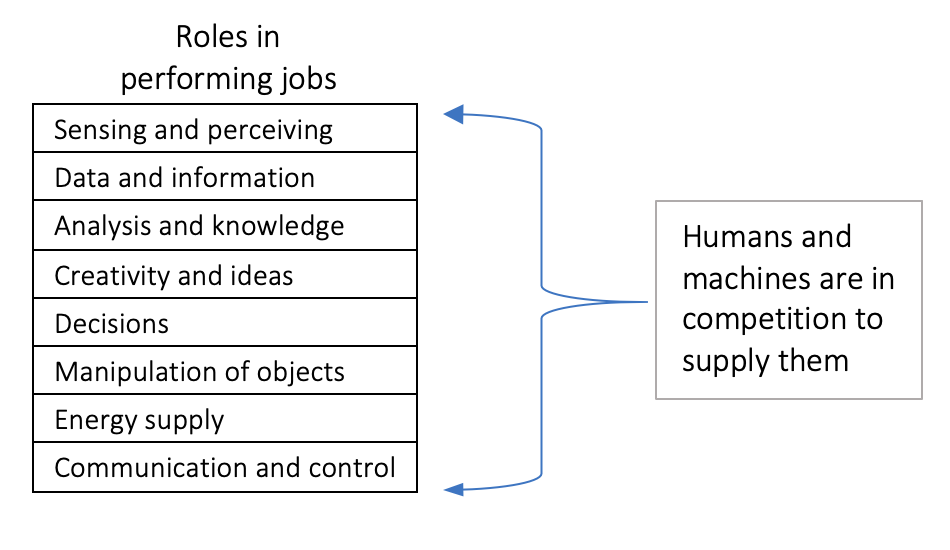
Humans are developing machines to imitate and perform human-like roles even better

For example, stone stools were useful for augmenting hands to manipulate objects and hunt animals. In addition to developing new tools, human beings also have an inherent urge to improve existing ones. Hence, knives replaced stone tools to separate meat from the bone. Progress has been made further in developing automated machines for deboning. Human beings are developing tools or machines and advancing them to delegate roles from humans to devices to improve effectiveness, reduce wastage, and lower costs. Hence, job loss is at the core of the advancement of the human race out of technology. But, does technology progression create jobs?  Yes, it does.         

Job creation and job loss dynamics underpin the future of work:

As we spoke, knowledge gathering, technology invention, innovation of products and processes, replication of products, and also consumption of products create jobs. But they also destroy jobs as human roles are redefined duo to the product and process innovation. Besides, the advancement of products and process also redefine human roles. For example, the improvement of the smartphone by replacing physical keyboards with software one has reduced human function in manufacturing; but it created an additional role of humans in conducting R&D for that innovation. Therefore, we need to look into the whole chain, from knowledge-gathering, innovation, production to consumption, to understand job creation and loss dynamics due to technology advancement.   

Invention, innovation, and Reinvention make the future of work uncertain:

Invention, innovation, and reinvention form our core capability of creating increasing Wealth from depleting resources. But they create and kill jobs. Hence, there has been a constant transformation in jobs—making the future of work uncertain. Although the human role in production has been falling, there has been a growing role in knowledge discovery, technology invention, and innovation of products and processes.

AI, Robotics, and Automation defining the future of work:

Due to technological progress, certain production processes only demand innate abilities for humans to supply, resulting in making the unskilled workforce of less developed countries qualified for manufacturing jobs

Human-like cognitive ability is the target of automation. It takes the form of both software (bots) and hardware machines. Software robots or bots have been taking over humans’ cognitive role in business processes, giving birth to robotic process automation. On the other hand, physical robots also can take over those roles that require humans’ cognitive functions. Hence, robots are no longer after dull, dirty, and dangerous jobs.

Furthermore, the job division and organization of tasks as production lines and the development of machines for automating routine tasks have reduced knowledge and skill requirements. In producing certain products, only innate abilities are left for humans to supply. Such a reality is the underlying cause of making the unskilled labor force of less developed countries eligible for export-oriented manufacturing jobs. But further technology progression runs the risk of automating those abilities. Hence, technology progression has been in a constant move in creating and killing jobs—making future of jobs uncertain.      

...welcome to join us. We are on a mission to develop an enlightened community by sharing the insights of wealth creation out of technology possibilities as reoccuring patters. If you like the article, you may encourage us by sharing it through social media to enlighten others. 
Enlighten others

Subscribe

Subscribe now to our newsletter

You May Also Like

Which Type of R&D Should Be the Focus of Bangladesh and many other less developed countries?
View Post
  • 3 min

Types of Research and Development

Bangladesh can turn its high-tech parks into engines of prosperity by housing R&D wings of local producers
View Post
  • 3 min

Bangladesh’s High-Tech Park Owe: Can Low-Tech Be a Solution?

For producing patentable and licensable outputs, Universities should reverse the conventional research-to-commercialization process
View Post
  • 3 min

Patentable and Licensing-Revenue-Generating Ideas: How to Develop Them?

Leave a Reply Cancel reply

Your email address will not be published. Required fields are marked *

Subscribe

Subscribe now to our newsletter

Principles

  • Economics of Technology
  • Innovation Economics
  • Technology & Innovation Policy

History & Observations

  • Technology History
  • Innovation History
  • Strategy & Policy in retrospect
  • Entrepreneurs & Innovators
  • Startups & Corporations
  • Patents & Publications
  • Design & Redesign Thinking

About Us

  • Who we are
  • What we deliver
  • Genesis
  • Mission
  • Scope
  • Editorial & Advisory Board
THE WAVES
  • Contact
  • Advertise

Input your search keywords and press Enter.