By the end of 2024, Tesla achieved a market valuation of $1.4 trillion, a staggering accomplishment compared to Toyota, the world’s largest and most profitable automaker, valued at $312 billion. Consequently, Elon Musk’s net worth crossed the $400 mark. This rise raises an essential question: what is Elon Musk’s secret recipe for making Tesla more valuable than the combined worth of 29 large automobile manufacturers? The answer lies in a combination of (i) belief cultivation about the possibility of being a monopoly through Disruptive Innovation, (ii) strategic positioning, (iii) a heavy dose of market psychology, and (iv) preferential treatment from the Government.
The Monopoly Narrative: Tesla as the Apple of Automobiles
The first cornerstone of Tesla’s valuation success lies in fostering the belief that Tesla could dominate the global automobile market, relegating traditional automakers to the sidelines due to disruptive innovation success. Musk effectively promoted the notion that electric vehicles (EVs) powered by batteries would entirely replace internal combustion engine (ICE) vehicles, driving legacy automakers like Toyota, Ford, and GM out of business. This narrative was strongly tied to examples from the past: just as Kodak, typewriter manufacturers, and feature phone makers were disrupted, so too would ICE carmakers succumb to EVs.
However, achieving dominance in the automobile market required overcoming a major hurdle: battery technology. EV batteries were initially more expensive and less convenient than ICE engines. Tesla’s reliance on Panasonic for its battery supply posed challenges, as it lacked proprietary control over this critical technology. Yet, Panasonic’s advancements in lithium-ion batteries, spurred by the smartphone industry, improved cost performance and reliability, eventually signaling that EVs could indeed rival ICE vehicles. By 2019, Panasonic’s breakthroughs even won a Nobel Prize, igniting investor confidence that the automobile industry was on the brink of transformation. This belief drove Tesla’s stock price from below $3 in 2013 to $16 by mid-2019 and over $400 by November 2021.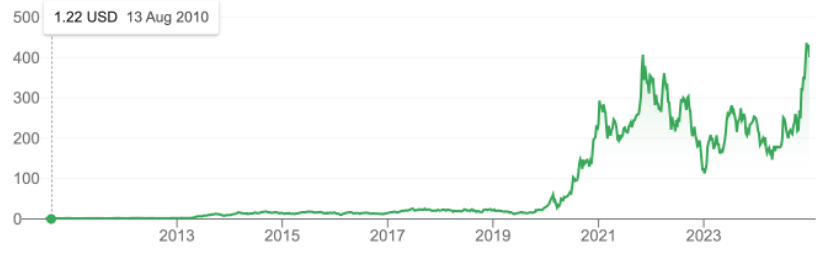
Tesla’s Rise to the Trillion-Dollar Club
Between 2019 and 2021, Tesla’s valuation exploded, crossing the trillion-dollar mark. The company’s stock price skyrocketed from under $20 to over $400 within two years. This growth was fueled by two critical factors:
- Battery Breakthroughs: Panasonic’s lithium-ion batteries reached a point where they made EVs competitive with ICE vehicles in terms of cost and quality, reinforcing the belief in Tesla’s eventual dominance.
- Self-Driving Technology: Tesla’s demonstrations of its Full Self-Driving (FSD) module excited investors about the prospect of autonomous vehicles revolutionizing transportation. Musk’s bold claims about FSD capabilities added fuel to the valuation surge.
Tesla’s perceived technological lead and its ability to position itself as the “next Apple or Microsoft” attracted massive investor interest. The result was an unprecedented valuation trajectory.
The Fall from Grace: What Went Wrong in Tesla Valuation?
By the end of 2022, Tesla’s stock price plummeted from over $400 to approximately $110. This dramatic fall highlighted several vulnerabilities:
- Legacy Automakers Strike Back: Established carmakers like GM, Ford, Toyota, and Volkswagen accelerated their EV transformations, leveraging their manufacturing scale and resources to launch competitive models. Tesla’s lack of proprietary battery technology meant it could not erect barriers to entry.
- FSD Controversies: Tesla’s Full Self-Driving module faced significant scrutiny due to safety issues and faulty behavior, eroding public trust and investor confidence.
- Emerging Competitors: Chinese EV manufacturers like BYD gained momentum, offering high-quality EVs at competitive prices. BYD’s rise further diluted Tesla’s market dominance.
- Battery Maturity: Lithium-ion battery technology began showing signs of reaching maturity, limiting further cost reductions and performance improvements. This diminished the technological edge that Tesla’s valuation had banked on.
These factors collectively burst the bubble of Tesla’s monopoly narrative, leading to a significant correction in its valuation.
The 2024 Resurgence: Political Winds and Optimism
Despite its setbacks, Tesla’s valuation rebounded sharply in 2024, with its stock price soaring over 200% from $147 in April to $479 by December. This recovery can be attributed to two main factors:
- Tariffs on Chinese EVs: The Biden administration’s 100% tariff on Chinese EVs effectively reduced competition from brands like BYD in the U.S. market, giving Tesla a substantial advantage.
- Political Ties: Musk’s close relationship with President-elect Donald Trump sparked optimism about Tesla’s ability to benefit from favorable policies, including potential subsidies and regulatory support. However, a deep division has already started about how to make America great again (MAGA).
While these developments boosted short-term valuation, they were rooted more in external factors than in Tesla’s core competencies.
The Optimus Gambit: A New Multi-Trillion Dollar Market?
To sustain its meteoric valuation and aim for a $25 trillion market cap, Musk has introduced the concept of the Tesla Optimus Humanoid robot. The narrative suggests that Optimus could revolutionize domestic chores and elderly care, creating a multi-trillion-dollar market for humanoid robots. Musk’s promotional strategy draws parallels to the disruptive potential of AI, positioning Tesla as a pioneer in this futuristic domain.
However, skepticism abounds. The current state of robotics technology suggests that achieving the level of functionality and affordability required for mass adoption of humanoid robots is a long way off—worth of drawing lesson from ASIMO and other dead robots. Without breakthroughs in areas like artificial intelligence, dexterity, hands and fingers, and sensing subtle signals, Optimus risks being more hype than reality.
Tesla’s Long-Term Outlook: Unicorn or Unicorpse?
Tesla’s valuation is heavily tied to its ability to innovate and maintain a competitive edge in critical technology cores. However, several challenges threaten its long-term prospects:
- Technology Barriers: Tesla lacks proprietary ownership of key technologies like batteries and autonomous driving systems. Without a strong R&D ecosystem or a robust patent portfolio, it struggles to create insurmountable barriers for competitors.
- Competitor Advances: Legacy automakers and new entrants are rapidly catching up, leveraging their resources to compete effectively in the EV space. On the other hand, legacy automaker Toyota has created a battery edge thorough solid state technology.
- Market Saturation: The maturity of lithium-ion battery technology and the plateauing of self-driving advancements signal that Tesla’s growth opportunities in the automobile sector may be limited.
- Political Risk: While political alliances can provide short-term advantages, they are unlikely to sustain valuation in the absence of technological breakthroughs.
- Unproven Markets: The humanoid robot market is speculative at best. Without clear evidence of demand or technology feasibility, relying on Optimus to justify a $25 trillion valuation appears overly ambitious.
Conclusion: A Valuation Built on Belief
Tesla’s valuation success lies in its ability to sell compelling narratives about the future. By promoting the vision of a world dominated by EVs and autonomous vehicles, Elon Musk captivated investors and the public alike. However, the company’s reliance on external technologies, increasing competition, and lack of sustainable technological advantages cast doubt on its ability to maintain its lofty valuation.
While political factors and ambitious projects like Optimus may drive short-term gains, the long-term sustainability of Tesla’s valuation depends on its ability to achieve genuine technological breakthroughs. Without such advancements, Tesla risks becoming another case study of the deceptive rise of a unicorn that failed to deliver on its promises, transforming into a unicorpse in the annals of business history.
Key Takeaways from Tesla Valuation:
- The Monopoly Narrative Fueled Tesla’s Valuation: Tesla’s early success hinged on promoting the belief that EVs would entirely replace ICE vehicles, leaving Tesla as the dominant global automaker. This narrative drew parallels to past technological disruptions, such as Kodak and feature phones, creating immense investor confidence.
- Battery Technology Was the Catalyst: Panasonic’s advancements in lithium-ion battery technology were critical to Tesla’s rise. By improving cost and performance, these batteries helped make EVs competitive with ICE vehicles, reinforcing the perception of an industry on the verge of transformation.
- Challenges Eroded Tesla’s Dominance: Tesla’s valuation faced significant setbacks as legacy automakers transitioned to EVs, Chinese competitors like BYD emerged, and issues with Tesla’s Full Self-Driving (FSD) system damaged trust. Additionally, the maturity of lithium-ion batteries reduced Tesla’s technological edge.
- Political and External Factors Boosted Recovery: Tesla’s recent valuation surge in 2024 was driven by external factors, including tariffs on Chinese EVs and Elon Musk’s political ties with Donald Trump, rather than intrinsic technological breakthroughs or sustainable competitive advantages.
- Sustainability of Valuation Depends on Innovation: Tesla’s long-term growth faces challenges due to its lack of proprietary technology in critical areas like batteries and autonomous systems. Projects like the Tesla Optimus robot are speculative and highlight the company’s reliance on hype rather than proven innovation to justify its valuation.
Research Questions on Tesla Valuation and Strategy
- What Role Does Investor Perception Play in Tesla’s Market Valuation?
Tesla’s valuation has been significantly influenced by market narratives and investor psychology. How do external perceptions of technological disruption and leadership impact Tesla’s stock price compared to its actual financial performance? - How Sustainable Is Tesla’s Competitive Advantage in the EV Market?
With traditional automakers and new entrants rapidly innovating in EVs, Tesla faces increased competition. What technological, manufacturing, or strategic advantages (if any) can Tesla leverage to sustain its leadership? - What Are the Long-Term Implications of Tesla’s Reliance on External Technology Providers?
Tesla depends on companies like Panasonic, lately CSTL, for battery technology and lacks proprietary dominance in critical areas. How does this dependency affect its ability to innovate and defend its market position? - Can Tesla Realistically Expand into Multi-Trillion Dollar Markets Like Humanoid Robotics?
Tesla’s Optimus humanoid robot is being touted as a transformative product. What technological and market challenges must Tesla overcome to create a viable humanoid robotics market, and how credible is its potential impact on valuation? - How Do Political Factors Influence Tesla’s Short-Term Valuation Gains?
Recent surges in Tesla’s stock price have been tied to U.S. political developments, such as tariffs and Elon Musk’s political ties. What is the long-term impact of such external, non-technological factors on Tesla’s valuation stability?