THE WAVES
  • Home
  • News
    • Recent Updates
    • Weekly Newsletter
    • Monthly Newsletter
    • Quarterly Newsletter
  • Topics
    • Technology
      • Internet
      • AR/VR & Digital twins
      • Robotics
      • AI & Data Analytics
      • IoT & Wearable
      • Blockchain
      • Computing
      • Sensors & Perception
      • 3D Printing
      • Energy Tech
      • Space
      • Gadgets
    • Transformation
      • Education
      • Health
      • Transportation
      • Farming
      • Energy
      • Security
      • Mining & Blue Economy
      • Food & Living
      • Communication
      • Entertainment
      • Manufacturing
      • Work & Management
      • Public Service
    • Startups
      • Culture
      • Country
      • New Entry
      • Accelerators
      • Incubators
      • Death Valley
      • Investments
      • Exit & IPO
      • Valuation & Financing
      • Idea & IP
    • Education & Research
      • School
      • University
      • Academic Research
      • Corporate Research
      • Public-funded Research
      • Economics of Innovation
      • Growth Economics
      • Training
      • Publications
      • Patents & IP
    • Industrial Revolutions
      • Future of Work
      • Sustainable Development
      • Smart Manufacturing
      • Job Transformation
      • Industry Transformation
      • Competition & Monopoly
      • National Response
      • Education & Skills
      • Social Change
    • Investment & Review
      • Public
      • Corporate
      • Venture Capital
      • Capital Market
      • Philanthropy
      • Personality
    • Inventions
    • Automation
  • Strategy
    • Value Proposition
      • Product
      • Process
      • Sustainability Goals
      • Business Model
      • Complementary
      • Externality
    • Innovation
      • Disruptive Innovation
      • Incremented Innovation
      • Sustaining
      • Schumpeter’s Creative Destruction
      • Redesign for Winning
    • Competition
      • Leading
      • Following
      • Blue Ocean
      • Monopolisation
      • Porter’s Five Forces
      • Business Cycle
    • Intangible Assets
      • Human Capital
      • R&D Management
      • Tripple Helix
      • Intellectual Property
      • Productive Knowledge
      • Technology Managment
    • Competence
      • Organization Agility
      • Innovation Culture
      • Infrastructure
      • R&D facility
      • Great by Choice
      • Build to Last
      • Good to Great
    • Technology Acquisition
      • Scientific discovery
      • Invention
      • Fusion
      • Adaptation & Refinement
      • Licensing
      • Start-up acquisition
  • Policy
    • Technology Development
    • Industry
    • Innovation Diffusion
    • Jobs, Privacy & Security
    • Regulation & Law
    • Sustainability
    • Equity & Inclusiveness
    • Climate Change
    • Environment
  • Opinion
    • Opinion
  • Megatrends
    • Individual Preferences
    • Planet and Society
    • Technology
    • Political Economy
    • Market Power & Monopoly
    • Globalisation
    • Schumpeter’s creative destruction
    • Startups & VC
    • Human Role in Work
    • Value of Natural Resources
    • Patents & Ideas for Redesign
  • Publication
    • Case Studies
    • Magazine
    • Books
    • Reports
    • White Papers
    • Journals
THE WAVES In-depth investigation on Technology, Society, and Policy dynamics for interpreting the past as well as present, and predicting the future so that success rate of pursuing ideas, start-ups, and innovation economy increases.

Technology, Society and Policy

Winning and Losing in Reinvention Race : keeps unfolding: --making America’s innovation bucket leaky, creating prosperity out of reinvention, and turning invention successes transitory
THE WAVES
  • Home
  • News
    • Recent Updates
    • Weekly Newsletter
    • Monthly Newsletter
    • Quarterly Newsletter
  • Topics
    • Technology
      • Internet
      • AR/VR & Digital twins
      • Robotics
      • AI & Data Analytics
      • IoT & Wearable
      • Blockchain
      • Computing
      • Sensors & Perception
      • 3D Printing
      • Energy Tech
      • Space
      • Gadgets
    • Transformation
      • Education
      • Health
      • Transportation
      • Farming
      • Energy
      • Security
      • Mining & Blue Economy
      • Food & Living
      • Communication
      • Entertainment
      • Manufacturing
      • Work & Management
      • Public Service
    • Startups
      • Culture
      • Country
      • New Entry
      • Accelerators
      • Incubators
      • Death Valley
      • Investments
      • Exit & IPO
      • Valuation & Financing
      • Idea & IP
    • Education & Research
      • School
      • University
      • Academic Research
      • Corporate Research
      • Public-funded Research
      • Economics of Innovation
      • Growth Economics
      • Training
      • Publications
      • Patents & IP
    • Industrial Revolutions
      • Future of Work
      • Sustainable Development
      • Smart Manufacturing
      • Job Transformation
      • Industry Transformation
      • Competition & Monopoly
      • National Response
      • Education & Skills
      • Social Change
    • Investment & Review
      • Public
      • Corporate
      • Venture Capital
      • Capital Market
      • Philanthropy
      • Personality
    • Inventions
    • Automation
  • Strategy
    • Value Proposition
      • Product
      • Process
      • Sustainability Goals
      • Business Model
      • Complementary
      • Externality
    • Innovation
      • Disruptive Innovation
      • Incremented Innovation
      • Sustaining
      • Schumpeter’s Creative Destruction
      • Redesign for Winning
    • Competition
      • Leading
      • Following
      • Blue Ocean
      • Monopolisation
      • Porter’s Five Forces
      • Business Cycle
    • Intangible Assets
      • Human Capital
      • R&D Management
      • Tripple Helix
      • Intellectual Property
      • Productive Knowledge
      • Technology Managment
    • Competence
      • Organization Agility
      • Innovation Culture
      • Infrastructure
      • R&D facility
      • Great by Choice
      • Build to Last
      • Good to Great
    • Technology Acquisition
      • Scientific discovery
      • Invention
      • Fusion
      • Adaptation & Refinement
      • Licensing
      • Start-up acquisition
  • Policy
    • Technology Development
    • Industry
    • Innovation Diffusion
    • Jobs, Privacy & Security
    • Regulation & Law
    • Sustainability
    • Equity & Inclusiveness
    • Climate Change
    • Environment
  • Opinion
    • Opinion
  • Megatrends
    • Individual Preferences
    • Planet and Society
    • Technology
    • Political Economy
    • Market Power & Monopoly
    • Globalisation
    • Schumpeter’s creative destruction
    • Startups & VC
    • Human Role in Work
    • Value of Natural Resources
    • Patents & Ideas for Redesign
  • Publication
    • Case Studies
    • Magazine
    • Books
    • Reports
    • White Papers
    • Journals

  • Editor's Pick
  • Growth Economics

Innovation for Growth—too important to be left with hype spreading innovators

Focus has shifted from refining innovation to inflating valuation through spreading disruptive innovation narratives

  • Md. Rokonuzzaman
  • Created: November 22, 2025
  • Last updated: November 28, 2025
Innovation for Growth agenda should be released from the grip of inflating valuation by spreading hypes of disruptive innovation narratives

Innovation is about ideas that enable Jobs to be done better by consuming fewer resources. It has been at the core of improving our living standards. Innovation is the fuel for the rise and fall of high-performing firms. In an aggregate form, innovation is the driver of economic growth, the rise of a nation, and the uplifting of the whole human race. Hence, innovation for growth has been a primary development agenda. But should it be left to innovators only?

Historically, innovators have been hailed for their creativity, great ideas, and fine-tuning their crafts to offer better alternatives in Getting jobs done. However, that has not been the reality for some time.  From the dawn of the 21st century, we have been witnessing an astronomical rise in venture capital funding, as the Startups drive waves of Creative Destruction through digitization, AI, and robotics. This is accompanied by a massive subsidy-led push of primitive alternatives for inflating the valuation of loss-making firms. Is it good for society? Should policies and regulations intervene?

There has been a commonality among Uber, Tesla, OpenAI, and many other innovation poster children. Upon witnessing unfulfilled innovation promises, the influx of massive venture capital fund, and the astronomical rise of market capitalization, should we say innovation is to be left to innovators only?

Suffering from Rational Policy Justification

There could be an argument that such intervention runs the risk of throttling innovation. Besides, private firms offer a bulk of risk capital in pursuing innovation. For example, in Singapore, the USA, and South Korea, as high as 60%, 72% and 78% application-level R&D funding comes from private firms, respectively. Does it mean that the Government has no say in how it plays the game of inflating the valuation of firms pursuing innovation?

To facilitate innovation, society has been investing in preparing the ground. It also provides direct incentives. For example, every government of major countries in the world invests somewhere between 2% and 4% of its GDP in education to supply the human capital necessary for innovation. For basic research, universities receive funding from public sources. Additionally, the government offers patent rights and ensures private appropriation of returns to profit through labor and contract law. Governments also subsidize private R&D through grants, tax credits, and other policies.  

Innovation for Growth through Creative Destruction

Creative destruction through the Reinvention of existing mature products is at the core of Wealth creation and economic growth. Due to its immense importance, the Nobel Prize was awarded for the theorization attempt in 2025.

Despite their power, irrespective of the greatness, all innovations reach saturation, limiting the diffusion and benefits we derive from using them. Inevitably, economic growth slows down, demanding reinvention for a new wave of growth. Hence, the creative destruction wave out of reinvention has been our primary means of driving economic growth. However, due to a lack of theorization, the process of unfolding a new wave of development remains a mystery. Therefore, it has been left to the magical creativity and entrepreneurship tactics of the innovators.

Besides economic growth, creative destruction has been at the core of the fall of high-performing firms. Due to the rapid decline in demand for mature products, high-performing firms suffer from a loss of demand, revenue, and profit. As a result, once a high-value asset becomes worthless, it leads to a collapse in the stock prices of these companies. On the contrary, often new entrants, firms driving creative destruction, succeed in enjoying high growth in demand, revenue, and profit, leading to a rapid appreciation of their stock price. Therefore, a fear factor has been holding back the stock of incumbent innovation leaders, and there is a sense of missing the big opportunity for capital gain from owning stock of firms that pursue creative destruction. Prof. Clayton popularized the concept as “Disruptive innovation.” As a result, business school graduates became interested in taking advantage of this narrative.

Disruptive Innovation Narrative for Inflating Valuation—risk of undelivered promises

Among Edison, Tesla, Steve Jobs, Bill Gates, Tanaka, and many founders of Silicon Valley firms, there had been a common trait. They were creative individuals with an internal passion for refining ideas and offering better alternatives to help people get their jobs done.  Historically, innovations have been led by technologically capable creative minds. However, the proliferation of the disruptive innovation narrative diffused the frightening effect of the Kodak moment and the rapid rise in the valuation of startups. Hence, business school graduates found it an opportunity to create and sell disruptive innovation narratives, which would fuel the valuation of firms or startups pursuing reinvention.

Notably, at the dawn of the 21st century, digitization, connectivity, and smartphones opened up the opportunity to reinvent a range of services. Similarly, the advancement of battery technology, sensors, and machine learning has opened up the opportunity to reinvent physical products, such as automobiles. Hence, venture capital funds led by business school graduates grabbed them to cook disruptive innovation narratives. Unfortunately, unlike in the past, instead of refining through humble investment, empathy and Passion for Perfection, they focused on pushing primitive emergence through massive subsidies. As a result, they succeeded in creating hype and inflating the valuation of loss-making firms. The underlying thesis has been that one can get rich by spreading fear and highlighting sense of missing the opportunity of unfolding waves of creative destruction.

Unfortunately, despite pumping in huge VC funds and even receiving Government subsidies, although valuations got inflated and many people became billionaires by owning stock in loss-making firms, most creative destruction waves are yet to unfold.  For example, Uber is far from revolutionizing car ownership. Similarly, although Elon Musk became the wealthiest person by promoting EV reinvention narrative, Tesla has been walking away from being an EV disruptor.

Valuation Race Cripples Innovation for Growth Agenda

As explained, unlike in the past, rather than fine-tuning technologies for unfolding creative destruction waves, the VC fund manager-led innovation agenda has been focused on inflating valuations. As a result, although trillions have been spent on infrastructure and subsidies to promote half-baked innovations, and many people have become billionaires due to stock price appreciation, society has yet to receive better alternatives. Hence, EVs are not yet superior, autonomous vehicles are yet to make roads safer, and many other disruptive innovation narratives are yet to deliver on their promises. Hence, it’s not unfair to say that VC fund managers and so-called innovators have hijacked the innovation agenda to enrich themselves through spreading hype, rather than delivering innovation.

There is no doubt that it must stop. However, despite receiving the Nobel Prize in Economics in 2025, the creative destruction theory is not robust enough to support rational policy and regulatory intervention. On the other hand, due to innovation asymmetry, economists are not in a position to make innovation theory sufficiently sound to improve the situation. Hence, there has been an urgency to improve the theorization of innovation for releasing innovations from the quick money-making agenda of hype-spreading innovators, so that society can leverage innovation for growth in a predictable manner.  
Enlighten others

Subscribe

Subscribe now to our newsletter

You May Also Like

Which Type of R&D Should Be the Focus of Bangladesh and many other less developed countries?
View Post
  • 3 min

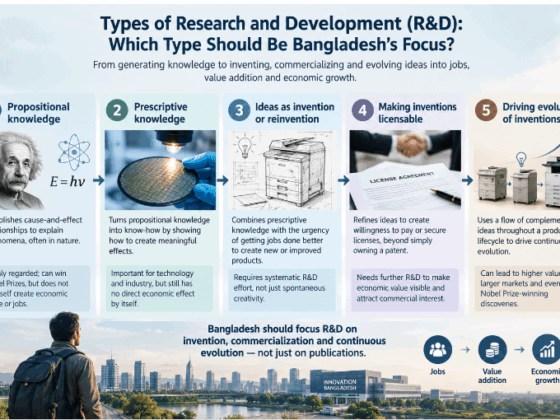
Types of Research and Development

Bangladesh can turn its high-tech parks into engines of prosperity by housing R&D wings of local producers
View Post
  • 3 min

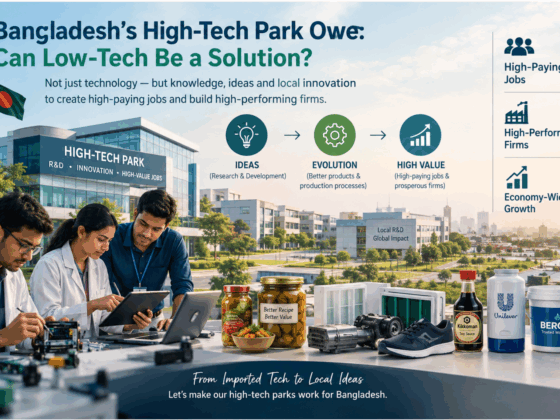
Bangladesh’s High-Tech Park Owe: Can Low-Tech Be a Solution?

Bangladesh's complex development problem could be solved by driving the evolution of products and production processes through engaging local graduates in R&D
View Post
  • 3 min

Bangladesh Suffers from a Very Complex Problem: Is There a Simple Solution?

Leave a Reply Cancel reply

Your email address will not be published. Required fields are marked *

Subscribe

Subscribe now to our newsletter

Principles

  • Economics of Technology
  • Innovation Economics
  • Technology & Innovation Policy

History & Observations

  • Technology History
  • Innovation History
  • Strategy & Policy in retrospect
  • Entrepreneurs & Innovators
  • Startups & Corporations
  • Patents & Publications
  • Design & Redesign Thinking

About Us

  • Who we are
  • What we deliver
  • Genesis
  • Mission
  • Scope
  • Editorial & Advisory Board
THE WAVES
  • Contact
  • Advertise

Input your search keywords and press Enter.