In the pursuit of identifying the intellectual origins of modern economic growth, Nobel laureate Joel Mokyr has drawn sustained attention to the role of useful scientific knowledge—knowledge that is not merely abstract, but economically meaningful. Unfortunately, he could not theorise the mechanics of growth necessitating the flow of economically meaningful scientific knowledge. As a result, policymakers are left in a blind spot when it comes to guiding growth.
Mokyr argues that the sustained economic growth beginning in the early nineteenth century, commonly described as the Industrial Revolution, was rooted in the systematic generation, accumulation, and application of such knowledge. Unlike earlier episodes of growth, this transformation was not driven by chance discoveries or isolated inventions, but by a growing capacity to translate scientific understanding into productive technologies.
Yet Mokyr was careful to note that access to knowledge alone was insufficient. Technological innovations, institutional reforms, and new ideas did not instantly transform aggregate economic outcomes. Instead, they had to diffuse across regions, industries, and national borders; they had to be tested, adapted, refined, and recombined. Innovators needed to challenge entrenched interests, persuade skeptics, and reassure those who feared disruption to the evolution and diffusion. This process unfolded gradually, not as a sudden rupture or social convulsion akin to the French Revolution, but as a slow, cumulative transformation.
While Mokyr convincingly established the importance of useful knowledge and its diffusion, his framework left an important question insufficiently resolved: what are the underlying mechanics through which scientific knowledge unfolds into long waves of economic growth? Why do some technological revolutions sustain momentum while others stagnate? And why do conventional economic tools struggle to identify the beginnings—or guide the direction—of such transformations?
One clue lies in the limits of economic data itself. Standard economic indicators failed to detect the onset of the Industrial Revolution in real time. Growth statistics, productivity measures, and national accounts largely became meaningful only after the transformation was well underway. As a result, data-centric economic analysis excels at explaining the past but struggles to anticipate or guide emergent industrial revolutions. Policies grounded primarily in historical data tend to focus on efficient allocation within existing structures, rather than on enabling structural Reinvention.
Consequently, nations and firms receive little guidance from orthodox, data-driven economics when attempting to pursue long-wave economic growth. Such frameworks are ill-suited for moments when growth depends not on optimizing known activities, but on nurturing immature technologies whose economic potential has yet to be realized or measured.
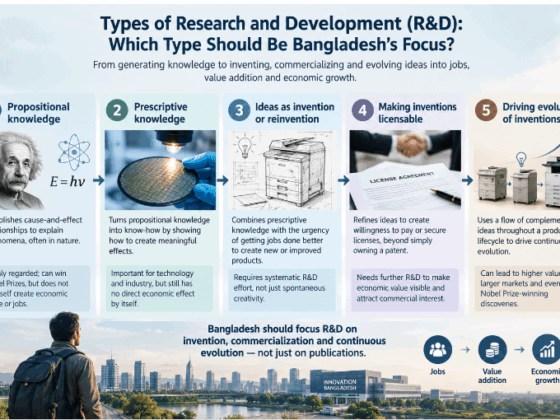
This limitation can be overcome by reframing economic growth through the lens of product and production-process lifecycles—their emergence, diffusion, maturity, saturation, and eventual reinvention—and by explicitly integrating the role of scientific knowledge in driving these transitions. Regardless of the initial brilliance of an invention, its contribution to economic growth depends on its capacity to evolve: to become more reliable, more affordable, and more effective at accomplishing real-world tasks. This evolutionary process requires a continuous influx of knowledge.
The first Industrial Revolution provides a powerful illustration. The Baconian program of the seventeenth century—emphasizing inductive reasoning, systematic experimentation, and the practical use of knowledge—laid the intellectual groundwork for this transformation. Contributions from figures such as Galileo, Descartes, and Newton did not immediately translate into factories or machines. Instead, they reshaped the epistemic culture of Europe, legitimizing the idea that nature could be understood, manipulated, and improved upon through disciplined inquiry. Over time, this steady flow of economically useful knowledge enabled pivotal technological breakthroughs in mechanics, materials, and energy use, allowing the first Industrial Revolution to unfold.
However, inventions—much like living organisms—follow lifecycle trajectories. As mechanical technologies matured in the nineteenth century, their rates of improvement slowed. Incremental refinements yielded diminishing returns, and by the late nineteenth century, growth driven by the original engines of the first Industrial Revolution began to decelerate. This slowdown did not signal the exhaustion of growth itself, but rather the saturation of a particular technological paradigm.
Renewed growth emerged only when scientific inquiry penetrated a deeper layer of reality. Advances in electrical science and engineering enabled the reinvention of mature mechanical technologies, giving rise to the second Industrial Revolution. Electricity did not merely add new products; it transformed products and production processes, organizational forms, and spatial arrangements of industry. Factories, transportation systems, and communication networks were reimagined, restoring momentum to economic growth.
A similar pattern repeated in the twentieth century. As electrical and electromechanical systems approached maturity, further gains required insights from quantum science and advanced mechanics. These scientific breakthroughs powered the third Industrial Revolution, marked by semiconductors, computing, and information technologies. Again, growth was not the result of simple diffusion of existing inventions, but of reinvention enabled by deeper scientific understanding.
Today, the continued application of quantum science—combined with rapid advances in computational intelligence—signals the emergence of a Fourth Industrial Revolution. Artificial intelligence, advanced materials, biotechnology, and quantum computing are not merely extensions of existing industries; they represent potential reinventions of production, decision-making, and value creation itself. Yet their economic impact remains uneven and uncertain, precisely because they are still traversing early lifecycle stages that elude conventional measurement.
The failure to incorporate lifecycle dynamics, diffusion patterns, reinvention mechanisms, and the foundational role of science constitutes a major limitation of prevailing economic growth theories. By focusing primarily on equilibrium, incentives, and allocation, mainstream economics underestimates the importance of capability building—the cumulative development of scientific, technological, and organizational competence required to sustain long-term growth.
As a result, current economic theories offer limited guidance for societies seeking to leverage advances in science, technology, and engineering. They explain growth after it occurs, but do little to illuminate how new growth trajectories can be deliberately cultivated. A more complete theory of economic growth must therefore move beyond data-centric retrospection and embrace the dynamic interplay between scientific discovery, technological lifecycles, diffusion, and reinvention — forming the growth mechanics of the long wave.
Only by understanding these underlying mechanics can nations and firms hope to navigate industrial revolutions not as passive observers, but as active architects of sustained prosperity.
Key Messges:
Economic growth is not triggered by data, but by capability. Statistics explain growth after it happens; they cannot ignite or steer an industrial revolution in real time.
Scientific knowledge matters only when it evolves into better, cheaper, and scalable solutions. Invention alone does not drive growth—continuous reinvention does.
Industrial revolutions unfold through lifecycles, not shocks. Diffusion, maturation, saturation, and renewal determine long-wave growth, not sudden breakthroughs.
When technologies mature, growth slows—unless deeper science enables reinvention. Every major growth wave has been revived by breakthroughs at a more fundamental scientific level.
Mainstream economics misreads growth by focusing on allocation instead of reinvention. Sustainable prosperity depends on nurturing scientific and technological capabilities, not optimizing yesterday’s industries.