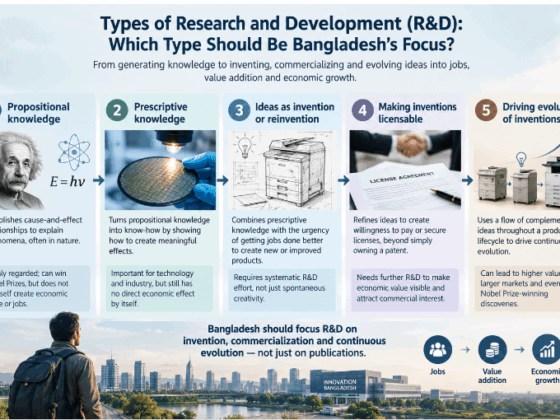
Over the last few hundred years, the world’s per capita income and population have been growing simultaneously. But our natural resource stock is limited. In some instances, it has been diminishing. What is the underlying reason for this growing prosperity? The apparent answer: ideas. Due to the growing Flow of Ideas, we have been deriving increasing value from the same amount of inputs, whether raw materials, labor, energy, etc. Will this journey continue, offering us endless prosperity? The answer appears to be Yes. The obvious question: Why?
Due to four primary reasons, the human race will keep driving prosperity out of ideas. First, unlike other living creatures, human beings are not content with how they get their jobs done. They are after finding better means. They have been after better quality, less cost, and faster delivery. The next one is about the endless scope of gathering knowledge about creation and human desire. The 3rd reason has been human creativity does not stop producing better ideas by processing newly discovered knowledge to meet the endless desire. Due to the profit-making opportunity in pursuing ideas for offering higher quality at less cost and faster speed, competition will keep chasing ideas; this is the fourth reason. Hence, it’s highly likely that the human race will collectivity and keep enjoying increasing prosperity from the endless flow of ideas. Such a possibility will likely turn the notion that “sustainable development” is an oxymoron wrong.
Genesis of Ideas
An idea arises in a reflexive, spontaneous manner, even without thinking or serious reflection. It is a thought or suggestion for a possible course of action. To address the urgency, whether how to quench thrust or improve microchip Transistor density, human beings gather knowledge and feed it to the creative process to generate ideas. Those ideas are for finding better alternatives to Getting jobs done. From our day-to-day activity to pursuing big missions like building autonomous vehicles, human beings have been on a relentless journey of generating ideas.
Although Innovation or creativity is perceived as the job of genius, interestingly, every human being is an idea producer. Every day, we produce ideas to reorganize, transform, and rearrange artifacts around us to meet the urgency most effectively and efficiently. Surprisingly, we do not pay much attention to such idea production capability. It appears natural for humans to gather knowledge and generate ideas to get the jobs done.
The disparity in deriving prosperity from ideas
Every human being is an idea producer. Despite it, not all individuals, firms, or nations equally succeed in driving prosperity out of ideas. What could be the underlying reason?
First of all, individual ideas do not carry much capability to produce economic value. Even ideas of producing light from electricity, automobile, or transistors did not start creating a flow of monetary value, let alone unfolding endless prosperity. Invariably, they emerge in primitive form. Ironically, in the beginning, unlike ideas we pursue to address day-to-day jobs, more or less, all the great ideas did not produce economic value. For sure, neither Edison, Wright Brothers, nor Shockley was able to generate profitable revenue from their great ideas. But unlike numerous other ideas we have been producing daily, great ideas are amenable to progression by adding a flow of ideas. This flow is vital in deriving endless prosperity from ideas. Unfortunately, not all individuals, firms, or nations are equally capable of producing those scalable ideas, detecting them, and scaling them through a systematic flow of complementary ideas. Hence, despite having the inherent ability to create ideas, not every human, firm, and nation equally benefits from them. Therefore, there is a need for systematic idea management to increase the Wealth creation capability from ideas consistently.
Power of Ideas–influences the value creation of other factors
Ideas are not powerful only for their virtues of economic value creation. Most importantly, they positively and negatively affect the value-creation abilities of other factors, including existing ideas. Their growth transforms the market of products, reforms industries, kills and creates jobs, and changes the demand for raw materials—leading to wealth accumulation and annihilation (extinction). Hence, if you do not pursue new ideas, such reality demands continuous monitoring and assessing of ideas followed by others; otherwise, individuals, firms, and nations may find their current prosperity to disappear due to the prosperity created by others with their ideas.
For example, Kodak enjoyed a stable high-margin business of imaging films, chemicals, machinery, and cameras. Similarly, Intel was enjoying the success of making microprocessors for PCs, and Nokia was enjoying impressive keyboard-centric smartphones. But soon after, they found their prosperity to disappear, causing job loss and evaporation of shareholders’ equity value. On the other hand, thousands of oil lamp makers lost their jobs due to the rise of the electric light bulb idea. What was the underlying reason? Did they show negligence in pursuing their great ideas, which brought them fortunes? Unfortunately, No.
Kodak lost its prosperity of inventing and nurturing the idea of imaging through films due to the rise of the electronic image sensor. Similarly, Intel has been losing its fortune in inventing and growing microprocessors for personal computers due to the increase in 3rd party foundry models and smartphones. On the other hand, Nokia lost its apparent unsinkable wealth creation platform due to the rise of Apple’s multitouch-based iPhone.
For sure, the invention of the automobile idea by Carl Benz and its continued progression have made middle eastern countries rich. But the rise of electric vehicles and renewable energy idea will destroy it. On the other hand, Bangladesh and many other less developed countries have been enjoying the demand for low skilled manufacturing workforce created by the idea of production process and automation. Unfortunately, further advancement of that idea will likely evaporate that fortune.
Must add up to create a cumulative effect
Creative genius’ capability of randomly producing great ideas is not good enough. Irrespective of the greatness of ideas, not a single idea produces little or no value. Of course, in some cases, they may create excitement, but that is not enough to create economic value—neither for producers nor for consumers. For example, Edison’s idea of recording and reproducing sound created excitement. Unfortunately, that single idea did not create a profitable willingness to pay among exited individuals. Hence, Edison left the idea on the shelf for over a decade. But that idea has been growing over the last 100 years, creating a big business and making more or less every one customer of it.
Ideas must keep adding up, forming a stream. Otherwise, they fail to create a flow of wealth. For this reason, despite their efficacy, most of the grassroots ideas have been failing to generate prosperity for the idea producers and consumers alike. Hence, ideas like making water sprinkle by perforating discarded plastic bottles are helpful at the birth but unsuitable for increasing benefits, creating jobs, and building businesses. On the other hand, despite the primitive start, ideas of automobiles, mobile phones, computers, airplanes, digital cameras, and many more have been growing, unfolding increasing prosperity. The underlying reason has been creating a flow of ideas for generating g cumulative effect.
Creative sparks in producing great ideas are not good enough
Often, great genius keeps generating, demonstrating, and patenting ideas. Despite creating excitement, due to randomness, such inventions do not bring economic benefit to the inventors or potential consumers. For this reason, many inventors remained poor, despite their splendid creativity. Hence, creating in producing ideas randomly is not good enough.
Life cycle
Most ideas get birth, used, and forgotten shortly after. Perhaps, billions of them are generated every day. Their practice remains limited within the idea producer or among a small group. In most cases, complementary ideas are not produced to keep them growing. But, in rare cases, a flow of ideas is developed to keep unleashing the latent potential of growth of great ideas. Due to the cumulative role of complementary ideas, ideas like LCD, automobiles, washing machines, television, and many more have been unfolding, increasing prosperity.
But all ideas are not equally scalable. Furthermore, producing a flow of complementary ideas for creating a cumulative effect demands a flow of knowledge discovery. Often, idea producers run out of knowledge flow and urgency in generating a flow of ideas. Hence, the urgency out of a Passion for Perfection, empathy, and profit-making is vital. But it should be empowered with the flow of knowledge, demanding a scientific approach. If urgency and knowledge flow keep unfolding, ideas keep emerging. But the growth rate progresses towards saturation. As a result, great ideas have an S-curve-like life cycle.
At the saturation of great ideas, wealth creation slows down. Hence, idea producers find and pursue alternative idea cores to replace the matured ones. For example, the electronic image sensor idea is an alternative to film to capture images. Similarly, electric motors and batteries are alternatives to internal combustion engines and liquid petroleum. Hence, at maturity, great ideas experience Reinvention, forming a new wave of growth. As a result, great ideas keep progressing in an episodic form, creating endless prosperity.
Ideas are not good enough for endless prosperity
Of course, ideas are our source of endless Utility creation. We have created billions of them every day. But their abilities to contribute to helping us get jobs done better widely vary, from as little as 1 cent to trillions of dollars. For example, the economic value of using discarded plastic bottles as water sprinklers may not be much. But the financial contribution of the idea of transistors or internal combustion engines is trillions of dollars.
The level of economic value creation does not depend only on creativity. The urgency of finding better alternatives, supplying knowledge, and systematically generating ideas for creating cumulative effects are vital. Without it, most individuals, firms, and nations are depriving themselves of benefiting from ideas. Furthermore, the ideas of others tend to destroy incumbents’ prosperity. Hence, it’s vital to pay attention to idea dynamics and profit from them to enjoy endless prosperity.
Relative articles:
Empathy Skills – for systematic ideation
Innovation Theory for Systematic Ferreting
Taiwan Semiconductor Industry–the rise of global monopoly from a virtuous cycle