Unlike Apple’s strategy, Tesla’s Innovation success is often measured by the skyrocketing valuation or the rise of its stock price. As an electric vehicle (EV) innovator, Tesla surfaced as an iconic innovation success, making its CEO, Elon Musk, the wealthiest person in the world. Besides, Tesla is the first automobile company to have a valuation exceeding $1 trillion. On the other hand, although Chinese BYD has surpassed Tesla in electric vehicle sales, BYD’s market capitalization is less than one-tenth that of Tesla. Furthermore, although Tesla generated little profit and offered no dividend to its shareholders, its market capitalization is significantly higher than that of the top five automobile makers combined. Even Toyota’s, whose EV strategy appears to be smarter, $263 billion market capitalization is far less than Tesla $1.33 trillion (as of November 19, 2025). Such a reality raises a vital question: what is Tesla’s innovation strategy? How has it achieved such a high market valuation? Should be a role model for others to follow?
Although Tesla expanded into the energy storage and solar markets, the rise in Tesla’s valuation has been primarily driven by its EV innovation. In 2003, Martin Eberhard and Marc Tarpenning founded Tesla to build high-performance electric vehicles. Soon after, in February 2004, Elon Musk became the lead investor and chairman of the company. He became the CEO in 2008. By the way, before Tesla, many companies pursued EVs. Notably, General Motors introduced the EV1 in 1996. Despite favorable customer reception, GM terminated its production in 1999 due to the belief that electric cars occupied an unprofitable niche of the automobile market. Surprisingly, as a latecomer, Tesla has become a success in raising stock price, creating interest in its innovative strategy.
Tesla Journey of EV Innovation
Tesla was not only a latecomer, but it also relied on a third-party supplier for its core technology, the battery. Unlike many other high-performing Startups, it did not begin its journey with a great idea or a proprietary technology core. Tesla’s initial prototype EV was powered by connecting several laptop computer batteries. Although Tesla used a specific design of battery pack for its commercial rollout, it relied on an outside supplier—Panasonic. After 5 years of development, Tesla rolled out its first EV– the Roadster– in 2008. Mass-market models like the Model S and Model 3 were released in 2012 and 2017, respectively. Did the launch of these models reflect Tesla’s innovation strategy, generating profitable revenue and contributing to its status as a trillion-dollar company? Perhaps, no.
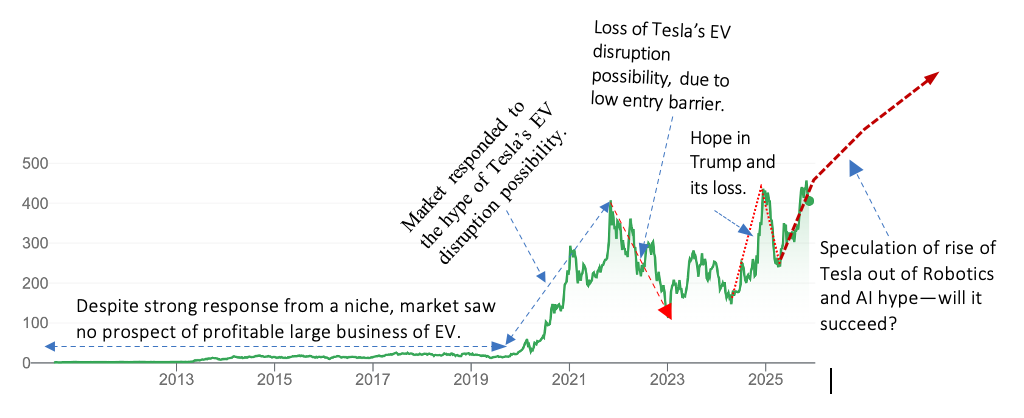
In 2010, Tesla conducted its initial public offering. It was not an instant hit. The market neither detected nor responded to its innovation performance. Unlike Apple, Tesla could not capture the interest of investors due to its innovation edge in the EV sector. Even after the release of Model S, its stock price managed to cross $2. More surprisingly, between 2014 and 2019, Tesla’s stock price remained flat. To the surprise of many, Tesla’s stock price started ramping up in 2019. Within two years, it rose from $16 to over $400—turning Tesla into an iconic innovation success. The question is: why did it happen like this, and is it a reflection of Tesla’s innovation strategy?
Tesla’s Innovation Strategy Left Core Technology to Outsiders
An electric vehicle is a Reinvention of gasoline-powered automobiles, due to the change in the core technology of the internal combustion engine to an electric one, comprising batteries, motors, and electronics. It promised to fuel a creative wave of destruction, unleashing Disruptive innovation by a new entrant on incumbent innovation leaders. However, to make it happen, the electric technology core had to cross the threshold set by gasoline automobiles. Hence, the market was waiting for the tipping point to be reached.
Tesla’s innovation success, reflected in its stock price, depended on the rise of the electric vehicle, notably the battery, both in terms of performance improvement and cost reduction. Unlike many other innovators, Tesla benefited from the success of innovations by third parties. It’s due to Panasonic’s, followed by CATL, contribution in improving the battery packs that power Tesla’s EVs. The EV wave showed signs of reaching the tipping point in 2019. Besides media coverage, the awarding of the Nobel Prize to advancements in lithium-ion batteries and Elon Musk’s hype claims, a belief began to surface that Tesla would likely emerge as the EV disruptor. Consequently, Tesla’s stock began to ramp up, raising questions about Tesla’s innovation strategy.
Tesla’s Innovation Strategy Suffered from a Lack of Proprietary Technology Competence
Unfortunately, Tesla’s stock did not sustain at the high level reached in November 2021. Within two years, it fell to nearly one-fourth of its peak in December 2023. Such a reality raised a question: What happened to Tesla’s innovation strategy? Two forces started showing the hollowness. First of all, the battery technology core began showing signs of Premature Saturation. The next point is that, as Tesla relied on third-party innovators, such as Panasonic and CATL, for this critical technology core, competition faced little barrier to respond and join the EV race.
Upon sensing the signs of losing the battle to be an EV disruptor, its CEO, Elon Musk, formed a political alliance to secure favorable regulation for its EV and autonomous vehicle technology. Hence, Donald Trump’s win led to a rally pushing Tesla’s stock from less than $150 to over $430 within nine months. Unfortunately, the honeymoon period did not last long, as the Trump administration did not become as favorable as the market had envisioned. Hence, Tesla’s stock experienced an avalanche, reaching the $240 level from $436 within 4 months.
Stock Price Inflating Tesla’s Innovation Strategy—leaves innovation promise unfulfilled
Following the loss of the opportunity to become an EV disruptor and the rejection of favorable incentives from the Trump administration, Elon Musk has been promoting a new narrative to sustain and boost up stock price: Tesla is no longer an EV company. Instead, it has been on a path to becoming a global leader in Humanoid Robots (Optimus), Autonomous Vehicles, and AI. It’s unfortunate to observe that, despite receiving public money in the form of subsidies and raising billions from the capital market by selling Tesla’s shares at a high price, Tesla has not developed a technological edge that is core to winning the global EV race. Essentially, it left the mission of offering cleaner vehicles unfulfilled. Hence, although its CEO became very wealthy, society did not reap the expected benefits from EV innovation.
Tesla’s Innovation Strategy—Is it a role model of innovation success?
It seems Tesla has been repeating the same strategy of EV for inflating the valuation of Tesla further by cooking and promoting a disruptive innovation narrative out of Robots, AI, and autonomous vehicles. Hence, it may not be unfair to conclude that Tesla’s innovation strategy has been to inflate the valuation by promoting a disruptive innovation narrative without having a proprietary technology edge, resulting in undelivered promises. Consequently, shareholders, notably its CEO, are getting rich without delivering innovation benefits to society.
Elon Musk’s Wealth does not accurately reflect the benefits that Tesla’s innovations offer to society. Therefore, Tesla’s innovation strategy does not appear to be a model for others to follow. The secret recipe of Tesla’s innovation strategy has been spreading a disruptive innovation hype that inflates valuation, while keeping innovation promises unfulfilled. Unfortunately, such an approach of getting rich out of undelivered disruptive innovation narratives has been dominating the innovation space—raising the issue of innovation is too important to be left with innovators alone.