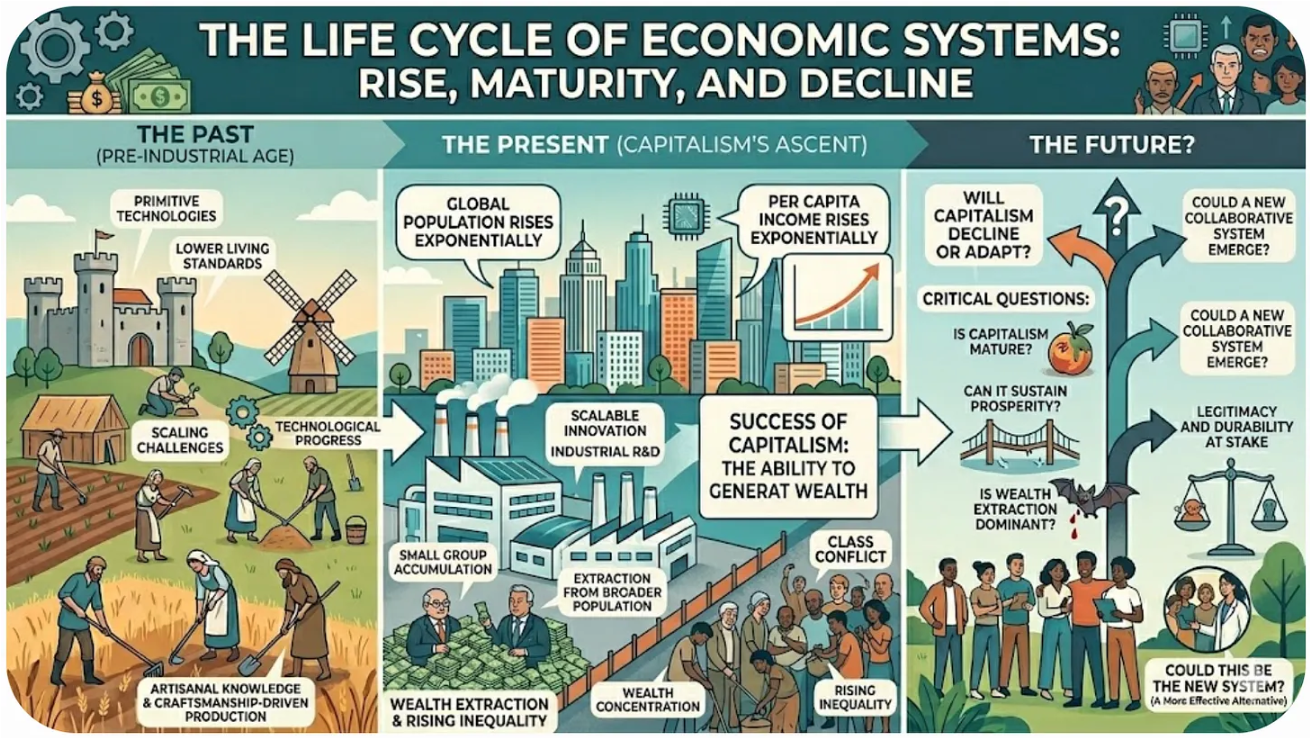
Economic systems are not static. From feudalism to modern Capitalism, they emerge, grow, reach maturity, and eventually decline. This pattern raises an important question about the underlying causes of such transitions. Among many factors, two fundamental drivers stand out in shaping the rise and fall of competing economic systems.
The first relates to the relative capability of competing systems to generate and sustain prosperity. The second concerns the concentration of Wealth—where a small group accumulates significant riches through extraction from the broader population, often leading to class conflict.
Therefore, to assess the future of capitalism, we must first examine whether it has reached maturity in its ability to drive prosperity and whether it is increasingly associated with wealth extraction and rising inequality. The next step is to consider whether a more effective alternative system is emerging to replace it.
Review of Philosophical Thoughts
Among others, Vivek Chibber has drawn on the ideas of Karl Marx and Friedrich Engels to argue that every economic system carries an inherent temporal limit—it is destined to come to an end. Accordingly, just as Roman slavery and feudalism eventually declined, capitalism too is expected to reach its endpoint.
Technological progress and economic efficiency, particularly in improving living standards and reducing the need for human labor, play a decisive role in determining how long people continue to accept the rules and structures of a given economic system. At the same time, class conflict—arising from the accumulation of wealth by a few through extraction from the broader population—also significantly affects the system’s legitimacy and durability. Notably, sign of impeding technology progress surfaces major limitation of an economic system.
Reasons Behind the Success of Capitalism
The success of capitalism appears to be rooted in its ability to generate wealth through technological progress. The quality of living standards largely depends on the range of tasks performed with the support of products and processes—in other words, through technology. In the pre-industrial age, our ancestors experienced lower living standards because their technologies were primitive. Moreover, these technologies could not be scaled, as invention and Innovation relied heavily on artisanal knowledge, tinkering-based ideation, and Craftsmanship-driven production.
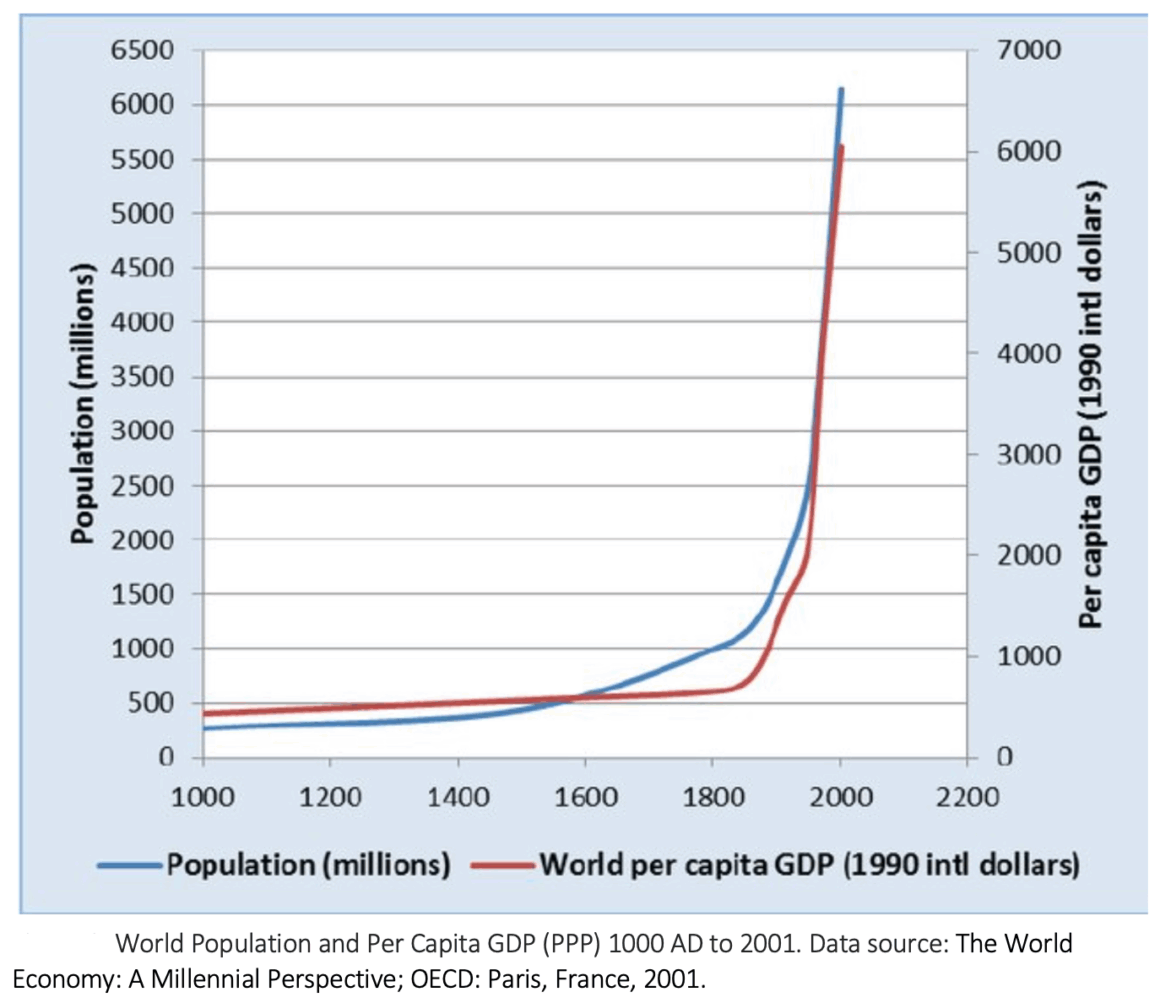
However, from the 16th century onward, the United Kingdom—followed by the rest of Europe—learned how to translate scientific knowledge into scalable technologies, making products and processes better and more affordable. This marked the beginning of a sustained and scalable improvement in living standards. As a result, both per capita income (measured by GDP) and global population began to rise exponentially, as shown in the following figure.
Importantly, this transformation did not stem from a few isolated breakthroughs. Rather, it emerged from a continuous stream of innovations, their incremental improvements, and the scaling of earlier inventions through ongoing evolution. This cumulative Flow of Ideas played a central role in driving progress.
It also became evident that the ownership of capital, along with the freedom to profit from the evolution of inventions and innovations, was critical in unlocking prosperity from technology. This institutional arrangement underpinned the success of capitalism. In contrast, socialist systems struggled to sustain similar levels of technological dynamism and economic growth.
Characteristics of Wealth Creation through Evolution of Technology
As discussed, economic prosperity does not arise merely from the growth of the stock of ideas, where each idea introduces a new product and increases diversity, as articulated by Paul Romer. Rather, prosperity has been driven by the continuous evolution of inventions and innovations.
Although the S-curve lifecycle dominates much of the literature, inventions and innovations have, in reality, evolved in an episodic manner—through successive waves of Reinvention, each following an S-curve-like trajectory. This process has been conceptualized as “creative destruction” by Schumpeter and further developed by scholars such as Philippe Aghion and Peter Howitt. However, mainstream formulations of Creative Destruction overlook several important characteristics.
First, each successive wave of reinvention faces increasing barriers to success. Second, these waves demand breakthroughs from progressively deeper layers of scientific knowledge. Third, technologies emerging from these deeper layers exhibit increasing scalability. This growing scale effect enables innovators to make products and processes progressively better and cheaper, thereby enhancing living standards and expanding the overall stock of wealth.
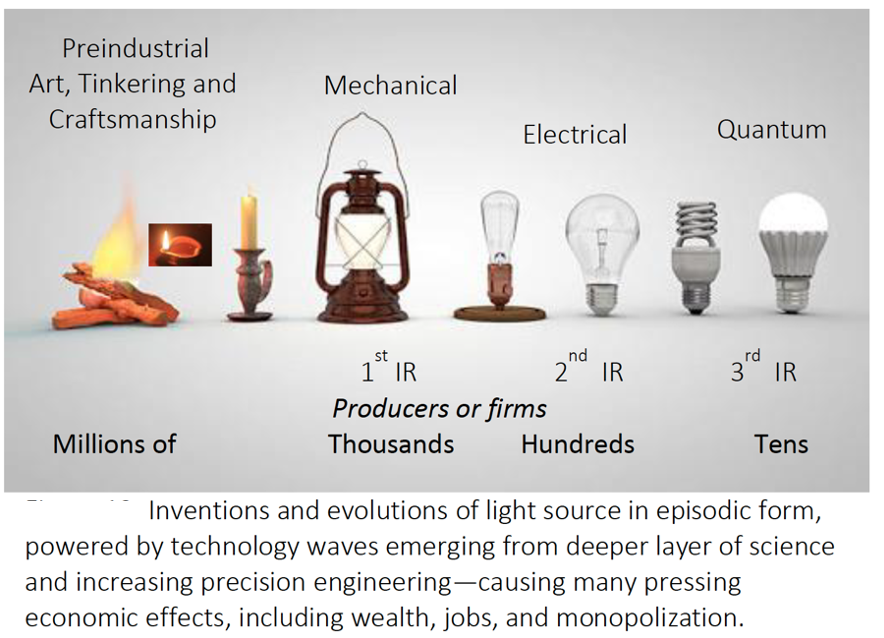
At the same time, this expanding scale effect contributes to monopolization, often resulting in winner-takes-all outcomes. The evolution of lighting technologies provides a useful illustration. Modern LED bulbs are the result of a long श्रृ of reinvention waves, beginning with primitive methods such as burning wood. Each stage of this evolution has contributed to improvements in living standards and the accumulation of societal wealth.
However, the requirement for increasingly advanced scientific knowledge has also slowed the pace of this evolution. For example, while Thomas Edison’s invention of the filament lamp was achieved through extensive experimentation, subsequent reinventions depended on Nobel Prize–level scientific discoveries. Moreover, the increasing scale of technologies has reduced the number of viable producers, contributing to the concentration of wealth in fewer hands and the rise of inequality.
Sign of Maturity of Capitalism
There are multiple signs of the maturity of capitalism, as explained below:
Wealth Extraction Through the Valuation Race:
Although innovation has long been the core strength of capitalism—particularly in the United States—there is a growing shift from delivering substantive innovations to extracting value through the promotion of Disruptive innovation narratives. Rather than focusing on market-ready outcomes, both new entrants and incumbents increasingly prioritize valuation gains driven by expectations.
For instance, fewer than 1% of global and U.S. unicorns are profitable at scale, and only about 13% or fewer generate any profit while still private. Moreover, analyses indicate that approximately 85% of American unicorn Startups that have gone public in recent years remained unprofitable at the time of their IPOs. Even more striking, despite limited tangible progress in market offerings, the so-called “Magnificent Seven” firms reportedly added around $3 trillion in market value during a short period—from February 28 to April 8, 2026—amid geopolitical tensions, as reported by the Wall Street Journal.
In pursuit of ever-higher valuations, firms appear to move from one unfulfilled “creative destruction” narrative to another. For example, after leveraging the electric vehicle (EV) narrative for valuation gains—without fully realizing its transformative potential—attention has rapidly shifted toward robotics and artificial intelligence to sustain valuation momentum. This pattern reflects a form of wealth extraction, where financial gains are increasingly decoupled from delivered innovation.
Furthermore, the high returns associated with this valuation race discourage financial markets from supporting incremental yet essential innovations in products and processes. As a consequence, consumers may be deprived of steady improvements in quality of life that traditionally arise from continuous, cumulative innovation.
Increasing Reinvention Barriers:
As discussed, over the past 300 years of capitalism, the success of innovators in advancing inventions has been the primary driver of wealth creation. However, the barriers to reinvention have been steadily rising, requiring increasingly large investments to enable technological advancement and trigger new waves of creative destruction. For example, while Carl Benz was able to reinvent the horse-drawn carriage into the automobile using family savings and part-time effort, the reinvention of automobiles into electric and autonomous vehicles has yet to fully succeed in unleashing a comparable wave of creative destruction. Notably, each of these reinvention efforts has already consumed more than $100 billion.
Growing Monopolization:
Driven by increasing scale, scope, and network effects, the race for innovation is increasingly resulting in monopolistic outcomes. This trend is rooted in the ability of ideas—originating from deeper layers of knowledge—to simultaneously improve quality and reduce cost. Moreover, the near-zero marginal cost of copying software, along with its expanding role in innovation, has further accelerated monopolization. For instance, around 2000, there were nearly 30 high-end semiconductor manufacturers; by 2025, this number had effectively consolidated to one dominant player. Similarly, in the mid-1980s, more than two dozen word processor companies existed, which ultimately converged into Microsoft’s dominance by 2000. As a result, wealth concentration has intensified. Furthermore, monopolies are often reluctant to pursue the next wave of reinvention due to uncertainty, thereby impeding sustained economic progress out of technology possibilities.
Buy-and-Bury Strategy:
As explained in Professor Clayton Christensen’s theory of disruptive innovation, incumbent leaders often avoid pursuing high-risk innovations, leaving opportunities for creative destruction to startups and new entrants. Historically, seven out of ten leading firms have failed to lead the next wave of innovation. However, this pathway is increasingly constrained by the strategy of dominant firms acquiring emerging competitors and subsequently shelving their innovations. This “buy-and-bury” approach suppresses the potential for new waves of technological evolution.
Ineffectiveness of Antitrust Laws in Addressing Technology Monopolies:
Existing antitrust frameworks appear ill-equipped to address modern technology monopolies. Traditionally, antitrust laws target practices such as collusion, vertical foreclosure, hoarding, and predatory pricing. However, technology monopolies often emerge not from such practices but from winning the innovation race—by making products simultaneously better and cheaper. Consequently, applying conventional antitrust tools to these firms often proves ineffective or even counterproductive.
Diminishing Demand for Factory Labor:
Capitalism promotes globalization, division of labor, and comparative advantage, leading less developed countries to specialize in labor supply within global value chains. Initially, this model generated employment and supported economic growth. However, with the rapid advancement of automation and robotics, the value added by factory-floor assembly labor has become marginal. For example, Apple reportedly allocates only about $1.5 in labor cost to assemble an iPhone valued at $799. As a result, employment opportunities in less developed countries are declining. Additionally, the growing role of machines in production has contributed to rising graduate unemployment. Consequently, the development models prescribed by mainstream economic thinking are increasingly failing, while simultaneously contributing to rising debt burdens. Besides, the rise of LLM based AI for automating cognitive role in applying codifying knowledge will like worsen this situation.
Long Waves of Growth Demand Government Planning:
Given the rising complexity, capital intensity, and uncertainty associated with reinvention, a greater role for government has become necessary—particularly in planning, seeding innovation, and ensuring coordinated responses across the value chain. This reality is reflected in the shifting competitive landscape: for instance, Tesla has struggled to sustain its early lead against China’s state-led, system-wide approach to electric vehicle development, which emphasizes coordinated specialization across the entire value chain.
Merits of Candidate Alternatives:
The surfacing of limitations associated with the maturity of capitalism raises an obvious question: what are the alternatives, and what merits do they offer? One such alternative is socialism, which has historically proven ineffective, largely due to its tendency to slow the evolution of inventions. Another alternative is social democracy. Some researchers, such as Vivek Chibber, argue that as productive capital remains in the hands of firms, their autonomy in making decisions regarding investment and employment may not align with pro-labor outcomes.
A relatively newer model, often referred to as market socialism (or market-oriented capitalism), attempts to address these concerns. It proposes state-level planning to ensure the provision of basic necessities—such as housing, transportation, communication, education, healthcare, and a basic income—through public employment or allowances. In this respect, it bears similarities to social democracy as practiced in several European countries. However, for consumer-level goods and services, it advocates for cooperative forms of enterprise with relatively dispersed capital ownership. Unlike traditional socialism, it retains competition among firms.
Despite these merits, market socialism faces significant limitations regarding the role of firms in wealth creation. High-performing firms that drive the evolution of inventions typically do not emerge as large entities designed to meet established demand. Instead, they originate from the creative pursuits of one or a few individuals to pursue uncertain possibilities. In this context, cooperative organizational forms may not be well suited to fostering such innovation. Moreover, firms engaged in advancing technological frontiers require the ability to accumulate substantial capital to finance uncertain and exploratory innovation paths. Market socialism, with its emphasis on dispersed ownership, may constrain this process and thereby limit wealth creation.
Additionally, state-led provision of basic inputs risks inefficiencies, including weak incentives for innovation, suboptimal pricing mechanisms, and limited responsiveness to citizens’ needs. These challenges are often exacerbated by information asymmetry, administrative incompetence, and, at times, lack of integrity among public officials, which collectively undermine regulatory effectiveness. It is worth noting that both developed and developing countries have pursued market-oriented reforms in sectors such as telecommunications to address similar limitations of state-led models.
In light of these considerations, market socialism does not appear to be a strong candidate to replace capitalism. Rather, a more promising approach may lie in implementing well-designed regulatory frameworks and smarter planning, distilled from deeper insights about technology possibilities, to mitigate the limitations of capitalism while preserving its core strengths in driving innovation and wealth creation.