The US faces challenges from countries like China in the Fourth Industrial Revolution—particularly in artificial intelligence, renewable energy, and electric vehicles—and concerns about its historical technological supremacy are growing. We discuss the historical and current economic leadership of the United States, tracing its rise from surpassing the UK in the early 20th century to its dominance during the third industrial revolution, driven by technological advancements. We highlight the detrimental impact of recent US policies, particularly under the Trump administration, which has favored traditional industries over Innovation. We conclude that to maintain its global economic leadership, the US must refocus on technological advancement and international collaboration for winning the industrial revolutions.
Historically, Britain was the world’s richest and most industrialized nation, boasting a GDP per capita significantly higher than that of the United States until the late 1800s. However, by 1880, the US began to close this economic gap, ultimately surpassing the UK around 1916. In the post-World War II era, the US solidified its status as a global economic leader, with Wealth disparities widening as it became increasingly affluent—a trend that continues today.
The UK’s initial prosperity was rooted in its pioneering role during the first industrial revolution. By successfully leveraging steam engines and mechanization, Britain scaled up production, improved product quality, and reduced costs, establishing itself as the wealthiest nation on the planet. However, the US capitalized on these innovations, transitioning from steam power to electrical and internal combustion technologies. This shift not only migrated the epicenter of industrial activity from the UK to the US but also heralded the onset of the second industrial revolution. As a result, the US emerged as a dominant economic force, surpassing the UK in wealth and influence.
The United States maintained its economic preeminence well into the 21st century, largely due to its leadership in the third industrial revolution, characterized by advancements in information technology, automation, and digital communication. The rise of Silicon Valley and the tech boom positioned the US at the forefront of innovation, significantly contributing to its GDP and global economic influence. However, as we stand on the brink of the fourth industrial revolution, challenges have emerged that threaten this leadership.
Countries like China, Taiwan, and Japan are rapidly innovating, particularly in sectors crucial to the fourth industrial revolution, such as semiconductor, artificial intelligence, robotics, renewable energy, and electric vehicles (EVs). The US has shown signs of falling behind in reinventing major products and advancing core technologies. This erosion of its technological supremacy has raised concerns about its position in global trade and innovation.
For example, initially, Tesla appeared to have a significant advantage in the electric vehicle (EV) race, showcasing innovation and ambition. However, instead of focusing on developing core technologies such as advanced battery systems, the company focused on inflating its market valuation through extensive hype and media attention. This strategy was further fueled by US government subsidies, which, while beneficial, did not compel Tesla to effectively enhance its technological edge. In contrast, despite its late entry, China has emerged as a formidable player in the global EV market, with companies like CATL and BYD rising to prominence as leaders in battery technology and electric vehicles.
Compounding this situation, the Trump administration’s policies favored traditional oil trade, extended the lifespan of gasoline vehicles, and withdrew support for electric vehicles. This shift has hindered the growth of the US EV sector. Meanwhile, American companies have been inflating the valuations of unprofitable AI firms, showcasing GDP growth largely driven by massive investments in AI data centers.
In stark contrast, China has been quietly advancing its capabilities by developing less compute-intensive, more efficient AI models, adopting AI tools across sectors, and enhancing manufacturing through smart factories. This strategic focus positions China to potentially outpace the US in both the EV and AI industries. Recent patent portfolio in AI and robotics underscores this unfolding reality. For example, China’s Tsinghua University has almost 9 times more patents in AI than six top US universities like Harvard, MIT, CalTech, Princeton, University of California, and Stanford combined, as shown in Fig. 1.
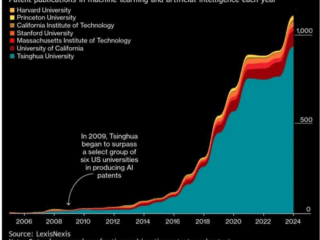
Figure 1: AI patents by one Chinese and six American universities.
In response to these challenges, the US government has pursued various tariff-based measures aimed at revitalizing domestic manufacturing and creating markets for US products abroad. However, these efforts have not been sufficient to restore the systems that created the country’s former glory. China, in particular, has gained a significant edge in manufacturing, EV production, and renewable energy technologies. The Trump administration’s strategies, which included discouraging investments in EVs and renewable energy while focusing on fossil fuels, have further complicated the US’s ability to compete effectively.
To make matters worse, the Trump administration’s strategy of aggressively seizing resources from other countries, such as the oil reserves of Venezuela, and its attempts to occupy land from allies, like Greenland, have significantly eroded the United States’ moral authority. This approach undermines trust and collaboration with European nations, which have, over the past century, relied on the US for leadership and partnership. By prioritizing self-interest over diplomatic relationships, the US has risked alienating allies and weakening the foundations of international cooperation.
As the global landscape shifts, the US is losing its economic and political leadership quickly. The reluctance to embrace the Reinvention race—particularly in emerging technologies that will define the fourth industrial revolution—could have lasting repercussions. While the US has historically been a leader in innovation, the current trajectory suggests that unless it refocuses its efforts on fostering technological advancement and collaboration, it will struggle to maintain its status as a global powerhouse.
The US became rich by leading the second and third industrial revolutions, but its future economic prosperity hinges on its ability to lead in the fourth industrial revolution. With significant competition from other nations, particularly China, the US must reinstitute practices to innovate and adapt in order to remain at the forefront of global economic leadership. Failing to do so will result in a diminished role on the world stage, with profound implications for its economy and influence as well as the economies of many nations with whom it has partnered and supported for many decades.
Key messages distilled from the write-up, aligned with your industrial revolution/reinvention framing:
- Economic leadership shifts with industrial revolutions, not with size or legacy.
Britain lost supremacy when it failed to lead beyond the first industrial revolution; the U.S. rose by mastering the second and third—showing that wealth follows reinvention, not historical dominance. - The U.S. risks decline by prioritizing valuation and protectionism over technological reinvention.
Subsidies, tariffs, and financial hype cannot substitute for deep innovation in core technologies like batteries, AI models, and manufacturing systems. - China’s advantage lies in system-level innovation, not just scale or late entry.
By integrating AI, EVs, energy, and manufacturing into coherent ecosystems, China is advancing faster in fourth–industrial–revolution industries than the U.S. - Policy choices extending legacy industries delay the future and erode competitiveness.
Favoring fossil fuels and slowing EV and renewable transitions weakened U.S. leadership while competitors accelerated ahead. - Global leadership in the 21st century depends on moral authority and collaborative innovation.
Resource grabbing, coercive diplomacy, and unilateralism undermine alliances—making technological leadership harder to sustain in a multipolar world.