THE WAVES
  • Home
  • News
    • Recent Updates
    • Weekly Newsletter
    • Monthly Newsletter
    • Quarterly Newsletter
  • Topics
    • Technology
      • Internet
      • AR/VR & Digital twins
      • Robotics
      • AI & Data Analytics
      • IoT & Wearable
      • Blockchain
      • Computing
      • Sensors & Perception
      • 3D Printing
      • Energy Tech
      • Space
      • Gadgets
    • Transformation
      • Education
      • Health
      • Transportation
      • Farming
      • Energy
      • Security
      • Mining & Blue Economy
      • Food & Living
      • Communication
      • Entertainment
      • Manufacturing
      • Work & Management
      • Public Service
    • Startups
      • Culture
      • Country
      • New Entry
      • Accelerators
      • Incubators
      • Death Valley
      • Investments
      • Exit & IPO
      • Valuation & Financing
      • Idea & IP
    • Education & Research
      • School
      • University
      • Academic Research
      • Corporate Research
      • Public-funded Research
      • Economics of Innovation
      • Growth Economics
      • Training
      • Publications
      • Patents & IP
    • Industrial Revolutions
      • Future of Work
      • Sustainable Development
      • Smart Manufacturing
      • Job Transformation
      • Industry Transformation
      • Competition & Monopoly
      • National Response
      • Education & Skills
      • Social Change
    • Investment & Review
      • Public
      • Corporate
      • Venture Capital
      • Capital Market
      • Philanthropy
      • Personality
    • Inventions
    • Automation
  • Strategy
    • Value Proposition
      • Product
      • Process
      • Sustainability Goals
      • Business Model
      • Complementary
      • Externality
    • Innovation
      • Disruptive Innovation
      • Incremented Innovation
      • Sustaining
      • Schumpeter’s Creative Destruction
      • Redesign for Winning
    • Competition
      • Leading
      • Following
      • Blue Ocean
      • Monopolisation
      • Porter’s Five Forces
      • Business Cycle
    • Intangible Assets
      • Human Capital
      • R&D Management
      • Tripple Helix
      • Intellectual Property
      • Productive Knowledge
      • Technology Managment
    • Competence
      • Organization Agility
      • Innovation Culture
      • Infrastructure
      • R&D facility
      • Great by Choice
      • Build to Last
      • Good to Great
    • Technology Acquisition
      • Scientific discovery
      • Invention
      • Fusion
      • Adaptation & Refinement
      • Licensing
      • Start-up acquisition
  • Policy
    • Technology Development
    • Industry
    • Innovation Diffusion
    • Jobs, Privacy & Security
    • Regulation & Law
    • Sustainability
    • Equity & Inclusiveness
    • Climate Change
    • Environment
  • Opinion
    • Opinion
  • Megatrends
    • Individual Preferences
    • Planet and Society
    • Technology
    • Political Economy
    • Market Power & Monopoly
    • Globalisation
    • Schumpeter’s creative destruction
    • Startups & VC
    • Human Role in Work
    • Value of Natural Resources
    • Patents & Ideas for Redesign
  • Publication
    • Case Studies
    • Magazine
    • Books
    • Reports
    • White Papers
    • Journals
THE WAVES In-depth investigation on Technology, Society, and Policy dynamics for interpreting the past as well as present, and predicting the future so that success rate of pursuing ideas, start-ups, and innovation economy increases.

Technology, Society and Policy

Winning and Losing in Reinvention Race : keeps unfolding: --making America’s innovation bucket leaky, creating prosperity out of reinvention, and turning invention successes transitory
THE WAVES
  • Home
  • News
    • Recent Updates
    • Weekly Newsletter
    • Monthly Newsletter
    • Quarterly Newsletter
  • Topics
    • Technology
      • Internet
      • AR/VR & Digital twins
      • Robotics
      • AI & Data Analytics
      • IoT & Wearable
      • Blockchain
      • Computing
      • Sensors & Perception
      • 3D Printing
      • Energy Tech
      • Space
      • Gadgets
    • Transformation
      • Education
      • Health
      • Transportation
      • Farming
      • Energy
      • Security
      • Mining & Blue Economy
      • Food & Living
      • Communication
      • Entertainment
      • Manufacturing
      • Work & Management
      • Public Service
    • Startups
      • Culture
      • Country
      • New Entry
      • Accelerators
      • Incubators
      • Death Valley
      • Investments
      • Exit & IPO
      • Valuation & Financing
      • Idea & IP
    • Education & Research
      • School
      • University
      • Academic Research
      • Corporate Research
      • Public-funded Research
      • Economics of Innovation
      • Growth Economics
      • Training
      • Publications
      • Patents & IP
    • Industrial Revolutions
      • Future of Work
      • Sustainable Development
      • Smart Manufacturing
      • Job Transformation
      • Industry Transformation
      • Competition & Monopoly
      • National Response
      • Education & Skills
      • Social Change
    • Investment & Review
      • Public
      • Corporate
      • Venture Capital
      • Capital Market
      • Philanthropy
      • Personality
    • Inventions
    • Automation
  • Strategy
    • Value Proposition
      • Product
      • Process
      • Sustainability Goals
      • Business Model
      • Complementary
      • Externality
    • Innovation
      • Disruptive Innovation
      • Incremented Innovation
      • Sustaining
      • Schumpeter’s Creative Destruction
      • Redesign for Winning
    • Competition
      • Leading
      • Following
      • Blue Ocean
      • Monopolisation
      • Porter’s Five Forces
      • Business Cycle
    • Intangible Assets
      • Human Capital
      • R&D Management
      • Tripple Helix
      • Intellectual Property
      • Productive Knowledge
      • Technology Managment
    • Competence
      • Organization Agility
      • Innovation Culture
      • Infrastructure
      • R&D facility
      • Great by Choice
      • Build to Last
      • Good to Great
    • Technology Acquisition
      • Scientific discovery
      • Invention
      • Fusion
      • Adaptation & Refinement
      • Licensing
      • Start-up acquisition
  • Policy
    • Technology Development
    • Industry
    • Innovation Diffusion
    • Jobs, Privacy & Security
    • Regulation & Law
    • Sustainability
    • Equity & Inclusiveness
    • Climate Change
    • Environment
  • Opinion
    • Opinion
  • Megatrends
    • Individual Preferences
    • Planet and Society
    • Technology
    • Political Economy
    • Market Power & Monopoly
    • Globalisation
    • Schumpeter’s creative destruction
    • Startups & VC
    • Human Role in Work
    • Value of Natural Resources
    • Patents & Ideas for Redesign
  • Publication
    • Case Studies
    • Magazine
    • Books
    • Reports
    • White Papers
    • Journals

  • Editor's Pick
  • Innovation

Evolution of Innovations: Underlying Driving Forces

  • Md. Rokonuzzaman
  • Created: May 22, 2026
  • Last updated: May 22, 2026
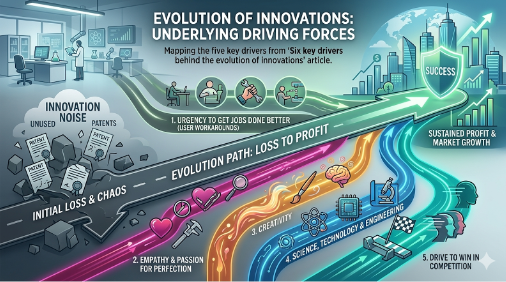
Evolution of Innovations is driven by five major forces such as jobs to be done, empathy, technology, creativity and competition

Starting from automobiles, smartphones, and word processors, all innovations have continuously evolved. While great ideas are often celebrated, it is the evolution of innovations that lies at the core of sustained business success. This evolution has not occurred randomly; rather, it has progressed from isolated, serendipitous discoveries in the pre-industrial era to more structured and systematic approaches in modern times.

However, a critical question remains: what forces actually drive this evolution? A lack of clear understanding of these forces—and how to apply them effectively—has become a major constraint. It is estimated that as much as 75 percent of innovative products fail to generate meaningful profit. One significant reason is the persistence of “innovation noise,” where a vast number of patents are filed but only a small fraction deliver real value—leaving up to 94 percent of patents effectively unused.

This gap highlights the importance of identifying and leveraging the true forces that shape Innovation. Accordingly, this article aims to uncover and explain the key drivers behind the evolution of innovations.

Five key drivers behind the evolution of innovations

Invariably, all innovations—including Apple’s iPhone—begin their journey at a loss. Their eventual success in achieving profitability and sustaining market expansion depends on how effectively they evolve over time. Studies suggest that five major forces shape this evolution. These are: (i) the urgency to get jobs done better, (ii) empathy and a Passion for Perfection, (iii) creativity, (iv) science, technology, and engineering, and (v) the drive to win in competition. Let us examine these forces in greater detail.

Urgency of Getting Jobs to be done Better

In a recent Harvard Business Review article, Donna Henrike Bohrer, Karolin Frankenberger, and Joakim Wincent share research showing that customer workarounds can reveal critical insights into needed product improvements. Notably, while teams stitching together third-party tools may appear to violate compliance standards, such behavior often signals opportunities for meaningful enhancement. For example, software users frequently build elaborate spreadsheets or rely on manual processes outside enterprise systems because official tools fail to support how work is actually performed. This pattern illustrates a fundamental human tendency: people naturally seek better ways to get their jobs done. Consequently, regardless of how advanced an innovation may seem, users inevitably encounter its limitations and feel an urgency for its evolution. Therefore, the focus should be on understanding this urgency to uncover which features need to be added or refined, ultimately increasing the appeal of innovations for both existing and new customers.

The outgrowth indicates that the given tool is not
good enough to get the job to be done.

Empathy and Passion for Perfection

Despite users’ urgency to get their jobs done better, not all innovators are equally successful in driving the evolution of innovation. One underlying reason is the variation in empathy and passion for perfection. A notable example is Steve Jobs and Apple Inc. in the evolution of the iPhone. As is well known, through empathy and a relentless pursuit of perfection, such innovators uncover users’ deep pain points and latent desires regarding how innovation can help them accomplish their tasks more effectively. Due to its vital role, empathy is considered the first step of Design Thinking. Similarly, through the passionate application of empathy and a commitment to refinement, despite the many failures of early palmtop computers, Jeff Hawkins succeeded in identifying design features for the Palm Pilot that closely resonated with consumer preferences.

Creativity

Creativity is the ability to generate novel and valuable ideas, solutions, or works through imagination. However, creativity alone is not sufficient. This is an inherent ability of every human being. It needs to operate in conjunction with two earlier driving forces: (i) the urgency of Getting jobs done better, and (ii) empathy coupled with a passion for perfection. In the absence of these, creativity is unlikely to produce ideas that customers find relevant to their urgent needs.

Science, Technology, and Engineering

The first three forces must be complemented by the implementation possibilities offered by science, technology, and engineering. For example, while empathy may identify heat generation in filament lamps as a key pain point, in the absence of having knowledge about light-emitting diodes, creativity alone could not have produced a viable alternative solution. Hence, to drive the evolution of innovation, beyond focusing on the urgency of getting jobs done, empathy and passion for perfection, and creativity, innovators must also possess a deep understanding of the current and plausible frontiers of science, technology, and engineering. Without this capability, innovators are likely to run out of feasible ideas or pursue concepts that are ultimately not deliverable. For instance, due to a weak understanding of computational intelligence and its potential as well as limitations to replicate or surpass certain human innate abilities, many autonomous vehicle, AI, and robotics initiatives remain stuck at the “last-mile” stage of development.

Winning the Competition for Sustaining Innovation

The necessity of winning competition in sustaining innovation within competitive markets plays a critical role in driving the evolution of innovation. The prospect of profitability stimulates competitive responses such as (i) replication, (ii) imitation, (iii) innovation, and (iv) substitution. On the other hand, technological progress is reinforced by (i) complementary goods and services, (ii) network externalities, (iii) reduced information and experience gaps, and (iv) improvements in infrastructure, compatibility, and standardization.

To address these dynamics, one common approach is to fend off competition through intellectual property laws. However, this approach has limited effectiveness, given the growing litigation costs and time required for enforcement. Another approach is the speed of innovation, characterized by the continuous release of improved versions that render previous iterations less attractive. As a result, followers have limited time to catch up. This strategy also increases users’ willingness to pay, thereby expanding markets and driving revenue growth. Besides, this strategy benefit from positive externalities to drive the evolution of innovation.

As this article clarifies, business success depends on the evolution of innovation. While we often emphasize creativity, Breakthrough inventions, and major scientific discoveries, these alone do not drive innovation evolution. Instead, as discussed, they operate within a broader set of five forces. Due to it, despite endless human ability of creativity, innovations take S-curve like life cycle due to saturation of technology core. However, emergence of new technology core begins the next wave of life cycle.  Hence, innovators should focus on leveraging these forces as an integrated system through effective institutional practices.
Enlighten others

Subscribe

Subscribe now to our newsletter

You May Also Like

Which Type of R&D Should Be the Focus of Bangladesh and many other less developed countries?
View Post
  • 3 min

Types of Research and Development

Bangladesh can turn its high-tech parks into engines of prosperity by housing R&D wings of local producers
View Post
  • 3 min

Bangladesh’s High-Tech Park Owe: Can Low-Tech Be a Solution?

How speculative markets and continuous storytelling combine to decouple asset valuation from delivery of innovations
View Post
  • 8 min

The Rise of Muskism Turning Musk a Trillionaire: Narrative-Driven Capital Accumulation and the Illusion of Disruptive Innovation

Leave a Reply Cancel reply

Your email address will not be published. Required fields are marked *

Subscribe

Subscribe now to our newsletter

Principles

  • Economics of Technology
  • Innovation Economics
  • Technology & Innovation Policy

History & Observations

  • Technology History
  • Innovation History
  • Strategy & Policy in retrospect
  • Entrepreneurs & Innovators
  • Startups & Corporations
  • Patents & Publications
  • Design & Redesign Thinking

About Us

  • Who we are
  • What we deliver
  • Genesis
  • Mission
  • Scope
  • Editorial & Advisory Board
THE WAVES
  • Contact
  • Advertise

Input your search keywords and press Enter.