ASIMO robot is a highly sophisticated Humanoid robot developed by Honda. A team of engineers conducted R&D over 32 years at a cost of $500 to develop and demonstrate human-like performances of ASIMO, such as kicking balls and serving food. Among many applications, the ASIMO robot targeted to take over service jobs like nursing, elderly care, and food serving, consequentially unleashing a transformational effect on the future of work. However, despite sensational demonstrations, due to the difficulty of imitating humans’ innate abilities, the Honda humanoid robot ASIMO ended the life cycle before qualifying to fuel waves of Creative Destruction on the future of work in the service sector.
The future of Work is uncertain. “Robots could take over 20 million manufacturing jobs around the world by 2030”—a recent study of the Economist shares. It’s widely believed that robotization will take away tens of millions of jobs in the near future. It’s also believed that human-like robots, humanoid, will work side by side of humans. Consequentially, they will keep growing and taking away one after another work from humans, creating increasing unemployment. Among all the robots developed to date, ASIMO by Honda appears to be the most sophisticated. In fact, this is a symbol of Japan’s advances in robotics technology. Unfortunately, Honda stopped its further development in 2018. Consequentially, ASIMO Honda robot ends its lifecycle. What is the underlying message of this news?
At the dawn of the Fourth Industrial Revolution, why did the world’s most sophisticated robot, the ASIMO robot, retire? Moreover, it does not leave either siblings or offspring. Is it the end of this species? Does it mean that we will unlikely witness the growth of the human-like robot population in our society? As ASIMO Humanoid robot ends its lifecycle prematurely, there is doubt about some observations like “Latest research from the World Economic Forum forecasts that by 2025, machines will perform more current work tasks than humans, compared to 71% being performed by humans today.” In fact, humanoids have the potential to drive waves of creative destruction, affecting the future of work.
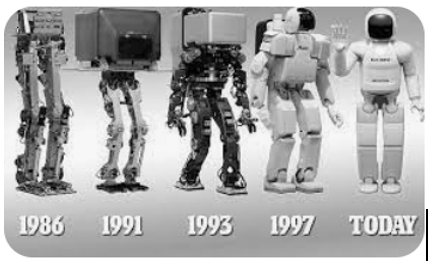
Birth and growth of ASIMO Robot—reaching adolescence
Like human beings, technologies also have a life cycle. They are born, grow, reach adulthood, and retire. As they keep progressing to retirement, they also witness the uprising of the next waves of technologies, offering better possibilities. As the precursor to ASIMO, we observed a few past generations of humanoids. Around 1495, it was born in the sketch of Leonardo da Vinci. Subsequently, Eric was born in 1929, creating a high sensation. In the 1960s, university research laboratories started working on the idea of humanoid, giving birth to successive better versions.
Consequentially, humanoid robots drew commercial interest, leading to Honda’s R&D program in 1986. That year, Honda opened a brand-new R&D center at Saitama in Japan. Among the three flagship R&D projects, there was ASIMO. The other two projects were for fuel cell batteries and HondaJet.
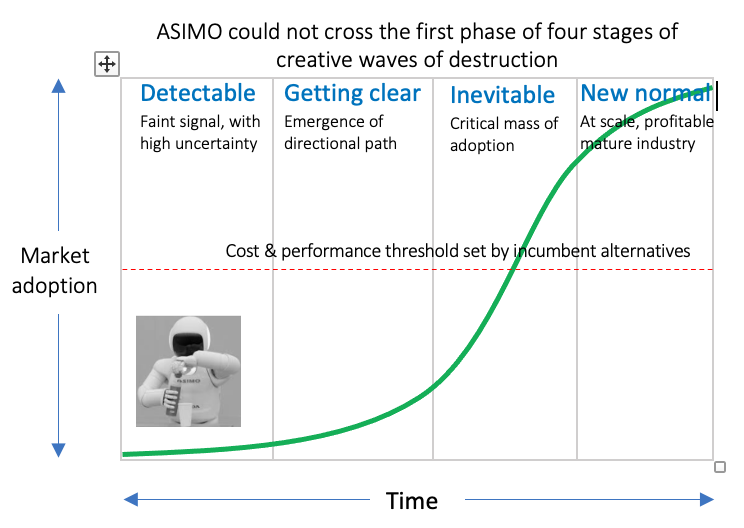
ASIMO stands for Advanced Step in Innovative Mobility. After 14 years of R&D, ASIMO emerged in 2000. It was 130 cm tall, 54 kg humanoid. Of course, prior to the unveiling of ASIMO, Honda also developed several earlier versions like Honda E and P series robots. In addition to mechanical capabilities, like walking even through stairs, ASIMO had sensing and vision capabilities. It could recognize moving objects and exchange gestures–among other capabilities. In fact, Honda humanoid ASIMO had a rich set of technologies for robots. Despite this, ASIMO robot could not cross the first phase of the Innovation life Cycle.
Honda’s R&D team kept growing ASIMO Robot
ASIMO can recognize moving objects, postures, gestures, surrounding environment, sounds, and faces, enabling it to interact with humans. By 2014, ASIMO grew up from being an awkward, stumbling toddler and entering adolescence. During the past fourteen years, it grew up with the capacity to serve breakfast and not slam into people in the halls, thanks to the continued R&D efforts of Honda engineers. By then, they started working as a competent waiter in a robot café. But it had a bigger dream. In the same year, teenager ASIMO finally became a soccer star, kicking the ball around with the United States president, no less.
ASIMO’s target work areas—service
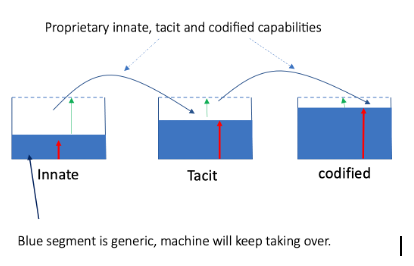
Unlike industrial robots, primarily in the form of arms, Honda targeted to create service jobs for ASIMO. At the age of 14, it already started working in a café as a waiter. The ultimate target place to work was at the nursing homes for taking care of the growing elderly. Unfortunately, ASIMO could not offer a human touch, feel, and warmth to them. Although ASIMO had a human shape and could walk like a human, it did not have many innate abilities of humans. Among some limitations, it did not have tender fingers with a rich ability to feel the touch. It could not hold arms with warmth, as the hand was not flexible enough. Due to such limitations, it could not precisely coordinate the movements of the fingers of one or both hands to grasp and manipulate objects. It did not have skin with millions of receptors.
Among many other inabilities, ASIMO was not quick enough to respond (with the hand, finger, or foot) to a signal (sound, light, picture) when it appeared. As a matter of fact, ASIMO did not have more or less any of the 52 major innate abilities of humans. Among other limitations, ASIMO could not concentrate on listening to specific messages amid surrounding conversations. Subsequently, ASIMO failed to qualify for the job of offering caregiving services. Of course, Honda engineers offered some sensing capabilities. Nevertheless, they were highly primitive in comparison to humans. Consequentially, ASIMO not only failed to get nursing jobs but also it could not qualify for many other target service jobs.
Uprising of Robots in Manufacturing
Contrary to ASIMO’s disqualification for getting service jobs, its cousins are doing well in the workplace. ASIMO’s cousins work in factories, performing industrial jobs. They are called industrial robots. Across the world, industrial robots are experiencing accelerated penetration. According to the Economist analysis, the number of robots in use worldwide increased threefold over the past two decades. According to the International Federation of Robotics, the global operational stock of robots rose to 2.4 million units. In addition to it, Oxford Economics estimates that by 2030, China alone will have more than 14 million robots in work. Such an uprising of industrial robots raises a question: what was wrong with ASIMO? In contrary to service delivery, robots performing manufacturing tasks do not require most of the human-like innate capabilities. For example, instead of a tender handful of sensors, they need robust fingers that do not wear out while welding metal pieces.
Robots’ capability for delivering service is shaken with the news: ASIMO Robots ends lifecycle prematurely
As opposed to performing dull, dirty, and dangerous jobs repeatedly with a high level of accuracy, service robots need to be flexible and adaptable in performing tasks, often with a soft touch. In fact, they need to rely on human-like innate abilities in delivering services, which require high-level interactions with recipient humans, and also objects. For example, serving the elderly with help for moving in and out of beds, baths, wheelchairs, or automobiles and dressing and grooming needs many human-like innate abilities. Some of them are near and far vision, arm-hand steadiness, and inductive reasoning. Robots in service will require many such abilities to perform even a simple task. Moreover, it has been found that technologically it’s quite difficult, perhaps not impossible, to build such abilities in machines. Possibly, due to such technological complexities, ASIMO Japanese robot ends its lifecycle prematurely.
ASIMO bows out—robots face roadblock to penetrate in service
Over more than 30 years, Honda engineers pursued a relentless journey to build human-like capability in ASIMO. On the one hand, Honda is a technology-rich company. On the other hand, ASIMO was a national pride of Japan. Indeed, an icon of technological superiority. Moreover, the Japanese are known for their desire to pursue a relentless journey of perfection. Furthermore, Honda has maintained its position among the top 10 global robotics patent ownership over 2010-2019. Nevertheless, Honda’s R&D team could not build enough abilities to make ASIMO qualify for service jobs.
In 2018, Honda decided to end further R&D to improve ASIMO. In fact, this is the only long-term project which failed to roll out for commercial applications. Honda’s long journey in building ASIMO to qualify for service carries important lessons indeed. Does it mean that there is a serious roadblock on the way of the uprising of service robots, which we could not foresee?
Future of Work—does ASIMO’s demise make all predictions wrong?
Of course, robots have been accelerating progress in taking over manufacturing jobs. On average, the entry of one new robot in a factory leads to a loss of 6 human jobs. According to IFR, in 2018, 422,000 units of robots were shipped globally. Based on these numbers, we lost more or less 2.5 million jobs to robots in 2018 alone. At this rate, we will likely lose 25 million jobs by 2030. What are the underlying factors affecting the growth trend? Will the growth be linear or exponential? Is there a chance that growth might flatten out? Moreover, will we experience similar growth or robot penetration and job loss in the service sector? Many of the predictions are based on the assumption that robots would replicate the past and ongoing industrial success in the service sector.
In fact, many of us anticipated that humanoids like ASIMO would grow to power a creative wave of destruction in the service sector. In retrospect, we mistakenly assessed the technological complexity in building human-like innate abilities in humanoid robots. Such abilities are vital for robots to take over major categories of service jobs. As service constitutes more than 70 percent of global GDP, robots’ progression in taking over an increasing number of jobs from humans faces questions.
The premature end of the lifecycle of the ASIMO robot made by Honda is more than a piece of simple news. Perhaps it tells us that robots face roadblocks to take over positions in the service sector. Subsequently, it contributes further to the uncertainty about the future of work. The premature end of the life cycle of ASIMO robots underscores the purpose of humanoid robots. Does it mean that dull jobs will remain for humans?
Related Articles:
Job Polarization – technology shaping future of work
Future of Work – persistent uncertainty
Future of Work from Home – Robotic process automation takes over
Dull Jobs for Human—Dead Robots Redefine Future of Work