
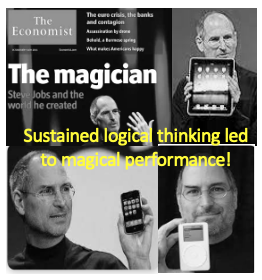
Steve jobs creation impresses all of us. Often, we show an addictive association with his creation–Mac, iPod, iPhone, and iPad. He used this magical power to create the Apple Computer Company. Most importantly, he used it to save Apple from bankruptcy. Finally, he made Apple a trillion-dollar company with his magical power. What are the hidden secrets of Steve Jobs creation? How can we build such a character? How can we reproduce similar success stories? Yes, these are all highly intriguing questions.
His mind focused on causing Creative Destruction. He succeeded in keep nurturing Innovation to cause destruction to several major industries. Such transformation is vital for the Market Economy to offer us increasingly better products. For this reason, there has been an urge to get to know the underlying secret of Steve Jobs creation. Is it magical or logical? It appears that sustained logical thinking in leveraging technology possibilities for advancing customer experiences through systematically fueling waves of creative destruction has led to magical Steve Jobs creation.
Examples of Steve Jobs creation
Notable examples of Steve Jobs creation are as follows:
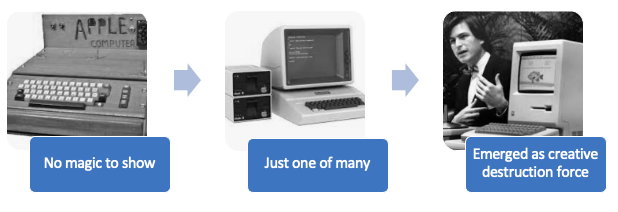
Apple I, Apple II and The Macintosh--Steve Jobs creation started with the release of Apple I in 1976. However, this wooden box had no magic inside. Hence, it became obsolete before its release. The subsequent release of Apple II could not show any magical performance either. It was just one of many. However, the Reinvention of the personal computer user interface led to the release of the maiden magical Steve Jobs creation-Macintosh. Due to his courage in following his heart and intuition, he succeeded in picking up Xerox’s discarded invention–Graphical User Interface (GUI)–for recreating the user experience of personal computers.
Next and Cube–In 1985, Steve started a new firm-Next- and produced innovative computer workstations for students and universities. However, they do not belong to notable Steve Jobs creation. Even upon winning an award for design, Cube, Mac personal computer, could not bring any unique benefits or features–let alone showing magical innovation performance.
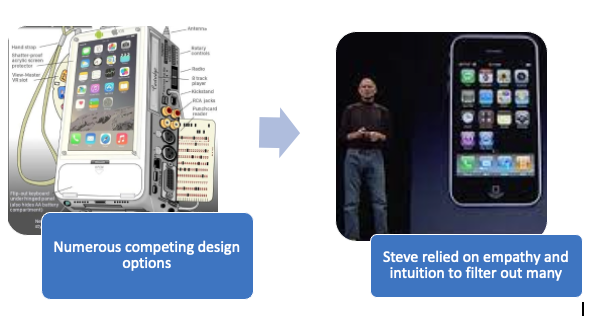
iPod, iPhone and iPad--Emerging from the creative approach of connecting things, iPod, iPhone and iPad have become magical players of Steve Jobs creation. However, it was not easy for Steve to decide about the features of iPod, iPhone and iPad to make them notable creations as there were many competing design options to connect. Strong empathy prevented the noises of others’ opinions from drowning out the inner voice led to Steve Jobs creation–iPod, iPhone and iPad.
Known for creative destruction–is it feasible to recreate the underlying force of Steve Jobs creation?
Among his magical plays, he caused three creative destructions. The first one is the graphical user interface for the computer. This wave made personal computers a success story. The uprising of it caused destruction to the mini-computer industry. The 2nd one is about iTunes and iPod. In fact, it was his bet to rescue the sinking Apple. This wave caused creative destruction to record labels, Walkman, and MP3 players. He is now mostly known for the last one. The ultimate innovation magic he came up with is the iPhone wave. He used multitouch technology to power creative destruction waves in mobile devices. Such remarkable successes inspire us to recreate Steve Jobs’ creative destruction capability.
The emergence of Macintosh to create Personal Computer wave
In fact, Apple was not the first company to bring personal computers into the market. In the late 1970s, there were more than a dozen companies making personal computers. Unfortunately, Steve’s magic did not appear as Apple I in a wooden box, without the monitor. Commodore and many other PC makers had far better offerings. Even in 1981, IBM unveiled its PC. How did Steve show the magic with the wooden box of Apple I? It all changed when Steve saw the graphical user interface developed by Xerox’s R&D facility in Silicon Valley.
He was intrigued by the idea of using a pointing device like a mouse and a graphical user interface. Immediately, he saw the possibility of offering an intuitive user interface for creating the next wave of computers. Subsequently, he asked the team to keep refining the concept, which led to the adoption of this GUI in the emergence of the Macintosh model. In addition to Xerox’s idea of GUI, Steve’s meticulous focus on details was equally important for creating aah impression with the debut of Machintosh.
Indeed, it was the beginning of an era, a new wave. Subsequently, Microsoft immitted. Apple and Microsoft’s collective effort led to the PC wave’s uprising. Of course, this new wave created a large new market of computers, far larger than before. Moreover, it caused destruction to the mini-computer industry. It has been a massive unfolding of Schumpeter’s creative destruction. Among others, it also disrupted mini-computer makers like DEC. There are many more examples of Disruptive innovation around us created by Steve Jobs creation.
Rising of iPod and iTunes waves as a rescue strategy
After Steve Jobs’ departure, unfortunately forceful, Apple started witnessing the fading of innovation luster. The continued fading led to declining revenue and market share. While Apple was facing the impending threat of bankruptcy, Apple’s board invited Steve to return to lead Apple. As a rescue strategy, he focused on building an innovation wave around the music downloading service, iTunes. To address the pain point of the music player, he conceived the iPod. He focused not only on technical performance. Most importantly, he paid attention to the aesthetic part, making it a fashion item.
Of course, he needed a Flow of Ideas to implement the conceived product. How did he all those needed ideas? In fact, he took ideas from multiple sources, including the rotating dial from old pocket radios. But he paid meticulous attention to detail and led the team to fine-tune. Eventually, the debut of the iPod created a loud aah expression. Subsequently, the journey of the iPod led to the uprising of an innovation wave, causing creative destruction to major products ad services. Thus, iPod emerged as a great example of Steve Jobs creation.
Survival strategy led to the emergence of the iPhone wave
While the iPod’s sale was at its peak, Steve Jobs detected the growth of the smartphone wave to take over its market. Slowly, smartphone makers were adding music downloading and playback options, among others. And they kept improving them too. Hence, as a survival strategy, Steve conceived iPhone. iPhone was conceived as a collection of three products. Of course, it would be a mobile phone handset. It will also have iPod features. On top of it, it would be an internet device. Additionally, to serve these three purposes with a single device, he opted to replace the physical keyboard with a pop-up software one. He also felt that the stylus was cumbersome. Therefore, he picked up a multitouch technology for having a finger-based interface. Like in the past, he acquired missing technology components like multitouch from multiple sources.
Upon having access, he asked his team to keep refining and fusing them until they reached the desired level of perfection. To the surprise of many, the iPhone emerged to trigger the formation of a very powerful wave in the smartphone industry. It was so powerful that Nokia could not withstand its force of creative destruction for more than two years. To keep fueling the creative destruction force, Apple kept adding and improving features and releasing successive better versions.
Market economy encourages to recreate Steve Jobs’ creative destructions
In fact, creative destruction plays a key role in offering us an increasingly better quality of life in the market economy. Human beings have an inherent urge to create ideas for Getting jobs done better at less cost. Moreover, they are driven by economic incentives. These two innate characteristics combine together to fuel entrepreneurship. And free-market economy taps into this virtue to offer us increasingly better quality products at less cost. Entrepreneurship journey in taking ideas to market for offering better substitution sometimes grows as a creative destruction force. The emergence of substitution keeps growing to surpass the quality and cost of incumbent products.
This journey of creative destruction offers a profit-making opportunity for entrepreneurs while offering better substitutions. For example, PC, iPod, and iPhone are success stories of creative destruction. They made both Apple’s shareholders, employees, and customers better off simultaneously. For this reason, there has been a strong urge to keep repeating waves of creative destruction. But how to make it happen is a serious issue. Therefore, there is a reason to investigate to draw lessons from the journey of Steve Jobs creation.
Fairness, freedom, culture, and access to knowledge
The society in which Steve Jobs grew up is known for fairness and freedom of pursuing an entrepreneurial journey in taking ideas to market. On top of it, cultural fabrics encourage pursuing new ideas instead of producing and consuming the same age-old products. However, to seek ideas for offering better products at less cost profitably, one needs quality ideas. Well, human beings have the inborn ability to produce ideas. But this creative process requires knowledge for generating ideas. Often a flow of ideas is needed to fuse to make a great idea to succeed.
Despite having magical successes, Steve did not create all the ideas needed to create the flow o ideas. Instead, he relied on picking from different places, refining them with both inside and out knowledge, and fusing them to fuel the creative destruction. The science and Technology policy of the US government played a vital role. Public-funded research done at academic and R&D institutions in California and the rest of the USA offered initial ideas, to begin with. In particular, defense application-led R&D programs were vital sources of ideas.
Moreover, such R&D activities produced high-caliber human resources that Steve needed to pick, refine, and fuse ideas. Without access to ideas, knowledge, and human resources, Steve Jobs would not have succeeded in creating those waves of creative destruction. As a matter of fact, borrowing ideas and perfecting them has been at the core of Steve Jobs creation.
Strong focus on customer preferences–vital role in Steve Jobs creation
He focused on making conceived products highly suitable to target jobs done by customers. To gather detailed insights about customer preferences, purposes, and situations in which those purposes would be solved, he silently observed and imagined. This exercise led to the formation of detailed feature space. Most importantly, he looked at the high level of perfection for each of the features. Often conceived perfection surpassed customers’ expectations and limits of available technologies. He used to press his R&D team to reach the limit. Subsequently, this high-end perfection was the key to exceeding customers’ expectations and creating the imitation barrier. As opposed to patent, often high precision of perfection of implementation of ideas poses a greater barrier to competition. This attribute of Steve Jobs paid him off by creating an ‘aah’ expression among customers and offering high imitation barriers. As a result, Apple has succeeded in attaining price-setting capability–resulting in winner takes all.
Silent observer, having attention to details
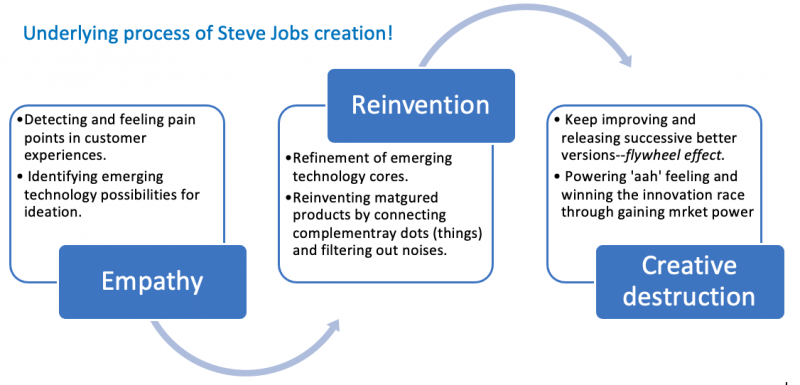
The underpinning of Steve Jobs creation was empathy. Instead of asking customers what they needed, he focused on silent observation and imagination. In social science research, there is a technique called ethnography. It happens to be that Steve had a strong natural affinity to approach. Of course, each of us has this attribute. It needs to be sharpened to enable us to make us submerge in the world of customers’ need to get jobs done. He had a tremendous focus in detail about each of the features and their roles in different situations to create targeted Utility for the customers. This attribute led to the maximization of utility from his magical innovations. We need to focus on sharpening this vital attribute of ours to add momentum to waves of creative destruction.
Craftsmanship spirit of keep refining is key to recreating Steve Jobs’ creative destruction
This is a compelling attribute indeed. The endless desire for perfection appears to be at the core of Steve Jobs’ magical power of innovation. Yes, craftsmanship out of tinkering did not offer a scalable path to Steve to keep releasing a successive better version. He linked his Passion for Perfection with the underlying science of making the refinement. Subsequently, he succeeded in scaling up the progression path out of fine-tuning. In the absence of scaling up the craftsmanship spirit with the support of science, he would not have succeeded in making his wave’s creative destruction powerful enough to keep growing.
Strong winning trait by causing destruction underpins Steve Jobs creation
Often, the journey for creating a wave of innovation having destructive power is long and uncertain. Irrespective of the underlying firepower, invariably, every wave of creative destruction begins the journey in primitive form. This primitive emergence makes spotting and decision-making quite challenging. Someone should have the insight to see through the fog, and a strong will to keep progressing amid uncertainty. The person at the helm of pursuing such an invisible journey should be very confident, demanding followers to adhere to given directions meticulously. Hence, he was often known as an abrasive, highly confident, rebellious, and ambitious character.
Focus on the next wave–recreation out of self-destruction
Steve Jobs also had an extreme focus on the next wave. He was unambiguous that innovation successes in the competitive market have a very short shelf life. He was always at the outlook for spotting the next wave. Unlike managers of Kodak or other once-dominant firms, he neither overlooked nor attempted to confront the next wave through arrogance and protection. Instead, he embraced. He was so much so welcoming to the next wave that he decided to kill the iPod at its peak to pursue the next wave of smartphones. In retrospect, it was by far the most crucial decision he took. Upon spotting the wave of smartphones posing a threat to the iPod, he embraced it, fueled it, and caused creative destruction to iPod itself.
To sum up, Steve’s creative destruction has been impressive. It made shareholders rich. More importantly, it made the world a bit better place. Consequentially, our living standards have increased with the growth and unfolding of each wave of creative destruction. Steve’s successes in driving three major waves, each in computing, consumer electronics, and smartphones, are impressive. Yes, he showed a magical performance indeed. Nevertheless, there are some common attributes that could be leveraged to fuel the waves of innovations. Although there has been an increasing focus on Startups to recreate Steve Jobs’ creative destruction, there has been a lack of focus on underlying attributes, particularly in developing countries. In the absence of them, creative genius cannot grow out of anywhere.
Steve Jobs creation has formed Apple’s innovation-winning strategy
The underlying pattern of Steve Jobs creation underscores the necessity of systematic recreation of user experience by leveraging highly refined technology possibilities. Consequently, Steve creation showed magical performance by unleashing creative destruction to available alternatives. By the way, in the process of listening to his inner feelings, he was very focused on responding to competitors’ responses. Steve’s strategy of fending off competition was reinventing and fine-tuning the creative destruction force by creating a flywheel effect. Subsequently, such an approach powering Steve Jobs creation has become Apple’s innovation-winning strategy.


1 comment